
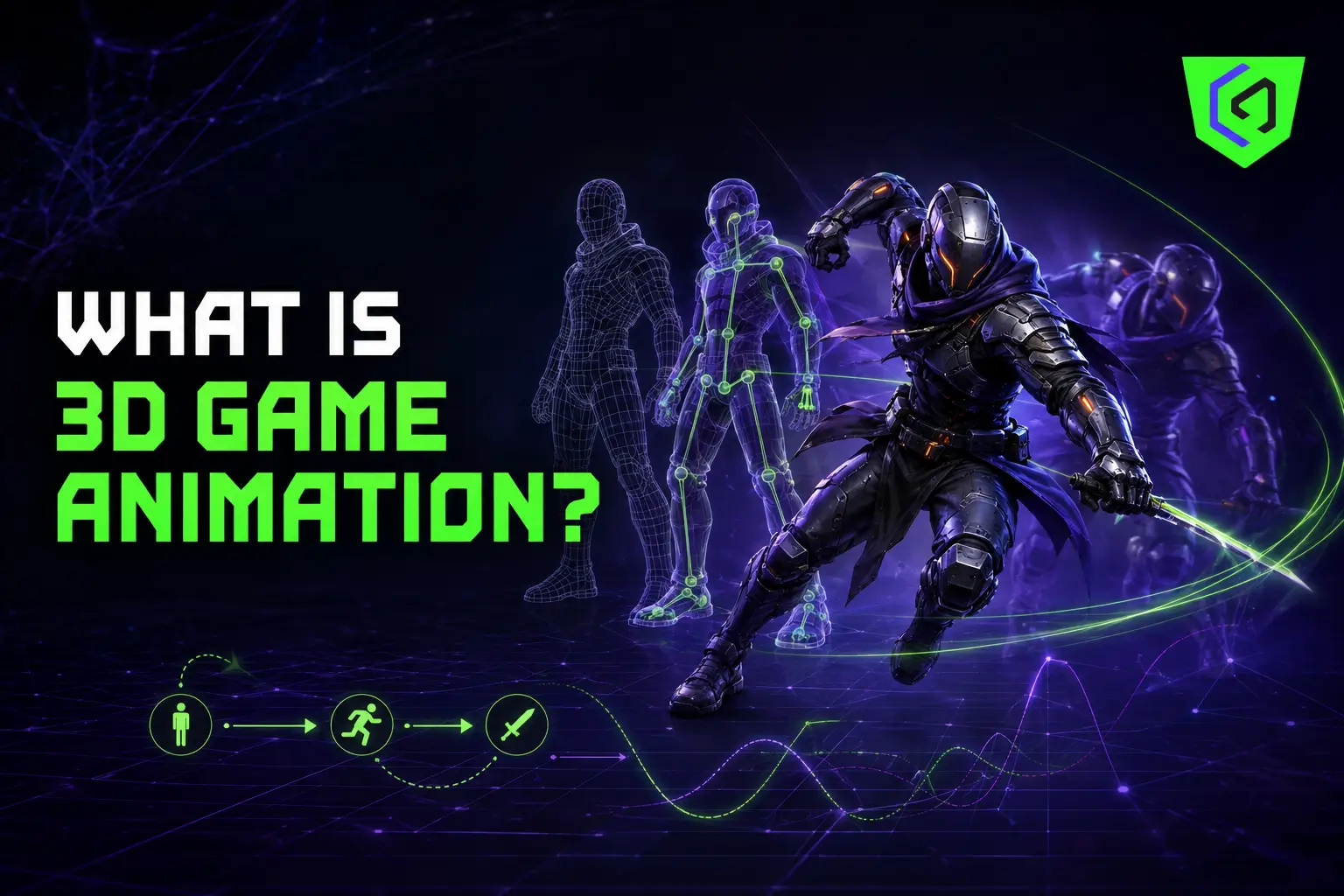
A character can be modeled beautifully and still feel completely lifeless the moment it starts moving, and that gap between a good model and a good performance is exactly where this discipline lives. It is responsible for turning a static mesh into something that runs, fights, reacts, and emotes convincingly inside a real-time engine, and it carries far more technical weight than most people outside game production ever realize. This guide breaks down what the craft actually involves, how it differs from other forms of animation, what a real production pipeline looks like, and what to expect if you are bringing in outside help to build it.
What Is 3D Game Animation?
3D game animation is the process of creating movement for three-dimensional characters, creatures, and objects inside a video game, built specifically to perform correctly in a real-time engine rather than in a pre-rendered film sequence. As one of the core disciplines inside a broader suite of 3D animation services, it covers everything from basic locomotion cycles to full combat systems, facial performance, and cinematic sequences, all of it constrained by frame budgets, player input, and the reality that a character has to blend seamlessly between dozens of different actions a player might trigger at any moment.
The core difference between this work and animation for film comes down to control. A film animator sets every frame in advance, knowing exactly what the camera will show and when. A game animator has to build motion that still looks correct regardless of camera angle, player timing, or which action gets interrupted by another one mid-sequence. That constraint shapes every decision in the pipeline, from how a rig gets built to how individual clips get authored so they blend cleanly into whatever comes next.
How Does 3D Video Game Animation Differ From Film or Marketing Animation?
The short answer is real-time performance requirements. 3D video game animation built for actual gameplay has to run inside a game engine at a locked frame rate, respond instantly to player input, and blend between states without a visible seam, while cinematic or marketing animation for the same title gets the luxury of pre-rendering every frame with no performance constraint at all. Anyone comparing 3D video game animation against traditional film work needs to account for this gap first, since it changes almost every downstream production decision. A cutscene animator can spend unlimited render time perfecting a single shot. A gameplay animator has to build a walk cycle that still looks correct whether a player holds the movement key for two seconds or twenty.
This distinction matters more than it might initially seem, because studios sometimes assume animation skill transfers directly between the two disciplines. It transfers partially. The artistic sense for weight, timing, and expression carries over completely, but the technical understanding of rigging for real-time deformation, building blend-ready clips, and working inside engine constraints has to be learned separately, and it usually takes a dedicated specialist to do both well at once.
The Building Blocks: Rigging, Weight Painting, and Deformation
Every piece of real-time character motion starts with a rig, the skeleton and control system that lets an animator pose and move a character. Rigging decisions made at this stage directly determine how much range an animator has later, and a rig built without enough consideration for a specific combat move or facial expression becomes a genuine bottleneck once production is underway.
Weight painting assigns how much influence each bone in that skeleton has over the surrounding mesh, and it is one of the most technically demanding parts of the entire pipeline. Poor weight painting produces visible mesh tearing or collapsing at joints, the kind of glitch that instantly breaks immersion no matter how good the underlying model looks. A character needs clean edge loops at the elbows, knees, shoulders, and face specifically because those are the areas that deform the most during actual gameplay, and getting that topology right before rigging even begins saves enormous rework later.
3D Character Design and Animation: Where the Two Disciplines Meet
A rig is only as good as the character model it gets built on, which is why 3D character design for games and downstream animation work are far more connected than most people assume. A modeler who understands how a rig actually deforms will build topology with the right edge flow around joints from the very first pass, while a model built purely for a static render often needs significant rework before it can move convincingly at all.
This connection matters most at the proportions stage. A character with unusually long limbs or an oversized head might look striking in a concept illustration, but those same proportions can create serious weight-painting problems once an animator has to make them move through a full combat kit. Studios that keep 3D character design and animation talent working from the same brief, rather than treating them as two disconnected handoffs, consistently avoid the costly redesign cycles that show up when a beautiful model turns out to be difficult to rig.
Character Animation Versus Environmental and Prop Animation
Character animation covers the movement, combat, and expressive performance of playable characters and NPCs, and it tends to demand the most nuance since players spend the most time looking directly at it. Every walk cycle, attack, and idle pose has to communicate something about who that character is, not just move correctly from a technical standpoint. Studios building out a full roster of playable characters often treat character animation as its own dedicated production track, separate from the environmental work happening in parallel.
Environmental and prop animation covers everything else that moves in a game world: foliage swaying in wind, doors opening, mechanical objects operating, and the ambient motion that makes a level feel alive rather than static. This work gets less attention in most conversations about real-time character motion, but a world full of frozen background elements reads as artificial almost immediately, even to players who could not articulate why a scene feels off.
How Does the Production Pipeline Actually Work?
Production typically starts with reference gathering and blocking, where an animator establishes rough key poses and timing for a specific action before committing to any polish. This stage is intentionally fast and rough, since the entire point is to lock the timing and readability of a move before investing hours into refinement that might need to be thrown out.
Once blocking gets approved, the animator moves into splining and polish, adding the secondary motion, follow-through, and overlap that separate a stiff, robotic movement from one that reads as genuinely alive. This is where most of the actual craft happens, and it is the stage that takes the longest per clip. After polish, clips get exported and wired into the engine’s animation state machine or blend tree, then tested inside an actual build rather than just reviewed in the animation software, since motion that looks perfect in Maya can still break the moment it gets blended with an adjacent clip inside a real game.
Character Animator or Game Animator: What Each Role Actually Covers?
A character animator typically focuses specifically on performance-driven work: combat, dialogue, and emotional beats that require real acting sensibility layered on top of technical skill. A broader role often covers a wider range, including environmental motion, UI animation, and technical rigging support, depending on team size and how specialized a particular studio’s pipeline is.
Smaller teams frequently combine both skill sets into a single hire out of necessity, while larger productions split the work across specialists who each focus on one narrow slice of the pipeline. Neither structure is inherently better, and the right setup depends heavily on production scale and how much depth a specific title’s motion actually needs. Cobweb Games’ animation services cover both ends of that range, from a single character animator embedded on a small indie project to a full team running rigging, animation, and technical integration in parallel alongside our broader game development company work. Studios that need both an art pipeline and an engineering team often find it easier to source both from a single full-cycle game development company rather than coordinating separate vendors for each half of the production.
When Does It Make Sense to Bring In Outside Help?
Most internal teams hit a capacity wall long before a project’s animation needs actually stop growing. A small studio might have one strong generalist artist capable of basic rigging, but a title with a full combat system, multiple enemy types, and cinematic sequences quickly outpaces what one person can realistically deliver on schedule. This is usually the point where studios start looking at outsourcing options rather than trying to hire a full internal department for a single production.
The decision tends to follow the same logic that governs the rest of a studio’s art pipeline. Teams that already handle game art outsourcing for concept work, environments, or marketing assets typically extend that same relationship to cover animation, since managing one vendor across multiple disciplines is simpler than coordinating several separate specialists who have never worked together. A studio evaluating whether to build an animation department internally or bring in outside support should weigh the same factors that apply to any other outsourced discipline: project duration, whether the need is ongoing or one-time, and how much of the internal team’s bandwidth genuinely needs to stay focused on design and engineering instead of production art.
What Makes 3D Game Animation Actually Look Good?
Weight and timing matter more than almost any other factor. A punch that connects a frame too early or too late reads as weightless no matter how detailed the character model is, and players notice this instinctively even without being able to name what feels wrong. Anticipation and follow-through, the small windup before an action and the settle after it, are what separate motion that feels physically grounded from motion that feels like a puppet being dragged through poses.
Blending quality is the other major factor, and it is specific to games rather than film. A character needs to transition smoothly between an idle stance, a walk, a sprint, and a combat stance without a visible pop or hitch, and that smoothness depends on how carefully the underlying clips were authored to share compatible poses at their start and end points. Poor blending is one of the fastest ways to make an otherwise well-animated character feel broken in actual play.
What Does Professional 3D Animation Cost?
Pricing depends heavily on move count, fidelity, and whether the work includes facial animation or combat systems specifically, since those disciplines demand considerably more time per clip than basic locomotion. A modest character movement library, covering walk, run, idle, and a handful of basic actions, typically runs several thousand dollars. Full combat-ready character libraries with dozens of unique moves, reactions, and facial performance can run into the tens of thousands depending on scope and polish level. Cinematics and trailer-specific work usually get quoted per second of final footage rather than as a flat package price, since that metric more accurately reflects the labor involved. Studios weighing this against building an internal team should also look at what it costs to handle game art outsourcing more broadly, since animation pricing typically follows a similar logic to the rest of a production’s outsourced art budget.
Frequently Asked Questions
What software is used to build 3D game animation?
Maya and Blender are the two most common tools for the actual keyframing and rigging work, while engines like Unity and Unreal handle the final integration, blend trees, and state machine setup. Motion capture pipelines often add specialized cleanup software on top of that core toolset to retarget and polish raw capture data.
Do I need a separate character animator and a technical animator?
Not necessarily, though larger productions often benefit from splitting the roles. A character animator focuses on performance and timing, while a technical animator handles rigging, engine integration, and the more code-adjacent side of the pipeline. Smaller teams frequently find one skilled game animator who can cover both roles adequately for the scope of the project.
How long does it take to animate a single game character?
A basic movement set, covering idle, walk, run, and a few simple actions, typically takes one to two weeks. A full combat-ready character with dialogue support, unique attacks, and facial animation can take four to eight weeks depending on complexity and how many revision rounds the process requires.
Can this kind of work be outsourced the same way as other art disciplines?
Yes, and it is one of the more commonly outsourced production categories, since rigging and animation demand specialized technical skill that not every internal team has staffed. Studios evaluating an outsourcing partner should specifically confirm the team understands real-time engine constraints, not just traditional keyframe animation, since that distinction is where a lot of otherwise talented outside animators fall short.
Is motion capture considered part of 3D game animation, or a separate discipline?
Motion capture is generally treated as a starting point within the broader discipline rather than a separate one. Raw capture data almost always needs manual cleanup, retargeting to a game rig, and polish passes before it looks correct on screen, so a skilled animator still does substantial hand work even on a motion-capture-driven project.
How does 3D character design for games affect the animation budget?
Significantly. A character designed with rigging and deformation in mind from the first sketch generally costs less to animate, since the modeler and animator are not fighting proportions or topology that were never built with movement in mind. Studios that involve animation feedback during the 3D character design game asset pipeline, rather than after modeling is finished, consistently spend less time on rework later in production.
What is the difference between 3D animation services for games versus product visualization work?
The core keyframing skills overlap, but game-specific 3D animation services require an additional layer of technical knowledge: rigging for real-time deformation, building state-machine-ready clips, and working within strict performance budgets that architectural or product visualization work simply does not have to account for. A studio strong in one does not automatically transfer that strength to the other without dedicated game production experience.
