
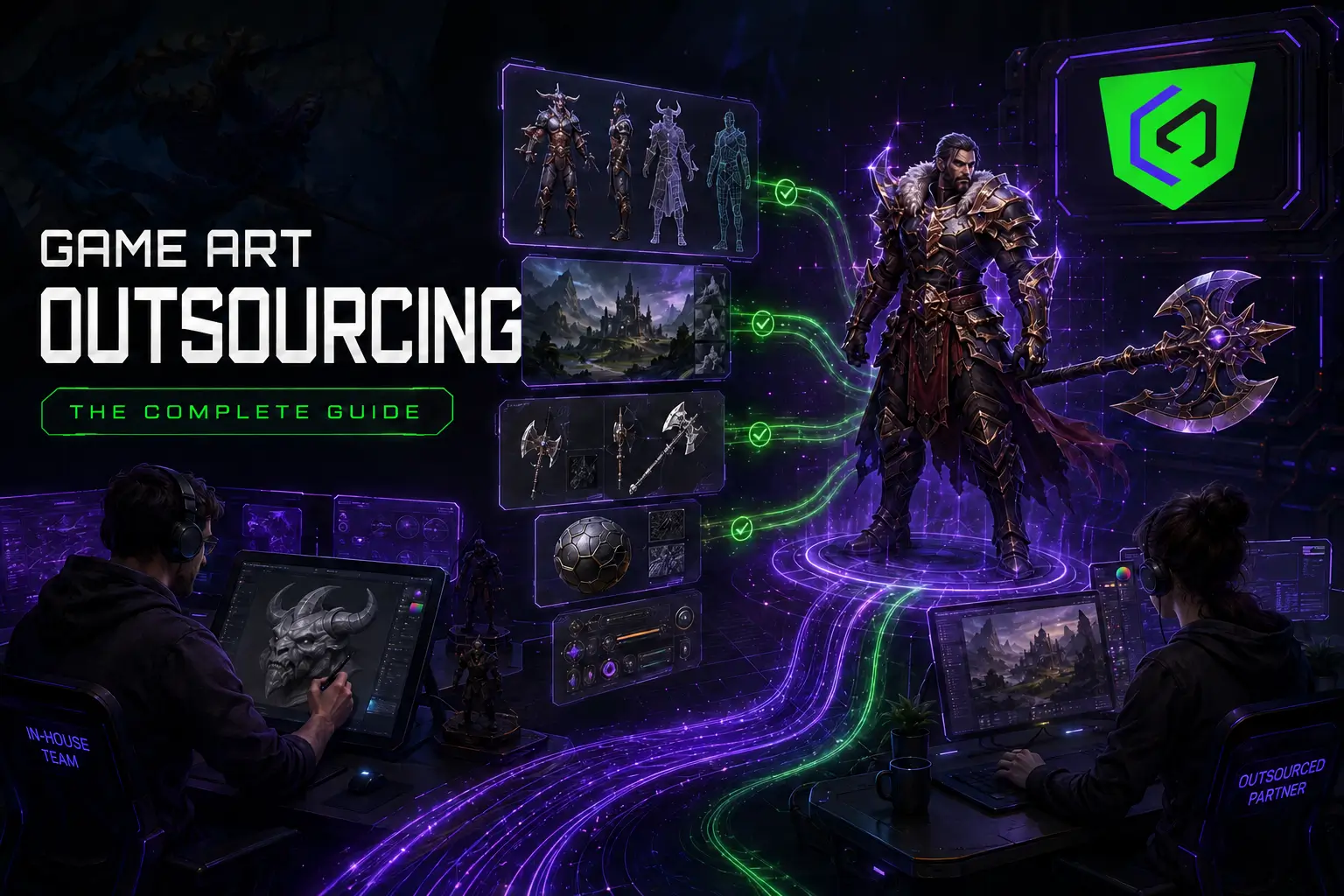
Every studio that says it does not outsource game art is usually lying or has not shipped enough games to need to yet. Somewhere in the pipeline of nearly every game you have played, a level of environment art, a batch of character variants, or a marketing key art piece was built by an external team. Game art outsourcing stopped being a compromise years ago. It is how modern studios hit visual bars they could never afford to staff internally, on timelines their own team could never hit alone.
The numbers back that up. The game art outsourcing market was valued at roughly $1.5 billion in 2024 and is projected to reach $3.8 billion by 2033, growing faster than most other corners of game production. This guide covers what game art outsourcing actually involves, when it makes sense, what it should cost, and how to tell a studio worth hiring from one that will cost you a shipping deadline.
What Is Game Art Outsourcing?
Game art outsourcing is the practice of hiring an external studio or team of freelance artists to produce visual assets for a game- characters, environments, UI, marketing art- instead of building that capacity entirely in-house. It ranges from a single contractor filling a short-term gap to a full external game art studio running an entire art department on a client’s behalf.
The scope varies enormously. Some studios outsource game art for one specific discipline, environment art, say, while keeping character design in-house. Others hand off an entire game’s visual production to external game artists and keep only art direction internal. Neither approach is more legitimate than the other. The right split depends on what a studio’s internal team is actually strong at and where the gaps are costing time.
Why Do Studios Outsource Game Art?
Cost Efficiency Without Cutting Quality
Building a full-time art department for a single project rarely makes financial sense, especially for studios that do not have a steady pipeline of future titles to keep that team busy afterward. Game art outsourcing lets a studio access senior-level talent for the duration of a project without carrying that headcount once the project wraps.
Speed and Scalability
A small internal team hits a hard ceiling on how much art it can produce in a given month. An external game artists partner can scale up quickly for a content-heavy phase, seasonal live-ops push, or crunch period, then scale back down without the studio managing layoffs or idle payroll.
Access to Specialized Skills
Not every internal team has a strong character artist, a technical artist who understands shader optimization, and a concept illustrator all under one roof. Outsourcing game art lets a studio pull in exactly the specialist a project needs for exactly as long as it needs them, rather than trying to hire a permanent generalist who is competent at everything and exceptional at nothing.
Focus on Core Competencies
Studios built around gameplay systems and design do not always want to also run an art department. Game asset outsourcing lets internal leadership stay focused on what the studio does best: mechanics, systems, and monetization, while a specialized partner handles visual production to a shared brief.
What Can Actually Be Outsourced?
Game art outsourcing covers a wide range of disciplines: 2D and 3D character design, environment art, UI and UX design, concept art, marketing and key art, animation, and technical art like rigging and shader work. A studio can outsource a single asset category or run an entire art pipeline through an external partner, depending on internal capacity and budget.
How Does Game Art Outsourcing Actually Work?
Brief and Scope
The process starts with a detailed brief: reference art, style guides, technical specs, poly budgets, naming conventions, and the pipeline the assets need to integrate into. A vague brief is the single most common cause of wasted revision rounds later in the engagement, since an external game art studio can only match a target it has actually been shown clearly.
Trial or Pilot Phase
Most serious outsourcing engagements start with a small trial batch of assets rather than a full commitment. This lets both sides confirm the studio’s style matches, the communication rhythm works, and the pipeline integration is clean before either party commits to a larger scope.
Production and Review Cycles
Full production runs on milestone-based delivery with structured feedback rounds, usually weekly or biweekly depending on project pace. Clear, specific feedback at this stage, not just vague notes, keeps revision counts down and keeps the external team producing assets that hit the mark on the first or second pass instead of the fifth.
Integration and QA
Delivered assets need to actually work inside the engine, not just look good in a folder. This means correct naming conventions, proper file formats, optimized poly counts, and UV layouts that match what the internal pipeline expects. A studio that treats delivery as the finish line, rather than integration, is not thinking about the client’s actual workflow.
How to Choose a Game Art Outsourcing Partner
- Look at a portfolio that matches your specific style, not just general competence. A studio that produces beautiful stylized art is not automatically the right fit for a gritty, realistic project, and the reverse is just as true.
- Ask how they handle pipeline integration. A good external game art studio will ask about your engine, your naming conventions, and your technical constraints before quoting a price, not after delivering the first batch of assets.
- Check communication speed and time zone overlap. Game art outsourcing that spans a twelve-hour time difference with slow response times turns every revision round into a multi-day delay, which adds up fast across a full production schedule.
- Request references from studios of a similar size and genre to yours. A vendor that has only worked with AAA publishers may not scope or price appropriately for an indie budget, and a vendor used to quick mobile turnarounds may struggle with a AAA-scale production pipeline.
What Does Game Art Outsourcing Cost?
Pricing varies by discipline, region, and experience level. A single stylized 2D character can run anywhere from a few hundred dollars for a simple mobile game to several thousand for a detailed AAA-quality character sheet. Full environment sets, complete character rosters, or ongoing outsourced art department arrangements are typically quoted as a project retainer rather than per-asset, since that structure gives both sides more predictable planning.
Region affects pricing significantly. Outsourcing to established studios in North America or Western Europe generally costs more than partnering with skilled teams in South Asia or Eastern Europe, though the quality gap between regions has narrowed considerably as the global outsourcing market has matured. Cheapest is rarely the right filter. The real question is cost relative to the revision cycles a studio will actually need to hit its bar.
Common Mistakes When Outsourcing Game Art
- Choosing on price alone. The cheapest quote often comes with the most revision rounds, and by the third or fourth round of rework, the savings have usually disappeared.
- Sending an incomplete brief. Missing technical specs, unclear style references, or an absent naming convention guarantees mismatched deliverables and wasted time on both sides.
- Skipping the trial phase. Committing to a full production scope before confirming style fit and communication rhythm is a gamble most studios regret at least once.
- Treating outsourced artists as disposable. The studios that get the most consistent quality over multiple projects are the ones that build an actual working relationship with their outsourcing partner instead of treating every engagement as a one-off transaction.
- Underestimating pipeline documentation. Game asset outsourcing runs smoothly when the external team has clear documentation of file formats, folder structures, and version control expectations from day one. Studios that assume this is obvious end up spending the first few weeks of an engagement fixing avoidable formatting mismatches instead of producing usable assets.
Frequently Asked Questions
Is outsourcing game art cheaper than hiring in-house?
Usually, yes, for project-based or fluctuating workloads. In-house artists carry salary, benefits, and equipment costs year-round regardless of workload, while game art outsourcing scales with actual production needs. For studios with a constant, predictable pipeline of work, an in-house team can eventually become more cost-effective, but most studios do not have that kind of steady-state demand.
How do I protect my game’s intellectual property when outsourcing?
A signed NDA before any project details are shared is standard practice, along with a contract that explicitly transfers full IP ownership of delivered assets to the client on final payment. Reputable outsourcing studios expect this and will not push back on reasonable IP protection terms.
Can I outsource just part of my art pipeline?
Yes, this is one of the most common outsourcing structures. Studios frequently keep character design or art direction in-house while outsourcing environment art, marketing assets, or overflow capacity during crunch periods. Partial outsourcing lets a studio fill specific gaps without handing over creative control of the whole project.
What is the difference between freelancers and an outsourcing studio?
A freelancer is typically one artist handling one discipline, which works well for small, well-defined tasks. An outsourcing studio brings a full team, project management, quality control, and the ability to scale across multiple disciplines at once, which suits larger or more complex art pipelines better than coordinating several individual freelancers directly.
How long does it take to onboard an outsourcing partner?
A trial phase to confirm style fit and pipeline compatibility usually takes one to three weeks. Full onboarding, including detailed brief handoff, pipeline documentation, and communication setup, typically adds another week or two before a partner is running at full production speed.
Outsourcing Done Right Looks Like a Second Studio, Not a Vendor
The studios that get the most out of game art outsourcing stop treating it as a transaction and start treating it as an extension of their own team. That means a real brief, a real feedback loop, and a partner chosen for fit rather than the lowest quote on the page. Cobweb Games works as exactly that kind of extension, running as an integrated art department for studios that need production capacity without the overhead of building one internally.
