
Ask ten developers how long a game takes to make, and you will get twelve answers, most of them starting with a deep sigh. The short version is that a simple mobile game can ship in a few months, an indie title usually needs one to three years, and a blockbuster can eat five or more. The useful version explains why those ranges are so wide, which parts of the schedule are predictable, and which parts quietly eat the calendar when nobody is looking.
This guide gives you a realistic game development timeline built from published industry sources, walks through each stage of production with typical durations, shows a week-by-week example of a small project, and lists the specific habits that stretch or shrink a schedule. If you are a founder, a marketing lead, or a producer building a plan, treat it as a reality check you can put in front of a stakeholder.
The Short Answer, by Scope
Published ranges vary because the people publishing them define “a game” differently. Two industry sources give the clearest picture, and they agree more than they differ.
| Project Type | Typical Team | Typical Duration |
| Simple mobile game (hyper-casual, puzzle, basic arcade) | 3 to 10 people | About 2 to 6 months, up to 12 months depending on source |
| Mid-sized indie game | 5 to 25 people | 6 to 18 months, with many projects running 1 to 3 years |
| Large AAA game | 100+ developers, often many hundreds | 3 to 5 years or more, with some sources putting the range at 3 to 6 |
Real examples sit comfortably inside those bands. Grand Theft Auto V is widely cited as taking nearly five years with a team that exceeded a thousand people across multiple studios. The ranges also show how much the answer depends on ambition. Features such as multiplayer, high-end visuals, or extensive voice acting can add months to a project, and in some estimates roughly double the total.
Two cautions about these numbers. First, they describe typical projects, not guarantees, and team experience matters as much as team size. Second, a calendar duration is not an effort measure. A game that takes 12 months with 4 people and one that takes 12 months with 40 people are different projects with different budgets.
The Development Stages and What Each One Takes
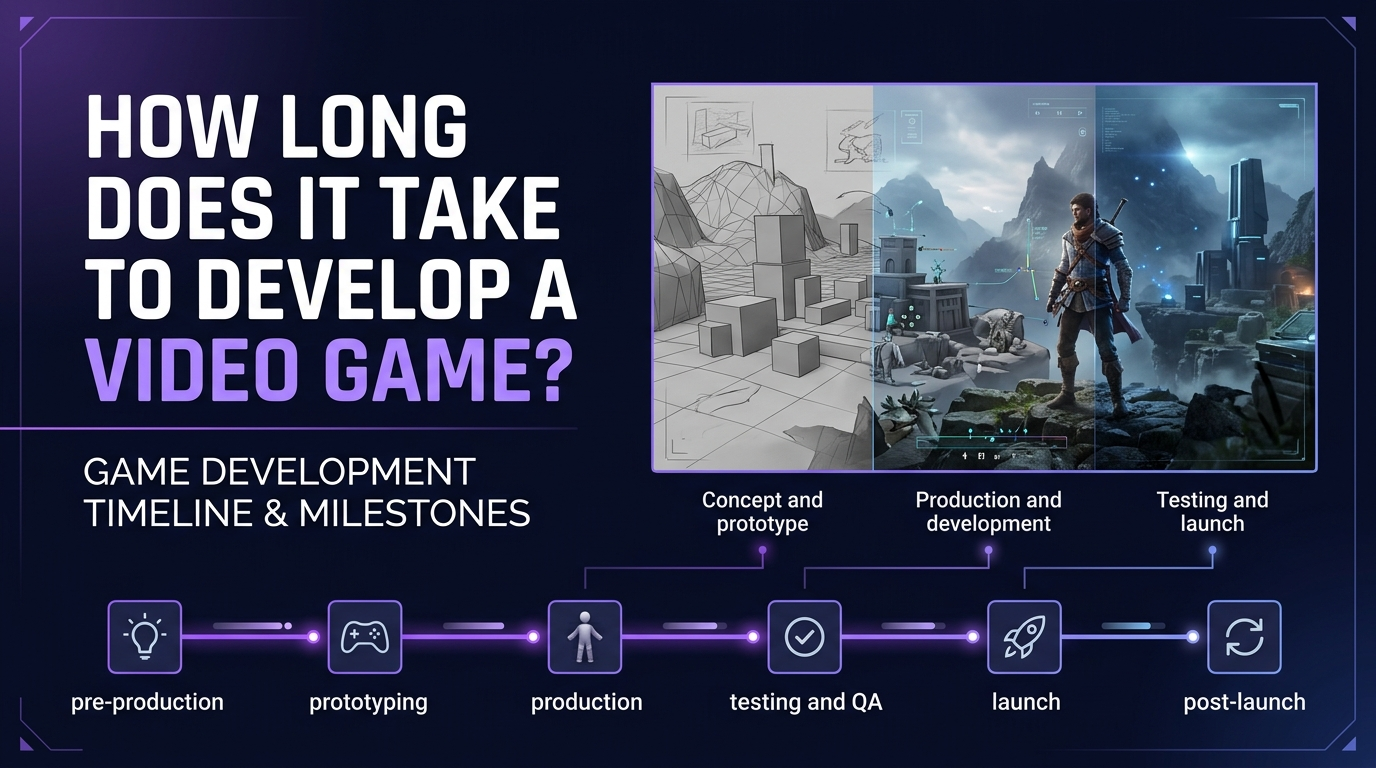
The time to develop a game splits across a familiar arc, even when studios name the development stages differently. Industry timelines for each stage:
| Stage | Typical Duration | What Happens |
| Pre-production | 1 to 3 months | Concept, scope, target audience, technology choices, production plan |
| Design and prototyping | 1 to 4 months | Core mechanic prototypes, “is this fun” testing, vertical slice planning |
| Full production | 6 months to 3 years | Building content, systems, art, audio, and levels |
| Testing and quality assurance | 2 to 6 months | Bug fixing, balancing, performance, platform compliance |
| Launch and marketing | 1 to 3 months | Store submission, marketing push, release |
| Post-launch support | Ongoing | Patches, updates, live operations |
Production is the heavyweight. One industry guide puts it at 60 to 70 percent of total development resources, which matches what most producers experience: the middle of the project is where the money and the months go.
Notice what the table does not say. The stages overlap in real projects. Testing starts long before the QA phase, art production begins while design is still settling, and marketing should start months before launch. The table is a map, not a Gantt chart, and any real game production timeline will blur its edges.
What Can Actually Be Outsourced?
Game art outsourcing covers a wide range of disciplines: 2D and 3D character design, environment art, UI and UX design, concept art, marketing and key art, animation, and technical art like rigging and shader work. A studio can outsource a single asset category or run an entire art pipeline through an external partner, depending on internal capacity and budget.
Stage by Stage: Where the Time Goes
Pre-production: the cheapest months you will ever spend
Pre-production feels like delay and works like insurance. The team decides what the game is, who it is for, what engine and platforms it targets, and what the scope boundaries are. Typical output is a design document or pitch, a technology decision, a rough budget, and a production plan.
Skipping this stage rarely saves time. Teams that dive straight into production tend to discover fundamental problems, such as a mechanic that is not fun or a technical approach that will not scale, after months of content has been built on top of them. A solid game prototyping phase exists to find those problems while changing course still costs days, not quarters.
Design and prototyping: proving the fun
A prototype answers one question: is the core loop worth building a game around? It should be ugly, quick, and blunt. Many successful games spent weeks as boxes moving around a screen before an artist touched them.
The prototype’s job is to end arguments. If players enjoy the box version, the production plan gets confidence. If they do not, the team has saved a year. Studios that treat prototyping as a formality tend to keep building a game that was never going to work.
Full production: the long middle
This is where content gets built: levels, characters, animations, user interface, audio, systems, and the code that holds it together. Duration depends on scope more than anything else, and the usual levers are content volume, visual fidelity, number of platforms, and multiplayer or live-service features.
A healthy production phase runs in milestones. A common structure is a first playable, then a vertical slice (one polished slice of the full experience), then alpha (feature complete, rough), then beta (content complete, mostly bug fixing). Each milestone is a checkpoint where the team asks if the plan still fits reality. A studio that skips milestones discovers its schedule problems at the end, which is the worst possible moment.
Testing and quality assurance: the stage everyone underestimates
QA runs two to six months on typical projects, and it is the stage most likely to be compressed when the schedule slips. That is a mistake. Late testing finds the bugs that cost the most to fix: performance problems, save corruption, platform certification failures. A game testing plan that starts early, runs continuously, and covers target devices catches those issues while there is still time to repair them.
Launch and post-launch: the schedule keeps going
Store submission, review times, marketing assets, and community setup all take time, typically one to three months of preparation. Then the game launches and a different clock starts. Patches, balance updates, new content, and live operations continue for as long as the game has players, and a team that has no post-launch plan will watch reviews and retention slide in the first month.
A Worked Example: A Small Mobile Game in 20 Weeks
Abstract ranges help less than a concrete plan. Here is an illustrative schedule for a small, single-player mobile puzzle game built by a team of about five. It is an example of structure, not a promise, and real projects will vary.
| Weeks | Focus | Deliverable |
| 1 to 3 | Pre-production | Design document, scope list, engine and platform decisions, art style frames |
| 4 to 6 | Prototype | Playable core loop with placeholder art, first internal playtests |
| 7 to 10 | Vertical slice | One polished level with final-quality art, audio, and interface |
| 11 to 16 | Production | Remaining levels, progression, monetization, menus, tutorial |
| 17 to 19 | Alpha to beta and QA | Feature lock, bug fixing, device testing, performance tuning |
| 20 | Submission and launch prep | Store listing, build submission, release candidate |
Several things in that plan deserve attention. The prototype and vertical slice together take seven weeks, over a third of the schedule, before the bulk of content gets built. That is deliberate. The production phase is short only because the earlier phases removed most of the uncertainty. Testing gets three weeks even for a small game, and launch preparation is its own line item. Teams that compress those two lines tend to ship late anyway, because store rejections and last-minute bugs arrive on their own schedule.
If this team added multiplayer, a meta-progression system, or a live event calendar, the same plan would stretch by months, not weeks.
What Stretches a Schedule?
The same causes appear across nearly every project that runs late.
Scope creep. Features accumulate one reasonable request at a time. Each looks small, and none of them is free. Studios with a written scope list and a change process stay in control. Studios without one watch the date move in increments.
Unclear design. A team that begins production without a clear core loop builds, rebuilds, and abandons content. That rework is invisible on the plan and enormous on the calendar.
Underestimated polish. The last 10 percent of quality, the animation timing, the feel of the controls, the loading flow, can consume as much time as the first 90 percent. Software engineers have joked about this for decades. The old “ninety-ninety rule,” credited to Tom Cargill of Bell Labs, says the first 90 percent of the code takes the first 90 percent of the time, and the remaining 10 percent takes the other 90 percent.
Platform multiplication. Every added platform brings extra builds, extra testing, and extra store requirements. Shipping on iOS and Android together, or adding PC and console, can lengthen both development and QA.
Technical debt. Shortcuts taken early, such as unclear architecture, unoptimized assets, or missing tooling, accumulate interest. A project that ignores performance until late discovers its frame rate problem when there is no time to fix it.
Team changes. Losing a key person mid-production costs more than their calendar days. Knowledge walks out the door, and the replacement needs time to learn the project.
Dependencies on others. Third-party SDKs, platform approvals, licensed content, and outsourced work all introduce waits the team cannot control. Hofstadter’s Law, coined by Douglas Hofstadter in 1979, captures the pattern: it always takes longer than you expect, even when you take Hofstadter’s Law into account.
What Shrinks a Schedule?
Fewer things speed a project up than slow it down, and all of them involve deciding earlier.
| Habit | Why It Saves Time |
| Write scope down and defend it | Stops features from entering without a trade-off |
| Prototype before production | Kills bad ideas while they are cheap |
| Use a proven engine | Unity and Unreal remove years of foundational work |
| Reuse and license assets sensibly | Stock assets and plugins can fill noncritical gaps |
| Set budgets early | Performance and memory limits written in pre-production prevent late crises |
| Start QA early | Continuous testing finds problems when they are cheap |
| Cut early, not late | Dropping a feature in week 8 costs less than dropping it in week 40 |
| Hire experience where it counts | A senior engineer or producer in the right seat saves months |
| Use an experienced partner | A studio that has shipped similar games already knows the traps |
A final habit worth stating plainly: cut scope instead of extending the date. If the plan is late, the question to ask is what can leave the game, not how much longer everyone can work. Crunch is a bad schedule tool, and it damages quality, retention, and the team.
Estimating Your Own Project
A reasonable estimate comes from breaking the work down instead of guessing a total. A working method:
- List the content. Count levels, characters, enemies, items, screens, and systems.
- Estimate each category, ideally using numbers from a previous project or a similar game.
- Add the invisible work. Tools, builds, integration, bug fixing, and meetings typically add a substantial share to the visible production estimate.
- Add buffer, and treat it as real time, not slack to be spent early. A common rule of thumb adds 20 to 30 percent for a team with a good track record and more for a team on its first project together.
- Check against reference ranges. If your estimate lands far outside the ranges in this guide, either the scope is unusual, or the estimate is off.
- Plan in milestones, not in one long production stretch, and re-estimate at each one.
An estimate is a living document. The first one is the least accurate, and the best teams update it every few weeks.
Timelines by Genre and Features
Scope, not genre, drives duration, though genres carry typical content needs.
| Game Type | Why It Takes the Time It Takes |
| Hyper-casual | Tiny scope and rapid testing cycles, with the main time spent on prototyping many ideas |
| Puzzle and casual | Many levels to design and balance, light art and tech needs |
| Platformer or action indie | Tight controls and hand-crafted levels need heavy iteration |
| Multiplayer | Netcode, servers, matchmaking, and balance add months of engineering and testing |
| RPG or open world | Enormous content volume, narrative, and systems depth |
| Live-service | A launch is the starting line, and content cadence drives the real workload |
| VR or AR | Extra comfort, input, and performance work on specialized hardware |
Multiplayer deserves special mention. Adding online play late is one of the most expensive decisions a team can make, because it touches nearly every system. A multiplayer game plans for it from the first design meeting.
Cobweb Games’ Approach to the Game Development Schedule
Planning at Cobweb Games starts with a scoped milestone plan and a realistic range in place of one optimistic date. We run a short pre-production phase, build a prototype and vertical slice before scaling the team, and review the plan at every milestone so changes surface early. A game development schedule built this way holds up under pressure. Studios and brands working with us on game development get a schedule they can plan marketing and budgets around, with the assumptions written down.
For mobile projects, the same discipline applies to mobile game development, where device testing and store review windows need their own lines in the plan. We would rather tell a client a realistic date in week one than apologize for a missed one in month nine.
Common Timeline Mistakes
Planning with a single number. A range with stated assumptions is a plan, and a date with no assumptions is a wish.
Skipping prototyping to save time. It usually costs more time than it saves.
Compressing QA when the schedule slips. Late bugs are the expensive ones.
Forgetting store and platform lead times. Review, certification, and marketing preparation do not compress on request.
Letting scope grow without a change process. Each addition moves the date, and the date moves even when nobody says so.
Treating the launch as the finish line. Post-launch support is part of the schedule and the budget.
Assuming more people means faster delivery. Adding staff to a late project often slows it down in the short term, because the team must absorb the newcomers.
Frequently Asked Questions
How long does it take to develop a mobile game?
A simple mobile game typically takes about 2 to 6 months, and some sources put the range at 6 to 12 months for small teams of 3 to 10 people. Games with multiplayer, live events, or high production values take longer.
How long does it take to make an indie game?
Most mid-sized indie games take between 6 months and 3 years, depending on scope, team size, and experience. A small studio project often lands around 12 to 18 months.
How long does it take to make an AAA game?
Typically 3 to 5 years or more, with large teams of hundreds of developers. Grand Theft Auto V is a commonly cited example, taking nearly five years and a team of over a thousand people.
What is the longest stage of game development?
Full production, which can run from about six months to three years and accounts for roughly 60 to 70 percent of total development resources according to one industry guide.
Can a game be built faster by hiring more developers?
Sometimes, for work that can be split cleanly, such as parallel art production. Adding people to a late project usually slows it at first, because the team must onboard them, and some work cannot be divided.
How can I shorten my game development timeline?
Write a clear scope, prototype early, use a proven engine, set performance budgets in pre-production, start testing early, and cut features early instead of extending the date.
