
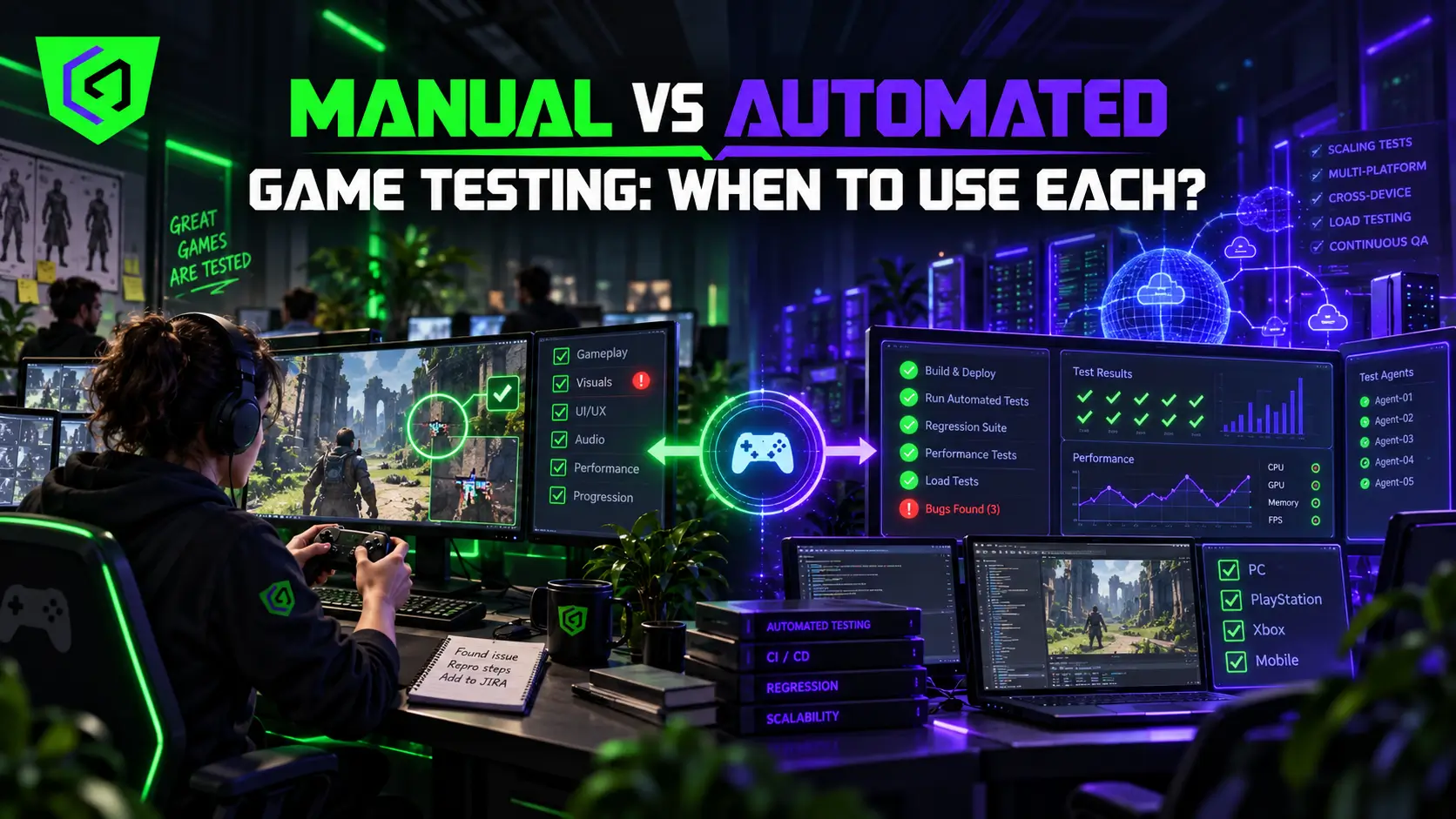
A tester who notices a menu button just feels sluggish, even though every automated check passed clean, has just caught something no script would ever flag, and that single moment captures why the manual vs automated game testing question refuses to resolve into a simple winner no matter how many years the industry spends arguing about it. The global test automation market has grown past 29 billion dollars and continues expanding at more than 15 percent annually, yet 82 percent of QA professionals still report using manual testing daily, according to recent industry surveys. Neither number cancels the other out. This guide breaks down exactly when each approach earns its place in a game’s QA process, and how the strongest testing strategies actually blend both rather than picking a side.
What Is the Core Difference Between Manual and Automated Game Testing?
Manual game QA means a human tester actively playing through a build, exploring mechanics, checking for visual glitches, and applying judgment about whether something feels right in a way no script currently replicates. A manual tester can notice that a jump animation feels a frame too floaty, that a UI element looks cramped on an unusual resolution, or that a joke in the dialogue lands flat, all forms of feedback that depend on human perception rather than a pass or fail condition a machine can check.
Automated testing, the category automated testing games increasingly depend on, uses predefined scripts and tools that execute the same test cases repeatedly without ongoing human input, checking for crashes, regressions, performance drops, and functional breaks at a speed and scale no manual team could match. A regression suite covering hundreds of scenarios that would take a human team three days to run manually can often complete in under two hours once properly automated, and it produces identical, repeatable results every single time it runs.
When Manual Testing Is Genuinely the Right Call?
New or frequently changing features are the clearest case for manual testing, since building an automated script for a feature that will likely change again next sprint often costs more engineering time than it saves. Exploratory testing, where a tester deliberately tries to break a build through unexpected inputs and edge cases a script would never think to attempt, remains one of the few QA activities that meaningfully benefits from genuine human creativity and intuition rather than predictable, repeatable execution.
Usability, feel, and overall player experience checks depend entirely on human judgment in ways automation genuinely cannot replicate yet. Whether a combat system feels satisfying, whether a difficulty curve seems fair, or whether a tutorial actually teaches a mechanic clearly are all questions that require a person actually playing the game and forming a subjective judgment, not a script confirming that a function returned the expected value. One-off or low-frequency scenarios round out the list, since writing, debugging, and maintaining an automated script for a test that will only run once or twice rarely makes economic sense compared to simply running it manually.
When Automated Testing Games Should Rely On It Instead?
Regression testing is the single strongest case for automation in any game production pipeline. Confirming that a new build has not broken previously working features is exactly the kind of repetitive, predictable check that benefits enormously from running automatically on every build rather than consuming manual tester hours re-verifying the same functionality over and over across every release candidate.
Performance, load, and stress testing represent scenarios automation handles by necessity rather than preference, since simulating ten thousand concurrent players hitting a server simultaneously is simply not something a manual QA team can physically replicate. Automated game testing tools can run these scenarios reliably and repeatedly, producing consistent data that a manual approach could never generate at comparable scale. Frequent release cycles favor automation too, since a studio shipping updates weekly or even daily needs a regression suite that runs automatically on every commit rather than gating every release behind a lengthy manual verification pass.
What Does Game QA Automation Actually Look Like in Practice?
Game QA automation typically starts with identifying the highest-value candidates for scripting: stable features that change infrequently, core functionality that needs verification on every build, and performance benchmarks that need consistent, repeatable measurement across releases. Building automated coverage for a feature that changes weekly is usually wasted effort, since the maintenance cost of constantly updating broken scripts can exceed whatever time the automation was meant to save in the first place.
Modern game testing tools have expanded considerably beyond basic scripted input replay. Frameworks now exist specifically for simulating multiplayer load, validating economy balance across thousands of simulated playthroughs, and even using AI-assisted approaches to generate test scenarios a human QA designer might not think to write manually. Industry adoption of AI-driven testing has grown sharply, with recent surveys showing 61 percent of QA teams now using some form of AI-assisted testing, up from under 30 percent just two years prior, though the technology still works best as a complement to human oversight rather than a full replacement for it.
The Hybrid Ratio Most Strong QA Teams Actually Use
Industry data increasingly points toward a rough seventy-twenty-ten split as a reasonable starting framework for many productions: roughly seventy percent of QA effort going toward automated regression coverage, twenty percent toward manual exploratory testing and new feature validation, and the remaining ten percent toward specialized checks like accessibility review or platform certification requirements. That ratio is a starting point rather than a fixed rule, and it shifts meaningfully based on how stable a game’s systems are and how frequently new content ships.
A game with a highly stable core loop and frequent live-service content updates typically skews further toward automation, since the underlying systems being tested repeatedly are unlikely to change even as new content layers on top of them. A game still in active pre-launch development, with mechanics changing significantly sprint over sprint, skews more heavily toward manual game QA, since building automated coverage for systems still in flux tends to waste engineering time on scripts that will need rewriting before they ever pay for themselves.
What Does a Real Testing Budget Actually Look Like?
Studios planning QA spend for the first time often underestimate how much of the budget should go toward tooling and setup versus ongoing execution. Building genuine automation infrastructure, framework selection, CI integration, and initial script development tends to represent the single largest upfront cost in a testing budget, often exceeding what a studio expects before comparing quotes from actual QA providers. That upfront investment pays off specifically on projects with a long tail of releases, since the same automated suite keeps running on every future build at a fraction of what an equivalent manual pass would cost. Studios weighing this investment should also compare it against the cost of good game testing tools licensed off the shelf rather than built fully in-house, since a mature commercial tool can sometimes cover eighty percent of a project’s needs at a fraction of the cost of a custom framework built entirely from scratch.
Ongoing costs look different for each approach. Manual testing scales roughly linearly with the number of testers and hours required per pass, which makes it predictable but expensive to scale up quickly during a crunch period. Automated coverage scales far more efficiently once built, since running an existing suite against a new build costs little beyond compute time, though script maintenance remains a real, recurring cost whenever the underlying game systems change enough to break existing tests. A realistic budget accounts for both categories rather than assuming automation is simply a one-time cost that eliminates ongoing QA spend entirely.
Platform Certification Testing Deserves Its Own Category
Console and major storefront certification requirements sit somewhat outside the standard manual versus automated framework, since these checks are dictated by platform holders rather than by what a studio would otherwise choose to prioritize. Certification testing typically requires a specific, documented pass through platform-mandated requirements, covering everything from save data handling to controller input standards to age rating compliance, and getting this wrong can delay a launch by weeks regardless of how solid the rest of a game’s QA coverage looks.
Some certification checks lend themselves to automation, particularly repetitive technical requirements like frame rate consistency or crash reporting standards. Others genuinely require a human tester walking through platform-specific user flows exactly as a real player would experience them, since platform holders are often evaluating subjective experience quality alongside pure technical compliance. Studios unfamiliar with a specific platform’s certification process benefit enormously from working with a testing partner who has already navigated those requirements successfully on previous titles, since a failed certification pass costs both time and, on some platforms, a resubmission fee on top of the delay itself.
Common Mistakes When Balancing the Two Approaches
Automating everything indiscriminately is one of the most expensive mistakes a studio can make in this area. Teams that attempt full automation coverage regardless of feature stability often find themselves spending more engineering time maintaining brittle scripts than they would have spent simply running the same checks manually, particularly for features that change frequently during active development.
Relying entirely on manual testing carries the opposite risk, and it shows up specifically as a coverage gap. Manual-only QA teams typically achieve somewhere between 20 and 40 percent test coverage, since human testers simply cannot execute the sheer volume of repetitive checks a mature production needs on every single build. Treating the two approaches as competing philosophies rather than complementary tools also causes real organizational friction, with teams sometimes debating which method is objectively superior instead of asking which specific test case actually calls for which approach in a given situation.
How Cobweb Games Structures QA Across Both Methods
Cobweb Games runs manual and automated coverage as integrated components of the same game testing practice rather than treating them as separate, competing services. Manual testers handle exploratory passes, usability review, and platform certification checks that genuinely require human judgment, while automated suites cover regression testing, performance benchmarking, and the repetitive verification work that would otherwise consume disproportionate manual tester time on every release cycle.
This structure lets a project’s testing strategy actually shift as it matures, leaning more heavily on manual exploratory work during active pre-launch development when systems are still changing rapidly, then rebalancing toward automation once core systems stabilize and the priority shifts toward fast, reliable regression coverage across frequent live content updates.
Frequently Asked Questions
Can automated testing fully replace manual game QA eventually?
Unlikely in the near term, at least for judgment-based testing like usability and player experience review. Automation excels at repetitive, well-defined checks, but assessing whether a mechanic feels satisfying or a tutorial teaches clearly still depends on human perception that current tools cannot reliably replicate.
How much does it cost to build a game QA automation suite?
Costs vary significantly based on scope, but initial setup, covering framework selection, infrastructure, and script development, typically represents the largest expense. Ongoing maintenance adds a recurring cost too, since scripts break whenever the underlying UI or systems change and need corresponding updates to stay functional
Is manual testing becoming obsolete as AI testing tools improve?
No, though the nature of manual work is shifting. Repetitive, checklist-driven manual regression testing is declining as automation absorbs that category of work, but exploratory testing, usability review, and judgment-based quality checks remain firmly in human territory and show no signs of disappearing.
What game testing tools are most commonly used for automation?
Common options include Unity Test Framework and Unreal Engine’s built-in automation tools for engine-native testing, alongside broader frameworks like Appium for mobile-specific scenarios and custom-built tools for game-specific needs like economy simulation or multiplayer load testing. Studios comparing options should weigh how well each tool integrates with their existing engine and CI pipeline rather than choosing based on feature lists alone, since integration friction tends to cause more wasted time than any missing feature would.
Should a small indie studio invest in automated testing games rely on, or stick with manual QA?
Small studios with limited budgets often start with manual testing, since building and maintaining automation infrastructure requires upfront investment that may not pay off until a project reaches meaningful scale or a live-service content cadence. As a title grows and release frequency increases, automation typically becomes worth the investment for regression coverage specifically.
How do I know if my QA strategy has the right balance between manual and automated testing?
Track where bugs actually get caught and by which method. If automation consistently misses usability or feel-related issues that manual testers catch, the balance likely needs more manual exploratory time. If manual testers spend most of their hours on repetitive regression checks that could run automatically overnight, that work is a strong candidate to shift toward automation instead.
