
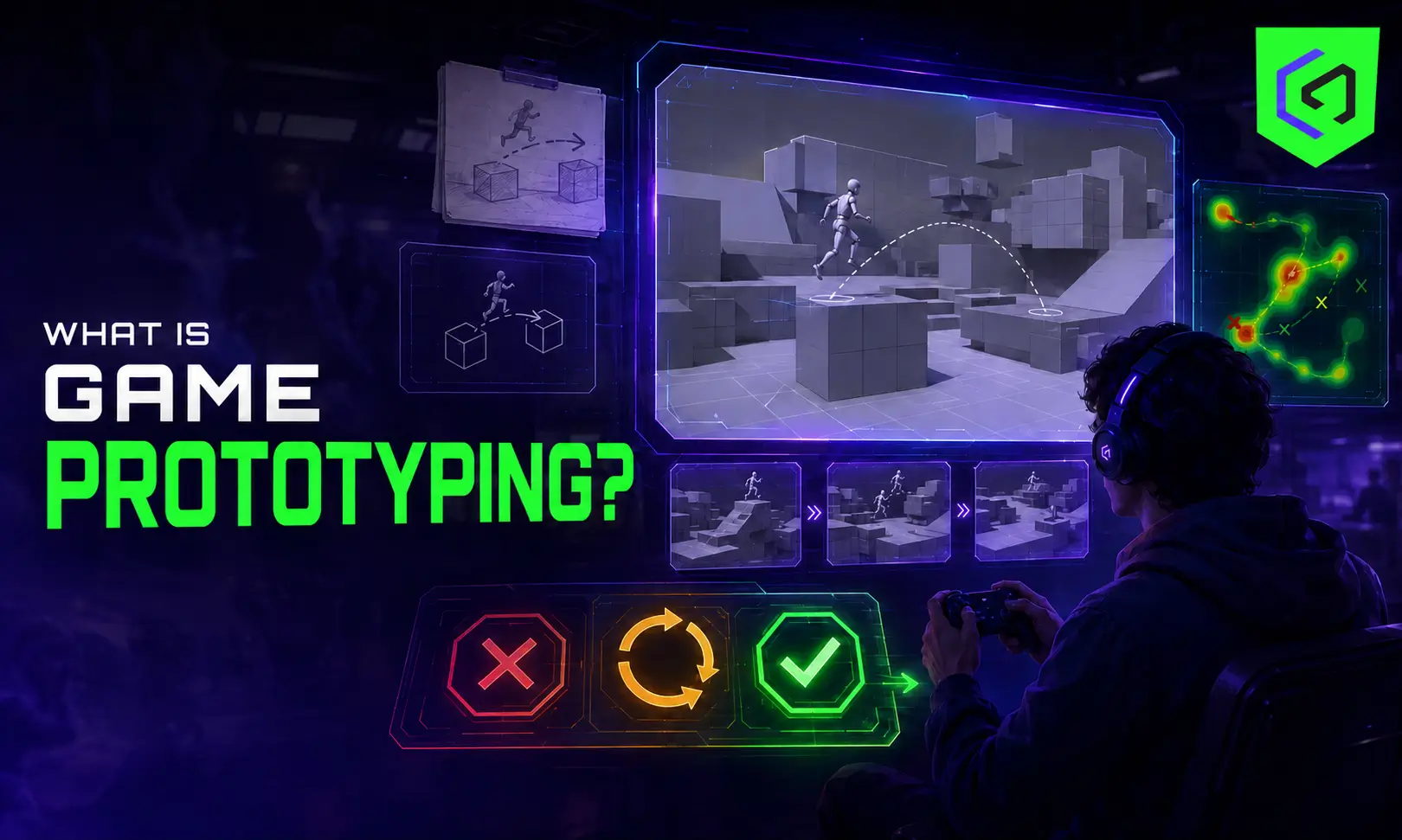
Game prototyping is the process of building a rough, playable version of a game mechanic or system to test whether it is fun, feasible, and worth full production investment, before committing the budget required to build the complete game. A game prototype usually has no final art, minimal UI, and often uses placeholder shapes instead of characters, because the entire point is to isolate the mechanic from everything that might make it look good without actually playing well.
Rapid prototyping is the specific discipline of building and testing these throwaway builds fast, often in days rather than weeks, so a team can iterate through several mechanic ideas before locking one in. Speed matters more than polish at this stage, since the value of a prototype comes from how quickly it answers a question, not from how presentable it looks in a deck.
What Happens When You Skip Game Prototyping?
Most cancelled games do not die because the art was bad or the code was buggy. They die because nobody tested whether the core mechanic was actually fun before six months and a real budget went into building the rest of the game around it. Game prototyping exists specifically to catch that failure early, when it costs a week and a rough build instead of a quarter and a studio’s runway.
A prototype is not a small version of the finished game. It is a deliberately ugly, stripped-down build with one job: answer whether the core loop holds up when a real person plays it, before anyone commits to art direction, engineering architecture, or a release date. Studios that treat game prototyping as a serious phase instead of a rushed formality tend to ship fewer dead projects, and the ones that skip it tend to find out why the hard way.
Why Does Game Prototyping Matter So Much?
Game concept testing at the prototype stage is the cheapest insurance a studio can buy. Reworking a broken core mechanic on paper or in a rough build costs a few days. Reworking that same mechanic after months of art production, engineering, and content creation costs a project’s entire budget and timeline, and by that point the team is often too invested to make the hard call to cut it.
A video game prototype also forces honesty earlier than a design document does. A pitch deck can make almost any mechanic sound compelling with the right framing. A prototype either plays well or it does not, and that verdict shows up within minutes of putting a controller or a mouse in a tester’s hands.
How Does the Game Prototyping Process Work?
Isolate the Core Question
Every prototype should exist to answer one specific question: is this movement mechanic satisfying, does this combat system feel responsive, does this puzzle logic create genuine tension? Prototypes that try to test five things at once produce muddy results, since it becomes hard to tell which element made the build feel good or bad.
Build Fast and Rough
Speed beats polish at this stage. Placeholder cubes standing in for characters, programmer art for environments, and reused engine assets are normal and expected in a prototype. The goal is a playable build in days, not a presentable one in weeks, since every extra day spent polishing a prototype is a day not spent testing whether the idea works at all.
Test With Real Players
Internal team testing catches obvious problems, but a prototype only proves its point when someone outside the project plays it without guidance. Watching a first-time player struggle with a mechanic the team assumed was intuitive is one of the most valuable moments in the entire prototyping process, and it is one a studio only gets if it actually brings in outside testers rather than relying on its own team’s familiarity with the build.
Decide: Kill, Iterate, or Greenlight
A prototype earns one of three outcomes. Kill it if the core loop does not hold up after reasonable iteration. Iterate if there is a spark worth chasing, but the current build is not quite there. Greenlight it into full production if the mechanic proves itself. The hardest of these calls is usually killing a prototype the team has grown attached to, but that is exactly the discipline game prototyping is supposed to enforce.
What Makes a Good Game Prototype?
A good game prototype answers its question clearly, gets built fast, and costs little enough that killing it is not a painful decision. It does not need good art, a complete UI, or even a full level. It needs one honest answer: does this mechanic make someone want to keep playing?
Studios that build a structured prototyping phase into their pipeline consistently report fewer late-stage pivots than teams that jump straight into full production, since catching a design flaw during pre-production costs a fraction of what the same fix costs after assets and code are already built around it. That cost curve is the entire argument for taking game prototyping seriously rather than treating it as a formality on the way to real production.
How Long Does Game Prototyping Take?
A single mechanic prototype usually takes anywhere from a few days to two weeks, depending on complexity and how many iterations the core loop needs before it clicks. A studio testing several competing concepts for a new title might run three or four parallel prototypes over a month before committing to one direction. Timelines stretch when a prototype reveals a problem that needs a genuinely different approach rather than a small tweak, which is normal and is the entire reason the phase exists.
Game Prototype vs Full Production: Where Is the Line?
A game prototype tests whether a mechanic is fun. Full production builds the complete game around a mechanic that has already proven itself. The two phases use different tools, different standards, and different definitions of success. A prototype succeeds by answering a question quickly and cheaply, even if the answer is no. Full production succeeds by shipping a polished, complete game built on the answer the prototype already gave. Confusing the two, treating a prototype like a finished product or treating early production like it is still open for major mechanic changes, is where a lot of studios lose time they never get back.
Common Mistakes in Game Prototyping
- Polishing too early. Adding real art or full UI to a prototype defeats the purpose, since a good-looking build can mask a mechanic that is not actually fun.
- Testing only with the internal team. A team that has been staring at its own mechanic for weeks cannot judge it the way a first-time player will, and internal testing alone misses the exact confusion points a real audience will hit.
- Skipping the kill decision. Some teams build a prototype, get lukewarm results, and move forward anyway because stopping feels like wasted effort. The effort is not wasted if it prevents a much larger waste later in full production.
- Testing too many variables at once. A video game prototype that changes the movement system, the combat, and the progression loop simultaneously cannot tell a team which change mattered, which defeats the entire point of isolating a single question.
- Confusing enthusiasm with evidence. A team excited about a mechanic during internal builds is not the same as game concept testing that shows real players are excited too. The two get conflated more often than studios like to admit, usually right before a mechanic that never actually tested well ends up greenlit anyway.
What Should a Prototyping Report Actually Include?
A useful prototype does not end when the build stops crashing. It ends with a short, honest write-up: what question the prototype was built to answer, what players actually did when they picked it up, where they got confused or bored, and a clear recommendation: kill, iterate, or greenlight. Game concept testing without a documented outcome tends to get re-litigated later based on memory and opinion rather than what testers actually showed the team, which defeats the purpose of having tested anything in the first place.
The best prototyping reports also capture what almost worked. A mechanic that scored well on engagement but confused half the testers is not a failure; it is a specific, fixable problem, and writing that down clearly is often more valuable than the initial verdict itself. Teams that skip this step tend to relearn the same lessons on the next prototype instead of building institutional knowledge about what actually plays well for their genre and audience.
Frequently Asked Questions
What is the difference between a prototype and an MVP?
A prototype tests whether a single mechanic or system is fun, usually with no art and minimal scope. An MVP, or minimum viable product, is a stripped-down but complete version of the actual game, built to validate the whole product with real players or a limited market release. A prototype typically comes first and informs whether building an MVP is worth the investment.
Do I need a game prototype before hiring a development studio?
Not strictly, but it helps considerably. A working prototype gives a game development studio something concrete to scope against instead of a written concept alone, which usually produces a more accurate cost and timeline estimate. Studios that offer game prototyping as a service can also build the prototype for you as the first phase of an engagement.
What tools are commonly used for rapid prototyping?
Unity and Godot are common choices for rapid prototyping because of their fast iteration cycles and large asset libraries for placeholder content. Some teams prototype board-game style mechanics on paper or with physical tokens before touching code at all, particularly for turn-based or strategy systems where the core logic can be tested without a digital build.
Can a prototype be reused in the final game?
Sometimes, but it should not be assumed. Prototype code is written for speed, not for long-term maintainability, and reusing it directly in production often introduces technical debt that costs more to untangle later than rewriting it properly would have. Some studios rebuild core systems from scratch once a prototype proves the concept, using the prototype as a reference rather than a foundation.
How much does game prototyping cost?
Game prototyping is typically the least expensive phase of development, often a few thousand dollars for a simple mechanic test up to the low tens of thousands for a more complex multi-system prototype. The cost is intentionally small relative to full production, since the entire value of the phase depends on it being cheap enough that killing a failed prototype is not a painful financial decision.
Prototype First, Build Second
Game prototyping is not a delay before the real work starts. It is the cheapest, fastest way to find out whether the real work is worth starting at all. Studios that build a genuine prototyping phase into their pipeline kill bad ideas early, when killing them is easy, and carry the good ones into production with actual evidence that the core loop works. Cobweb Games runs rapid prototyping as a standalone service and as the opening phase of larger development engagements, because a game that has not proven itself in a rough build has no business getting a full production budget.
