
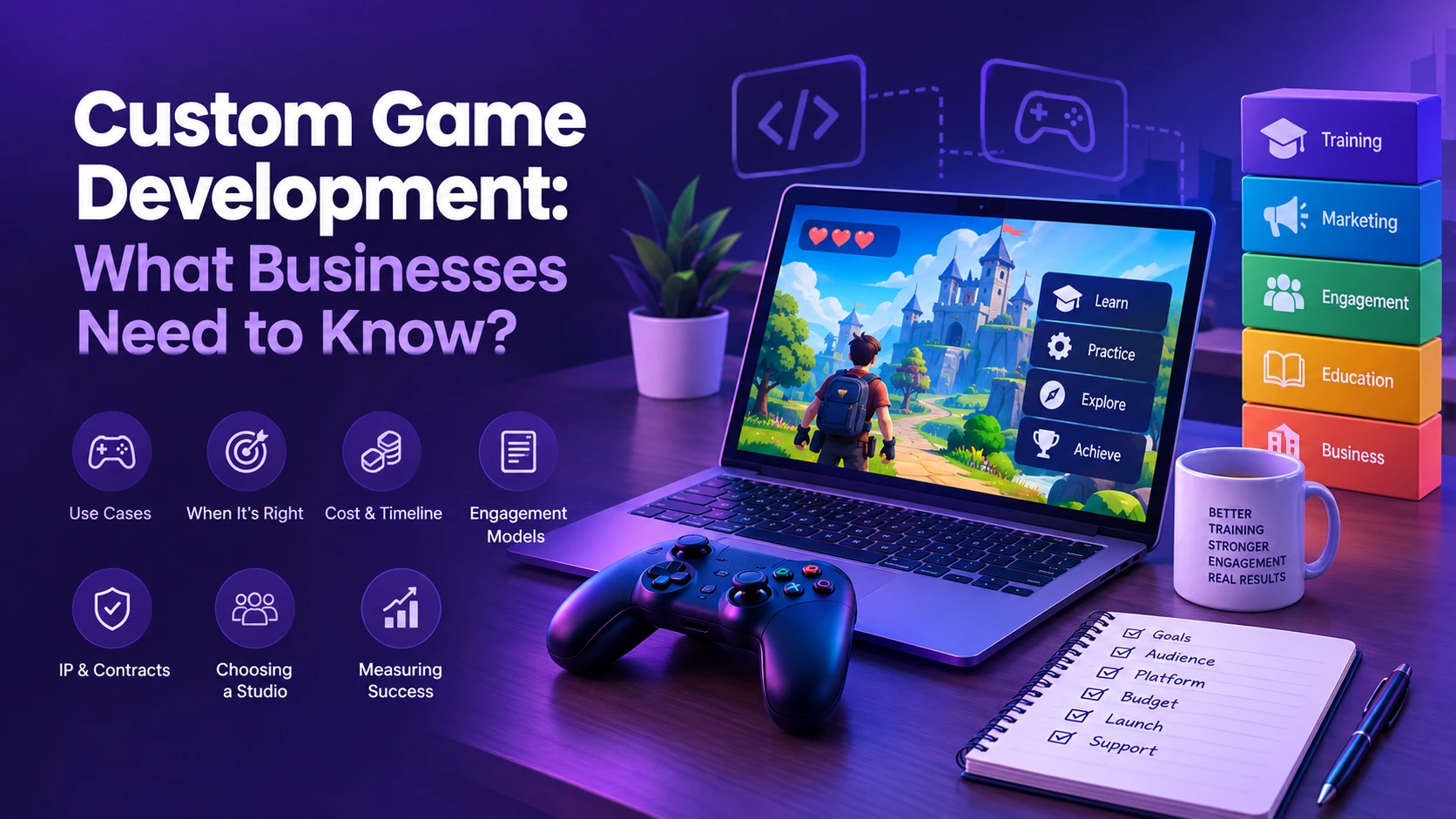
A training manager wants new hires to practice a safety procedure without risking a real one. A brand director wants a campaign people play for ten minutes instead of scrolling past in two seconds. A museum wants visitors to learn by doing. A software company wants onboarding that users finish. Each of them has a problem that a game could solve, and none of them is a game studio. That is the starting point for custom game development, and it is a very different purchase from buying a product off a shelf.
This guide is for the person holding the budget. It covers when a custom game is the right tool, which business uses work best, how engagement models and contracts differ, what drives cost, and what to ask a studio before signing. It is written from the buyer’s side of the table, because most of the expensive mistakes in this market happen before the first line of code.
Five Questions to Answer Before You Commission Anything
Game solutions are among the most expensive ways to deliver a message. They are also one of the few that people choose to spend time on. The first job is deciding if the investment fits the problem, and five questions settle it.
- What behavior should change, or what outcome should improve? A game with no measurable goal is a toy. State the target in plain terms: completion rates, knowledge retention, time on site, leads, retention, or revenue.
- Who plays, on what device, for how long? A warehouse team on shared tablets, a consumer on a phone during a commute, and a trade show visitor standing at a kiosk need three different designs.
- Does the interaction deserve to be a game? If a short video or a checklist would do the job, use one. Games earn their cost when the learner must practice, decide, or explore.
- What exists already? An off-the-shelf quiz platform, a gamification plugin, or a licensed template may cover the need at a fraction of the price. Custom work earns its place when the need is specific, the brand matters, or the mechanics must match a real process.
- What happens after launch? Hosting, updates, analytics, and support are part of the project. A game with no owner after release decays quickly.
If you can answer all five, you are ready to talk to studios. If you cannot, spend a week on them first. It is the cheapest week in the whole project.
When Custom Beats Off-the-Shelf?
Template and gamification platforms have improved, and for many needs they are the right answer. Points, badges, simple quizzes, and spin-to-win promotions are all well served by existing tools. Custom work makes sense in a narrower set of cases.
| Situation | Better Fit |
| Generic quiz, poll, or promotion with a short life | Off-the-shelf platform or template |
| Brand identity is central and must feel unmistakable | Custom |
| Mechanics must mirror a specific real-world process | Custom |
| Integration with internal systems, data, or learning platforms | Custom |
| One-off campaign with a tight deadline and modest budget | Template or lightly customized |
| Long-lived product that must evolve with the business | Custom |
| Needs to feel like a real game that people would play unprompted | Custom |
The decision is rarely binary. Many projects start with a template to validate the idea, then move to custom work once the concept proves itself. A good studio will say plainly when a template is enough, and that candor is a useful test of the partner.
What Can Actually Be Outsourced?
Game art outsourcing covers a wide range of disciplines: 2D and 3D character design, environment art, UI and UX design, concept art, marketing and key art, animation, and technical art like rigging and shader work. A studio can outsource a single asset category or run an entire art pipeline through an external partner, depending on internal capacity and budget.
Where Businesses Use Custom Games?
The list of applications keeps growing, though most fall into a handful of families.
Training and simulation. Games let employees practice in safe, repeatable scenarios: safety procedures, equipment operation, customer conversations, compliance decisions. The value is practice with feedback. Serious games, a term for games built primarily for something other than entertainment, have a long history. The U.S. Army released America’s Army in 2002 as a free game that doubled as a recruitment tool, a well-known early example of a game built to serve an organization’s goals.
Marketing and advergames. Branded games turn a campaign into something people choose to engage with. They work best when the mechanic fits the product and the experience stands on its own as fun. A game that exists only to deliver a logo gets ignored.
Customer engagement and loyalty. Games embedded in an app or a website can lift repeat visits and give customers a reason to return. Daily challenges, collectible rewards, and progression systems are the usual ingredients.
Education and public engagement. Museums, schools, and nonprofits use games to teach by doing. Games have even helped solve real scientific problems. In 2011, players of the online puzzle game Foldit helped researchers determine the structure of a retroviral protease, a result published in a peer-reviewed journal. That is an extreme case, but it shows what motivated players can do when a problem is turned into a game.
Onboarding and product education. Software and fintech companies use game mechanics to guide users through setup and key features, with progress and small rewards in place of manuals.
Events and exhibitions. Kiosk and large-screen games draw crowds, collect leads, and give booth visitors a reason to stay.
Entertainment products. Some businesses commission a game as the product itself, a title they intend to publish and monetize. This path overlaps with conventional commercial game production and carries the full range of market and marketing risks.
Three Levels of Custom
Custom game development is a spectrum, and vendors use the label loosely. Know where a proposal falls.
| Level | What You Get | Typical Use |
| Reskinned template | An existing mechanic with your branding | Quick campaigns, small budgets |
| Configured framework | A proven game framework adapted to your content and rules | Training games, quizzes, standard mechanics |
| Fully bespoke | New design, art, code, and audio built for your goals | Brand flagships, complex simulations, commercial titles |
Bespoke game development gives the most control and carries the highest cost and risk. A configured framework often lands in the middle: faster and cheaper than a ground-up build, and more tailored than a reskin. Ask each studio which level it is quoting, because a price comparison between a reskin and a bespoke build is meaningless.
The Process From Brief to Launch
A well-run project moves through recognizable phases. Ask any custom game development company to describe theirs, and compare the answers with the outline below.
Discovery. The studio learns your goals, audience, constraints, and success measures. Output: a brief or scope document. This phase is short and decisive.
Concept and design. Game mechanics, flow, tone, and art direction take shape. Output: a design document, mockups, and often a rough prototype. A game prototyping phase proves the idea is fun or effective before major spending begins.
Production. Art, code, audio, and content get built in milestones, with reviews you can see and play. Output: working builds delivered on a schedule.
Testing. Functional testing, usability testing with real players, and device testing. For anything with a defined audience, this includes testing with people from that audience. A game testing plan should be visible in the proposal, not an afterthought.
Launch. Deployment to stores, web hosting, or internal systems, plus analytics setup and training for whoever will run it.
Support. Bug fixes, content updates, and measurement against the goals set at the start.
For realistic durations, see our guide on how long it takes to develop a video game. A small branded game or training module often takes a few months, while a full commercial title takes far longer, and the scope you choose in discovery decides which side of that range you land on.
Engagement Models and Contracts
How you pay shapes how the project behaves. The three common structures each fit different situations.
| Model | How It Works | Best When | Watch Out For |
| Fixed price | Agreed scope for an agreed fee | Scope is clear and stable, such as a defined training game or campaign | Change requests are priced separately, and a vague scope produces disputes |
| Time and materials | You pay for effort, usually by the hour or day | Scope will evolve, or the project is exploratory | Needs trust, regular reporting, and a budget cap |
| Dedicated team | A group of specialists works exclusively on your product over months | Long-lived products or live-service games | Higher commitment, and management time on your side |
Many projects blend them: fixed price for discovery and design, then time and materials or a retainer for production and support. Whatever the structure, insist on milestone-based payments tied to playable deliverables. Paying in large lumps before anything works removes your leverage.
Intellectual property: decide before signing
IP ownership is the clause that causes the most pain later, so settle it in writing. Questions to resolve:
- Who owns the finished game, code, art, audio, and design, once you have paid? The common expectation for commissioned work is that the client owns the deliverables, but contracts vary, and the default is not always in your favor.
- Who owns the studio’s pre-existing tools and frameworks? Studios usually retain their own engine components and licensing, and grant you the right to use them within your game. Know what that license covers.
- What third-party assets and licenses are inside? Stock art, fonts, music, and plugins carry licenses. Ask for a list, and check that commercial use is allowed.
- Do you receive source code and project files? Without them, you cannot hire someone else to maintain the game. Make source delivery a contract term.
- Who can reuse what? If the studio wants to showcase the work or reuse mechanics, settle that explicitly.
- Confidentiality. Use a nondisclosure agreement from the first serious conversation, especially for training content that reflects internal processes.
Have your own legal counsel review the contract. This guide covers what to ask, and it is not legal advice.
What Drives the Cost?
Studios price custom projects by scope, and a handful of variables explain most of the spread.
| Cost Driver | Why It Matters |
| Platforms | Each added platform means more builds, testing, and store work |
| Art style and fidelity | Stylized 2D costs a fraction of high-fidelity 3D |
| Content volume | Number of levels, scenarios, characters, and screens |
| Mechanics complexity | Simple, proven mechanics against novel or system-heavy design |
| Multiplayer and online features | Backend, matchmaking, and security add major engineering |
| Integrations | Connecting to learning systems, CRMs, or analytics adds work |
| Audio, voice, and localization | Voice acting and multiple languages add production and testing |
| Timeline | Compressed schedules cost more, since work must run in parallel |
| Post-launch support | Updates, hosting, and live operations are recurring costs |
Be wary of any quote that arrives without questions. A responsible studio cannot price a game it does not understand, and it will ask about your audience, platforms, content, and goals before naming a figure. For technical choices that affect cost, such as engine selection, see our overview of Unity game development, where a mature engine often shortens the path to a result.
Choosing a Studio: What to Ask?
Game development services vary enormously in quality and focus. A short list of questions separates experienced partners from enthusiastic ones.
- Have you built something like this before? Ask for relevant examples, and play them. A strong art portfolio does not prove a studio can deliver a training simulation or a campaign game.
- Who will actually work on my project? Meet the producer, lead designer, and lead engineer. Ask if work is done in-house or subcontracted.
- How do you handle changes? Every project changes. Look for a defined change process, not a promise that nothing will.
- How will I see progress? Expect regular playable builds and demos, not status reports alone.
- How do you test? Ask about device coverage, usability testing, and bug tracking.
- What do I own at the end? Get a clear answer on source code, assets, and licenses.
- What does support look like after launch? Ask for a price and a scope, not a verbal assurance.
- Can I talk to past clients? References are the fastest reliable signal available.
- How do you measure success? A studio that cares about your goals will propose metrics, and one that only talks about graphics may be optimizing for the wrong thing.
Red flags
- A fixed quote delivered within a day, with no discovery.
- No playable builds until near the end.
- Reluctance to share source code or discuss IP plainly.
- A portfolio with no shipped, playable work.
- Pressure to sign quickly with large upfront payments.
- No mention of testing, analytics, or support.
Measuring the Result
Set the success measures before production, and build the tracking in. The right metrics follow the goal.
| Goal | Useful Measures |
| Training | Completion rate, assessment scores, time to competency, error rates in the real task |
| Marketing | Plays, session length, shares, leads captured, brand recall |
| Engagement and loyalty | Return visits, retention, redemption of rewards, revenue per user |
| Onboarding | Setup completion, time to first key action, support ticket volume |
| Commercial title | Downloads, retention, conversion, revenue, reviews |
Compare results against a baseline from before the game launched, and plan time to act on what the data says. A game is a living product, and the first version is rarely the best one.
Cobweb Games’ Approach to Custom Projects
Every engagement at Cobweb Games begins with a discovery conversation about the problem, the audience, and the measure of success, before any talk of mechanics or art. From there, we propose the lightest approach that meets the goal, which sometimes means a configured framework instead of a ground-up build. Businesses exploring game development services with us get a written scope, milestone-based delivery, playable builds throughout, and clear terms on ownership.
Our teams cover the full chain, from concept through art, engineering, and testing, including game UI/UX design so that non-gamers can play without instructions, and mobile game development for projects that live on phones. For businesses that want to explore newer approaches, our AI game development practice covers adaptive and generative features.
Common Mistakes Businesses Make?
Starting with mechanics instead of goals. A game built around a clever idea and no measurable outcome rarely survives its first review.
Buying on price alone. The cheapest quote usually leaves out testing, polish, or support, and the savings reappear as change orders.
Skipping the prototype. Discovering a weak concept after production is the most expensive way to learn.
Ignoring the audience. Designing for the people in the meeting instead of the people who will play.
Leaving IP terms vague. Ownership disputes surface when the relationship is least able to absorb them.
Underbudgeting after launch. Hosting, fixes, and updates are part of the cost of owning a game.
Treating launch as the finish. Measurement and iteration are where most of the value is created.
Frequently Asked Questions
What is custom game development?
It is the design and production of a game built to a specific client’s goals, audience, and brand, as opposed to buying an existing game or a generic template. The result can be a training simulation, a branded campaign game, an engagement feature inside an app, or a commercial title.
How much does a custom game cost?
It depends on scope: platforms, art style, content volume, mechanics, integrations, and timeline. A reskinned template costs a fraction of a fully bespoke build, so ask every studio what level it is quoting and what is excluded.
How long does it take to build a custom game?
A small branded game or training module often takes a few months, while a full commercial title takes a year or more. Discovery and prototyping early in the project give the most reliable estimate.
Who owns a custom game after it is built?
It depends on the contract. Clients commonly expect to own commissioned deliverables, though studios usually retain rights to their own underlying tools. Settle ownership, source code delivery, and third-party licenses in writing before work begins.
Should we use a template or build custom?
Use a template when the need is generic, the deadline is tight, or the budget is small. Choose custom when brand identity matters, the mechanics must match a real process, you need integrations, or the game must last and evolve.
What should a business look for in a custom game development company?
Relevant shipped work you can play, a transparent process with playable milestones, clear terms on IP and support, plain advice about scope, and references from past clients.
Outsourcing Done Right Looks Like a Second Studio, Not a Vendor
The studios that get the most out of game art outsourcing stop treating it as a transaction and start treating it as an extension of their own team. That means a real brief, a real feedback loop, and a partner chosen for fit rather than the lowest quote on the page. Cobweb Games works as exactly that kind of extension, running as an integrated art department for studios that need production capacity without the overhead of building one internally.
