
Ask ten developers how long a prototype takes, and you will hear ten answers, from “a weekend” to “about a year.” Everyone is correct, because they are describing different animals. One person built a toy to test a jump. Another built a playable demo for an investor deck. A third built a vertical slice for a publisher. All three called it a prototype, and all three had different calendars.
This guide untangles the confusion. It gives a realistic game prototyping timeline for each type of prototype, shows what stretches a schedule and what compresses it, walks through a sample four-week sprint, and ends with a way to estimate your own. Where numbers come from published sources, they are cited. Where they come from our own planning experience, they are labeled as planning ranges, because no industry body publishes a standard duration and anyone claiming one is guessing.
The Short Answer
Any reliable game prototyping timeline starts with the type of prototype.
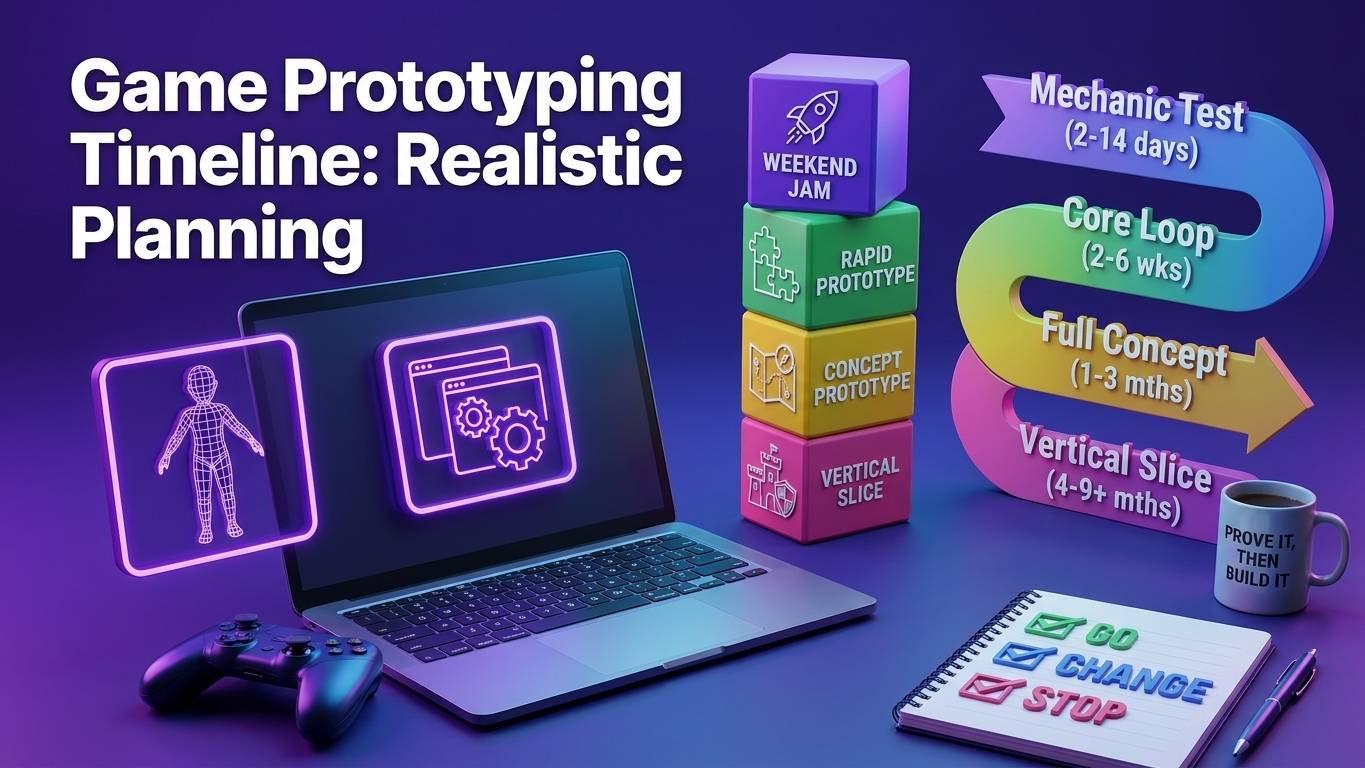
A focused prototype that tests one core mechanic usually takes days to a few weeks. A playable prototype of a full game concept usually takes one to three months. A vertical slice, which is a production-quality sample of the game, can take several months. The wide spread is the whole story: the type of prototype decides the duration far more than the size of the team does.
| Prototype Type | Question It Answers | Typical Planning Range |
| Mechanic test | Is this core action fun? | 2 days to 2 weeks |
| Rapid prototype of a core loop | Does the loop hold attention for several minutes? | 2 to 6 weeks |
| Concept prototype | Does the full idea hang together? | 1 to 3 months |
| Technical prototype | Can we build the hard part? | 2 to 8 weeks |
| Vertical slice | Can we produce the finished game at this quality? | Several months |
The ranges in the table are planning ranges from production experience, not industry standards. Treat them as a starting point and adjust for scope, team size, and how clearly the design is defined.
What Counts as a Prototype?
A prototype is a cheap experiment that answers a specific question about a game. It can look like a small version of the finished game, yet its job is to test one idea. The distinction matters because it controls the schedule. A prototype built to answer “is this fun?” needs no menus, no polish, and no save system. A prototype built to answer “will a publisher fund this?” needs all of those, and the calendar stretches to match.
One widely shared description puts it this way: prototypes are small, scrappy, disposable tests that answer the open questions in a game idea, built to be fast, cheap, and precise rather than good or reusable. The same source separates them from the vertical slice, which it calls a production prototype built at near-shipping quality, one functional segment of the game used to test the full pipeline. In its framing, a prototype tells you if you should make the game, while a vertical slice tells you if you can.
Keep that split in mind. Most arguments about timeline come from two people using the word “prototype” for two different things.
What Can Actually Be Outsourced?
Game art outsourcing covers a wide range of disciplines: 2D and 3D character design, environment art, UI and UX design, concept art, marketing and key art, animation, and technical art like rigging and shader work. A studio can outsource a single asset category or run an entire art pipeline through an external partner, depending on internal capacity and budget.
The Fastest Benchmark in Game Development: The Jam
If you want proof that a playable idea can appear quickly, look at game jams. Ludum Dare, one of the longest-running events, has a Compo format where a solo entrant creates a game entirely from scratch in 48 hours, and a Jam format where solo developers or teams get 72 hours, with an extra hour for packaging and submission, according to the event’s rules.
Jams show what is possible when scope is brutally small, one person owns every decision, and nothing else competes for attention. They do not show what a commercial prototype costs, because commercial teams also need design alignment, stakeholder review, and documentation. But the lesson transfers: a prototype that tests one idea can be playable in days. If yours is taking months, the scope has probably grown beyond a prototype.
Rapid Prototype: The Two-to-Six Week Core
A rapid prototype targets the core loop, the repeating cycle of actions a player performs most. In a match-three game, it is swap, match, cascade. In a survival shooter, it is move, aim, kill, upgrade. The goal is to find out if the loop holds attention for several minutes without any surrounding content.
A rapid prototype typically includes:
- A single playable level or arena
- Placeholder art, with shapes and free assets standing in for finished work
- Core controls tuned for feel
- One or two enemies or obstacles
- A basic win and lose state
- No monetization, save data, or onboarding
Because everything outside the loop is skipped, a small team can usually reach a playable build in two to six weeks. Speed comes from discipline about what to leave out. Our game prototyping service is built around this approach, with art, audio, and systems added only when a test needs them.
Concept Prototype: One to Three Months
A concept prototype stretches wider. It tests how the loop connects to a progression system, a meta layer, or a short narrative arc. A mobile game might add a simple economy and a few levels. A PC game might add a short campaign segment.
This is also where stakeholder needs arrive. A concept prototype often has to be presentable to investors, publishers, or internal leadership, which adds polish work: a coherent visual direction, readable UI, and enough content to carry a ten-to-twenty minute session. That work is legitimate, but it is not free, and it is the most common reason a one-month plan becomes a three-month plan.
Technical Prototype: Proving the Hard Part
Some games hinge on a technical bet: a large procedural world, a physics-heavy mechanic, networked multiplayer, a custom rendering style, or performance on low-end phones. A technical prototype isolates that risk and tests it with no concern for game design.
These typically take two to eight weeks, depending on the risk. A multiplayer test might need server infrastructure. A rendering test might need profiling across devices. The result is a go or no-go on feasibility, which is cheaper to learn in a prototype than in month eight of production. Our game development engineers often run a technical prototype in parallel with the design prototype, so both answers arrive together.
Vertical Slice: The Longest Prototype
The vertical slice sits at the far end of the scale. The same source that defines it says a vertical slice typically costs several months to create and can frequently cost over half a year of work. That figure comes from a single design-focused source rather than a measured industry study, but it matches common experience: building one section at near-final quality means building the art pipeline, animation pipeline, UI, audio, and build process for real.
A vertical slice is valuable because it exposes production problems early. Building one segment at shipping quality shows how long a finished level, character, or feature actually takes, and that number feeds every later estimate. Many studios count it as the end of pre-production rather than as a prototype at all. For the wider context on how pre-production fits the full schedule, see the section on the broader game development timeline below.
How Pre-Production Fits the Bigger Picture?
Prototyping lives inside pre-production, the planning phase before full production begins. RocketBrush Studio’s published development guide says pre-production can vary from a few weeks to over a year and typically takes about 20 percent of the entire development timeline. That is one studio’s estimate and varies by project, yet it gives a useful sense of proportion.
The implication is practical. If a game will take two years to build, spending several months on prototyping and planning is normal. Teams that skip it tend to pay for the skipped months later, in rewrites and design changes during production, when each change touches more assets and more people. This is the logic behind the broader game development timeline most studios follow, in which prototyping reduces risk before the budget grows.
How Genre and Platform Change the Calendar?
The same rapid prototype takes different amounts of time depending on what is being built. These planning ranges assume a small, experienced team.
| Game Type | Rapid Prototype Range | Why It Moves |
| Hyper-casual or arcade | 1 to 3 weeks | One mechanic, tiny content needs |
| Puzzle and match games | 2 to 4 weeks | Level design and tuning take iteration |
| Platformers and action games | 3 to 6 weeks | Controls and feel need many passes |
| Strategy and simulation | 4 to 8 weeks | Systems and balance must interact |
| RPG and open-ended games | 6 to 12 weeks | Many systems must exist before the loop appears |
| Multiplayer games | 6 to 12 weeks | Networking and test infrastructure |
| VR and AR games | 4 to 10 weeks | Hardware setup and comfort testing |
Platform adds its own wrinkles. A mobile prototype needs touch tuning and real device checks. A PC or console prototype needs controller support. A browser prototype needs load time discipline. If the final target is a phone, a prototype that only runs in the editor can hide the problems that matter most.
Team Size and Timeline
Adding people does not shorten a prototype in a straight line. A prototype is design-heavy and decision-heavy, so extra hands help only when the work can be split cleanly.
- Solo developer. Fast decisions, narrow skills. Good for mechanic tests, slow for anything needing art and audio.
- Two to three people (designer, programmer, artist). The sweet spot for most rapid prototypes. Communication stays easy, and every discipline is covered.
- Five or more people. Useful for concept prototypes and technical prototypes that run in parallel, but coordination time grows, and the extra people need clear tasks.
A useful rule is to staff the prototype with the smallest team that covers the skills the question requires. Larger teams belong to production.
Time Versus Budget
Time is one axis, but prototypes also cost money, and the two do not scale together neatly. A four-week prototype with three people costs roughly twelve person-weeks. A twelve-week prototype with one person costs the same in effort but delivers answers eight weeks later. Many studios prefer the shorter, denser version because early answers save more downstream money than a slow prototype does.
Our team prices prototypes as fixed time boxes with a defined question, so a client sees the cost and the stop point before work begins.
What Stretches a Game Prototyping Timeline?
Game prototype development time rarely overruns for mysterious reasons. Most overruns come from a short list of causes.
- Scope creep. A prototype for one mechanic quietly picks up a second mechanic, then a menu, then a tutorial.
- Unclear question. If nobody can state what the prototype must prove, nobody can say when it is done.
- Polish pressure. Stakeholders judge prototypes by how they look, so teams add art that the test does not need.
- Decision lag. Waiting days for design feedback adds up faster than any technical problem.
- Tool and pipeline setup. Choosing an engine, building a project structure, and setting up version control take time, especially for a team that has not worked together before.
- Technical surprises. A feature that looked simple turns out to need research.
- Team availability. A prototype staffed by people who are also working on other projects takes longer in calendar terms than the effort suggests.
What Compresses a Game Prototyping Timeline?
Game prototype development time shrinks when the team removes waiting, ambiguity, and polish.
The reverse list is just as useful.
- A written question. One sentence stating what the prototype answers keeps scope tight.
- An experienced engine team. Familiar tools remove setup time. Our Unity game development specialists reuse proven project templates, input systems, and debug tools.
- Placeholder everything. Gray boxes and free assets are fine for testing.
- Fixed time boxes. A two-week deadline forces choices that open-ended plans avoid.
- One decision maker. A single owner for design calls removes the waiting.
- Early playtests. Frequent feedback prevents building the wrong thing for weeks.
- Reusable components. Pre-built camera, input, and UI frameworks speed up the first week.
A Sample Four-Week Rapid Prototype Sprint
To make the numbers concrete, here is a plausible plan for a rapid prototype of a mobile action game. It is an illustration, not a guarantee.
| Week | Focus | Output |
| 1 | Define the question, set up the project, build player controls | Character moves and acts on a test level |
| 2 | Add core challenge, feedback, and tuning | A complete loop with win and lose |
| 3 | Add variation, a second challenge type, rough UI | Five-minute playable session |
| 4 | Playtest, fix, and decide | Findings report and go, change, or stop recommendation |
The fourth week matters most. A prototype with no decision at the end is just unfinished work, and no game prototyping timeline should end without one. The output should be a clear recommendation backed by what testers did, not what they said.
What a Prototype Cannot Tell You?
Prototypes answer design and feasibility questions. They cannot answer market questions, and confusing the two causes expensive mistakes.
Retention is a good example. GameAnalytics’ 2026 benchmark report, summarized by GameDev Reports for mobile games with at least 1,000 monthly active users, shows how steep real-world retention is: day-1 retention for the top 25 percent of games sits just above 30 percent, day-7 retention for the top quarter is around 6 to 7 percent, and median day-30 retention is under 1 percent. Those figures cover all genres combined and come from live games at scale. A prototype tested with twenty friendly players cannot reproduce them, and it should not try.
What a prototype can do is catch the problems that would make those numbers worse: a confusing first minute, a loop that gets repetitive after five minutes, a control scheme that frustrates. Real retention data comes later, from soft launches and live analytics.
When a Prototype Should Be Killed?
A good prototype timeline includes the option to stop. Supercell is the best-known example of a studio that treats cancellation as a feature. A 2016 GamesBeat profile reported that the company had published four games and killed 14 in development, and in February 2023 its CEO said the company had killed more than 30 games and launched five hits, according to Game World Observer’s tally. Smash Land, for instance, was shut down after nine months of work and an early beta release.
The takeaway for smaller studios is to skip the imitation of Supercell’s scale and keep the habit: treat a prototype as a cheap way to say no. Stopping a project at week four costs a month. Stopping it at month eighteen costs a company.
How to Estimate Your Own Prototype?
A game prototyping timeline built from guesses will slip, so build yours from tasks.
Work through five steps.
- Write the question. One sentence, such as “Does the swipe-and-merge loop stay fun for ten minutes?”
- List what must exist to answer it. Controls, one level, one enemy, a feedback system.
- Estimate each item in days. Use the team’s actual velocity, not the best day it ever had.
- Add buffer for decisions and playtests. Fifteen to twenty percent is a sensible starting point for a small team.
- Set a hard end date. The deadline matters more than the estimate.
Then compare the total against the table near the top. If your estimate lands far outside the range for your prototype type, either the scope has drifted, or the type is wrong.
Cobweb Games’ Approach to Prototyping
We build prototypes to answer specific questions, so each engagement begins with a written brief that names the question, the success criteria, and the stop conditions. Our game prototyping team builds in Unity or Unreal depending on the target platform, and our mobile game development specialists test on real devices from the first build, since a prototype that runs on a flagship phone alone can mislead. When a design is ready to leave the prototype stage, our game art and game animation teams plan the production pipeline around what the prototype taught us.
Common Mistakes in Prototype Planning
- Calling everything a prototype. A mechanic test, a pitch demo, and a vertical slice need separate plans and budgets.
- Skipping the written question. Without it, nobody knows when to stop.
- Polishing early. Art that testing does not need steals days.
- Testing only with teammates. People who know the design forgive its flaws.
- Treating the prototype as production code. Prototype code is built for speed, and carrying it into production without review leads to trouble.
- Never killing anything. A process that approves every prototype is not testing anything.
- Ignoring the decision step. A prototype without a go, change, or stop verdict has not finished its job.
Frequently Asked Questions
How long does it take to make a game prototype?
It depends on the type. A mechanic test can take days, a rapid prototype of a core loop usually takes two to six weeks, a concept prototype often takes one to three months, and a vertical slice can take several months. These are planning ranges, and scope drives them more than anything else.
What is a good game prototyping timeline for a small team?
A small team can often reach a playable rapid prototype in four to six weeks if the scope is limited to one core loop and the team uses placeholder art. Adding polish, content, or multiple systems extends the schedule.
What is the difference between a prototype and a vertical slice?
A prototype is a cheap test that answers a design or technical question, and it can be thrown away. A vertical slice is a segment of the game built at near-shipping quality to prove that the full production pipeline works. Vertical slices take considerably longer.
How much of game development time is pre-production?
RocketBrush Studio’s development guide says pre-production typically takes about 20 percent of the entire timeline and can range from a few weeks to over a year. Actual proportions vary by studio and project.
Can a game prototype be built in a weekend?
Yes, for a single mechanic. Game jams such as Ludum Dare ask participants to build complete small games in 48 or 72 hours. A weekend prototype will not answer the questions a commercial project needs, such as retention or production cost.
Should we reuse prototype code in the full game?
Sometimes, after review. Prototype code is written for speed, so it often lacks structure. Many teams keep the design learnings and rebuild the systems properly, while keeping assets and tools that proved solid.
What happens after the prototype is done?
The team makes a decision: proceed to pre-production and a vertical slice, revise the concept and test again, or stop. Moving forward involves scoping the full build, as covered in our guide to going from prototype to full game development.
