
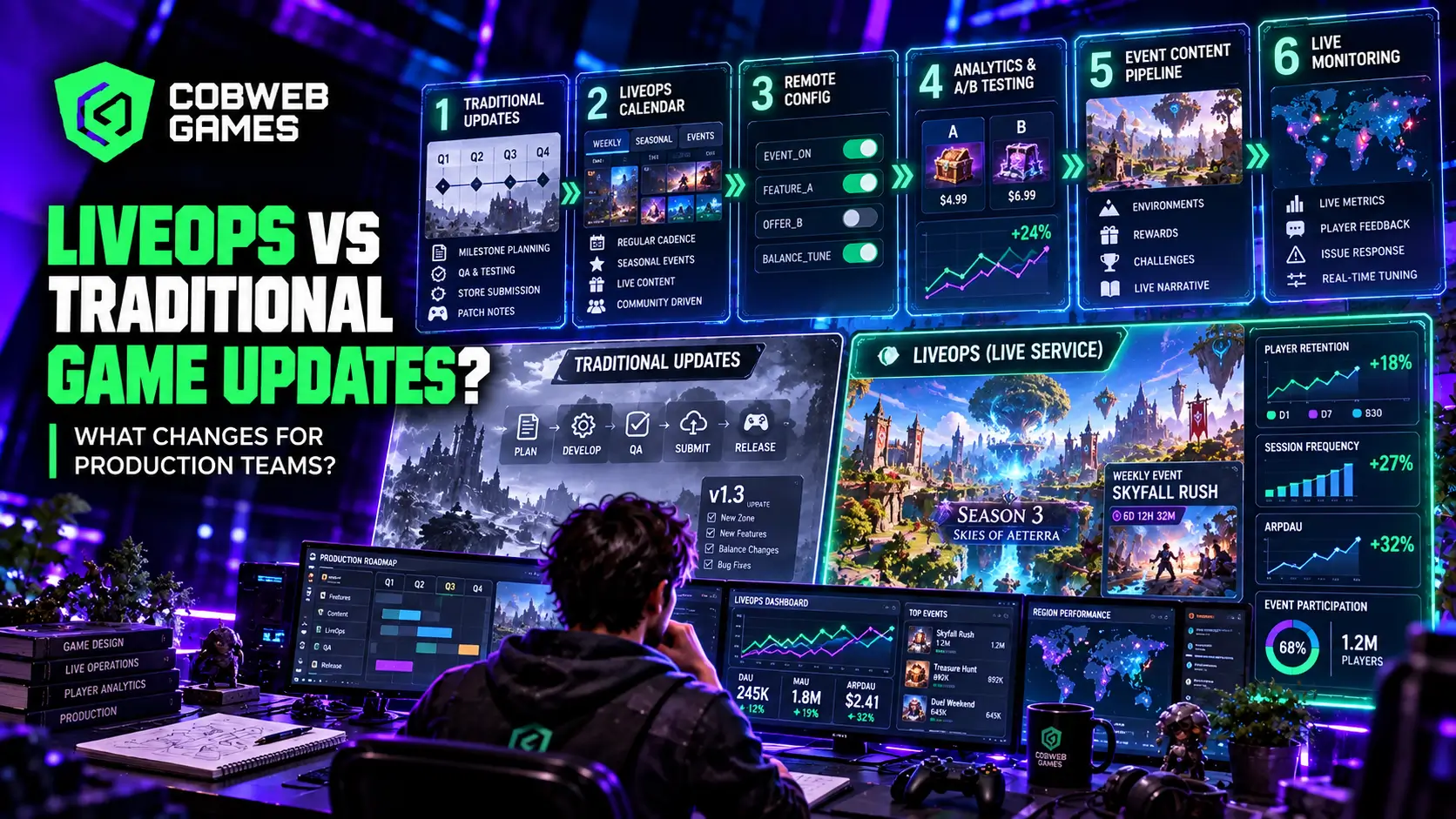
A traditional update ships, gets a patch note, and waits for the next milestone. LiveOps runs on a different clock entirely, one built around weekly events, live economy tuning, and player data that never stops arriving. Framed as LiveOps vs. game updates, the difference for a production team isn’t just cadence. It changes who owns decisions, how work gets scheduled, and what “done” even means for a build.
Studios that grew up shipping boxed releases or annual sequels often assume LiveOps is just faster patching. It isn’t. It’s a standing operational discipline that sits alongside development, sometimes for years past a game’s original launch date. Understanding where LiveOps vs. game updates actually diverge helps a team decide how much LiveOps infrastructure they need before committing to it.
Two Different Release Philosophies
Traditional game updates follow a milestone model. A build is scoped, developed, tested, and shipped as a discrete package. Between releases, the game is largely static. Players experience whatever was locked at the last certification pass, and the next meaningful change might be months away.
LiveOps treats the live game as a continuously evolving product. Content, balance, and monetization all shift on a rolling schedule, often weekly or even daily for high-engagement titles. The build itself becomes a platform for delivering configuration changes, seasonal content, and limited-time modes without a full client update every time.
| Dimension | Traditional Updates | LiveOps |
| Release cadence | Monthly, quarterly, or per-milestone | Weekly, sometimes daily |
| Primary driver | Fixed roadmap | Player behavior and telemetry |
| Team structure | Feature teams, then QA gate | Standing operations team plus feature support |
| Change type | Client builds, patches | Remote config, server-side toggles, content drops |
| Success metric | Bug count, feature completeness | Retention, session frequency, monetization curves |
Neither model is universally correct. A narrative single-player title has little use for weekly event cadence. A mobile title competing for daily attention usually can’t survive without it. The real question production leads should ask isn’t which model is better in the abstract, but which one matches how their specific players actually return to the game week over week.
Why Game Patching Alone Isn’t LiveOps?
It’s worth separating two things that get conflated constantly: game patching and full LiveOps operations. A patch fixes a crash, rebalances a weapon, or resolves a save-corruption bug. It’s reactive, tied to a specific defect, and generally treated as a cost center rather than a growth lever.
Post-launch updates in the LiveOps sense are proactive. They’re scheduled in advance, tied to a content or monetization goal, and measured against a target outcome rather than just “did the bug go away.” A studio can patch a game indefinitely without ever building the operational muscle that live service development actually requires. Plenty of games ship years of hotfixes without ever running a coordinated seasonal calendar, an economy tuning pass, or a scheduled event architecture. That’s fine for some titles. It’s a serious gap for anything trying to compete on daily engagement.
What Changes in Team Structure?
Moving toward LiveOps doesn’t just add a calendar of events. It restructures how a production team is built and staffed.
Dedicated operations roles emerge. A LiveOps producer or economy designer becomes a standing role, not a rotating assignment. Their job is reading dashboards daily and adjusting drop rates, event timing, or offer pricing based on what the data shows that week.
QA shifts from milestone gates to continuous verification. Traditional QA certifies a build once before release. LiveOps QA verifies smaller, more frequent changes, often server-side configuration rather than full client builds, which means test plans need to be lighter and faster to execute repeatedly.
Content pipelines need to scale down, not just up. A weekly event doesn’t need a AAA cinematic. It needs an art and animation pipeline that can turn around a themed skin, a new enemy variant, or a limited-time UI skin in days rather than months. Teams that outsource parts of production, using outside 3D character modeling or environment design support, often lean on those partners specifically for this faster-turnaround work rather than core systems.
Community and support become production stakeholders. Player sentiment during a live event directly informs if the next one gets adjusted, extended, or pulled early. That feedback loop has to be built into the production calendar, not bolted on after launch.
The Technical Backbone LiveOps Requires
None of the above works without infrastructure that traditional updates never needed.
- Remote configuration systems let teams change drop tables, pricing, or event parameters without submitting a new build to app stores, which matters enormously given review turnaround times.
- A/B testing frameworks run in production, not just in a test environment, since live player behavior is the only reliable signal for confirming a change actually improves retention.
- Analytics pipelines need to surface actionable dashboards daily, not quarterly reports. A team that can’t see yesterday’s event performance by this morning is flying blind on this week’s decisions.
- Content management tooling lets designers schedule and stage events without needing an engineer to push every change, which is the difference between a team that can run fifty events a year and one that can run four.
Studios building this from scratch for the first time often underestimate how much of the initial development budget needs to go toward this backbone rather than day-one content. Teams considering game development for a live-service title should scope this infrastructure work as its own milestone, separate from the launch feature set.
Where the Industry Is Actually Heading in 2026?
Live operations in 2026 are moving toward templatization: reusable event systems and economy frameworks applied across a studio’s portfolio rather than bespoke tooling built fresh for every title. This matters for smaller teams especially, since building a custom LiveOps stack from zero for a single game rarely pencils out financially.
Personalization is also shifting away from static player segments toward dynamic, behavior-reactive systems, where the event a player sees is shaped by their recent activity rather than a fixed cohort assignment. Analytics increasingly shape event design directly rather than just measuring it after the fact.
Event architecture has also matured past isolated one-off events into layered structures: long-running seasonal content supported by mid-term goals, reinforced by short daily check-in activities. This pyramid approach keeps players engaged across multiple time horizons at once rather than only during a single event window.
AI tools are increasingly used on the production side for ideation, data analysis, and workflow automation, letting smaller teams sustain content cadences that used to require much larger live-ops staffs. That said, player backlash toward visibly AI-generated assets or voice work remains a real risk, so studios are applying these tools mostly behind the scenes rather than in player-facing content.
Genre Shapes the Cadence
Casual and match-3 titles tend to run seasonal collectible albums and daily jackpot-style events, built around frequent short check-ins rather than deep session length. Midcore and RPG titles lean toward weekly PvP seasons and rotating challenge content that anchors the meta-game between larger content drops.
This distinction matters for a production team scoping their own LiveOps calendar. Copying a cadence built for a different genre without adjusting for how players in that genre actually engage is a common early mistake, and one that shows up quickly in retention data once an event underperforms.
Balancing Live Changes Without Breaking the Game
The riskiest part of LiveOps for a production team isn’t shipping fast. It’s shipping fast without destabilizing the systems players already trust. Successful live titles evolve existing systems gradually, adjusting drop rates or pricing incrementally, rather than reinventing core loops overnight. A sudden swing in economy balance reads to players as a bait-and-switch, even when the intent was simply optimization.
This is why experienced LiveOps teams treat every change as a hypothesis to test against a small player segment before rolling it out broadly, rather than pushing a change to the full player base and hoping the data comes back favorable. It’s a slower discipline than it looks from the outside, even though the release cadence itself is fast.
Budgeting for the Shift
Teams weighing an in-house LiveOps build against outside support should consider a few concrete factors:
- Volume of events needed per year. A handful of seasonal moments needs far less standing infrastructure than a weekly cadence.
- Existing telemetry maturity. If a studio doesn’t already have clean, actionable player data, that has to be solved before LiveOps can function at all.
- Content pipeline flexibility. Teams without a fast-turnaround art and animation pipeline will bottleneck on content long before they bottleneck on ideas.
- Staffing continuity. LiveOps doesn’t tolerate the feature-team model of assembling a crew, shipping, then disbanding. It needs people who stay with the game for its operational life.
Studios without the internal bandwidth to sustain this often bring in specialized mobile game development support specifically for the LiveOps layer, keeping their core team focused on the systems that define the game itself.
A Realistic Production Calendar Comparison
It helps to look at what a single month actually looks like under each model, side by side, for a mid-sized mobile title with roughly 50,000 daily active users.
| Week | Traditional Update Team | LiveOps Team |
| Week 1 | Sprint planning for next quarterly patch | Launch weekend event, monitor live dashboards daily |
| Week 2 | Feature development, internal builds only | Mid-event balance check, adjust drop rate via remote config |
| Week 3 | QA regression pass begins | Wind down event, prep next event’s assets |
| Week 4 | Certification and store submission | New event goes live, A/B test on offer pricing |
The traditional team produces one release at the end of the cycle. The LiveOps team produces continuous smaller releases throughout, each one informed by what happened in the previous week. Neither calendar is inherently more work. They’re differently shaped work, with different staffing and tooling needs behind them.
Common Pitfalls When Teams Blend the Two Models
Most studios don’t run a pure version of either model. They run a traditional feature roadmap for major content while layering in a lighter LiveOps calendar for events and economy tuning. This hybrid approach is common and often correct, but it creates a few recurring friction points worth planning around.
Engineering bandwidth gets split unpredictably. A live event that needs an unplanned hotfix competes for the same engineers scheduled against the next major feature milestone. Studios that don’t explicitly staff a small dedicated LiveOps engineering pool find their roadmap constantly slipping because of live-fire drills.
Content teams burn out on rapid-turnaround work. Producing a new skin or event asset every one to two weeks is a different rhythm than a six-month production cycle for a major feature. Art and animation teams built around long, deep production cycles often struggle to context-switch into short sprints without dedicated support, which is one reason studios increasingly separate their event content pipeline from their core feature content pipeline entirely, sometimes staffing each with a different mix of internal and outsourced talent.
Data ownership becomes contested. When a live event underperforms, is that a LiveOps failure or a core game design failure? Without clear ownership boundaries defined ahead of time, this question turns into finger-pointing during retros instead of productive iteration.
Player communication timing gets rushed. A traditional update has weeks of lead time for marketing and community messaging. A LiveOps change might go live within days of being decided. Community teams need a much faster internal notification process to keep player-facing messaging accurate and current.
Measuring Success Differently
Traditional updates are usually judged against a fairly narrow bar: did it ship on time, did it work as designed, and did the bug count stay low? LiveOps success looks different and needs its own dashboard.
- Day 1, day 7, and day 30 retention curves, tracked per cohort rather than as a single blended average.
- Event participation rate, meaning what percentage of active players actually engaged with a given event rather than ignoring it entirely.
- Average revenue per daily active user (ARPDAU), tracked before, during, and after each live event to isolate its actual monetization impact.
- Session frequency, since a well-run event should measurably increase how often players return that week, not just how long they stay once they’re in.
Teams that only track these numbers monthly are already too slow. Effective LiveOps teams review this data daily during an active event window, since the ability to adjust mid-event is the entire point of the operational model.
When to Bring In Outside Support?
Not every studio needs to build a full LiveOps department internally, and few can justify doing so from day one. A common and often smarter path is to bring in outside support for the specific pieces that are hardest to staff continuously: rapid-turnaround event art, animation for limited-time content, or overflow capacity during a particularly heavy event season.
This is different from outsourcing core game operations decisions, which almost always need to stay close to the team that understands the player base and the long-term economy design. What gets outsourced successfully tends to be execution capacity, not strategic ownership. A studio still decides what the next event should be and why. An outside partner helps that event actually ship on time without pulling engineers or artists off the next major feature milestone.
Studios running a hybrid model, part traditional roadmap and part live calendar, often find this the most sustainable long-term setup. It keeps the core creative and design decisions in-house while flexing production capacity up and down as the live calendar demands, rather than carrying a permanently oversized internal team built for peak event season year-round.
Frequently Asked Questions
Is LiveOps only relevant for mobile games?
No, though mobile titles adopted it earliest because of their reliance on daily engagement and in-app monetization. Live-service PC and console titles now run comparable operational calendars, just often with a slower weekly rather than daily rhythm.
Do traditional update cycles disappear once a game adopts LiveOps?
Not entirely. Most live titles still ship larger client updates periodically for new systems or content that can’t be delivered through remote configuration alone. LiveOps adds a faster layer on top of, not instead of, traditional builds.
How much of a production team needs to be dedicated to LiveOps specifically?
It varies widely by event cadence, but a functioning weekly LiveOps calendar typically needs at least one dedicated producer or economy designer, ongoing QA support, and a content pipeline that can turn around smaller assets quickly, separate from the team building the next major update.
Can a small studio realistically run LiveOps without a large team?
Yes, particularly with templated event systems and outside production support for content turnaround. The key constraint is usually pipeline speed and data visibility, not headcount alone.
What’s the biggest mistake teams make switching to LiveOps for the first time?
Underestimating the infrastructure work. Studios often plan content calendars before they’ve built remote configuration, analytics, or A/B testing systems, then discover they can’t actually execute the calendar they scheduled.
