
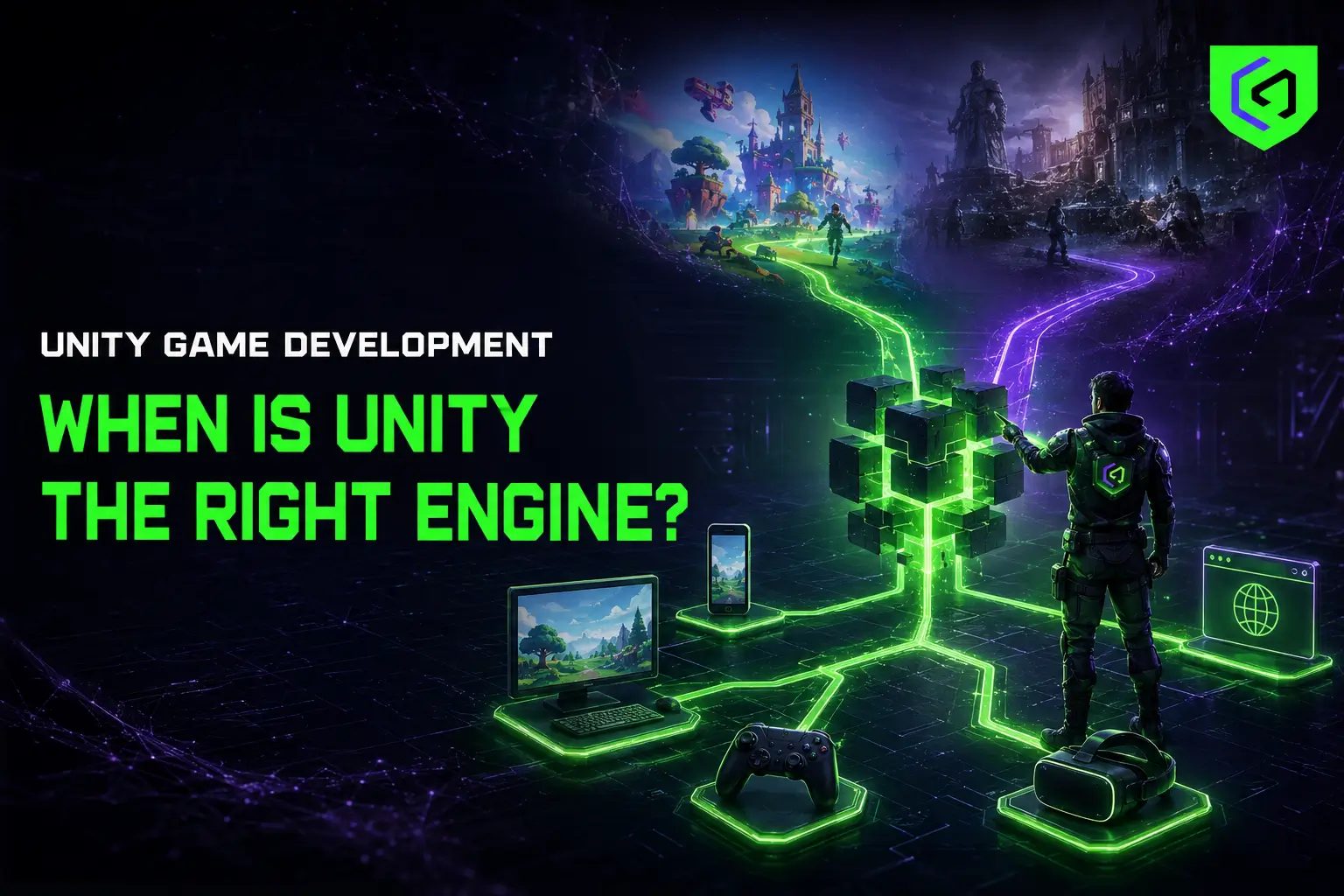
Every engine debate in game development eventually collapses into the same unhelpful advice: it depends. That answer is technically correct and completely useless without the specifics behind it, so this guide replaces the generic Unity vs Unreal Engine advice with an actual decision framework covering when Unity is genuinely the right call, when it is not, and what the current market data says about where each engine actually wins.
What Is Unity Game Development?
Unity game development is the process of building games using Unity, a cross-platform game engine known for its accessibility, fast iteration speed, and dominant position in mobile and indie production. It covers everything from a two-week hypercasual prototype to a full 3D console title, since the Unity game engine supports 2D, 3D, AR, VR, and mobile output from a single codebase.
The Unity game engine has held a specific market position for years now, and recent data confirms it rather than contradicts it. Unity still powers roughly 51 percent of new Steam releases and around 70 percent of the top-grossing mobile games according to recent industry tracking, which reflects exactly where its strengths concentrate: high release volume, mobile dominance, and a massive base of existing developers and assets to draw from.
When Is Unity the Right Engine for Your Project?
Unity earns its place fastest on mobile projects, and the data backs this up clearly. With roughly 70 percent of top-grossing mobile titles built on it, Unity development services benefit from an ecosystem specifically optimized for the constraints mobile actually demands: smaller build sizes, lower-end hardware support, and a mature App Store and Google Play submission pipeline that has been battle-tested across hundreds of thousands of shipped titles.
Cross-platform Unity development is the second major strength. A single Unity project can target iOS, Android, PC, console, and web from largely the same codebase, which matters enormously for studios that need to reach multiple platforms without maintaining separate builds for each one. Indie and small-to-mid studios also tend to gravitate toward Unity because of its shorter learning curve and faster iteration cycle, both of which matter more when a small team needs to prototype quickly and test whether a concept holds up before committing to months of full production.
AR and VR development is another area where Unity holds a clear practical edge. Its tooling for both categories is mature, well-documented, and supported by a large community that has already solved most of the common technical problems a new team will run into, which shortens development time considerably compared to building the same functionality from scratch in a less specialized environment.
When Should You Choose Unreal Engine Instead?
The engine landscape has shifted meaningfully over the past couple of years, and pretending otherwise would be doing readers a disservice. According to the 2026 State of the Game Industry survey from GDC, Unreal Engine has overtaken Unity as developers’ named primary engine, with 42 percent of surveyed developers naming Unreal against 30 percent for Unity, the first time Unreal has led that specific measure. On Steam specifically, Unreal-built games captured roughly 31 percent of 2024 revenue against Unity’s 26 percent, meaning Unreal ships fewer total titles but a disproportionately large share of the commercially successful, higher-budget ones.
That inversion points toward exactly the kind of project where Unreal Engine game development makes more sense than Unity. Console and PC titles chasing photorealistic fidelity benefit directly from Unreal’s Nanite and Lumen rendering systems, which handle extremely detailed geometry and dynamic lighting with far less manual optimization work than achieving comparable results in Unity would require. AAA studios building large, visually ambitious worlds increasingly default to Unreal for exactly this reason, and the survey data reflects that pattern clearly, with Unreal now the primary engine for 47 percent of AAA studios specifically.
Unity Games and Unreal Games: A Direct Comparison
Unity games tend to dominate in categories where iteration speed and platform reach matter more than raw visual fidelity: mobile titles, indie releases, VR experiences, and games that need to ship across many platforms without a large dedicated engineering team for each one. Unreal games tend to dominate in categories where visual ambition is the primary selling point: AAA console and PC titles, cinematic-heavy narrative games, and anything leaning hard on photorealistic environments or characters. Studios building live-service Unity games in particular benefit from the engine’s shorter iteration cycle, since frequent content updates depend on how quickly a team can test and ship changes.
Neither engine is objectively superior across the board, and framing the decision that way misses what the data actually shows. Unity still shipped 51 percent of new Steam releases against Unreal’s 28 percent as of the most recent tracking, which means Unity remains the volume leader by a wide margin even as Unreal gains ground on revenue and developer sentiment. The right read on this data is specialization, not a single winner: Unity spreads widest across mobile, XR, and indie development, while Unreal concentrates in high-end console, PC, and increasingly virtual production work for film and television.
Unity vs Unreal Engine: What the Numbers Actually Say
Framed as a straight Unity vs Unreal Engine comparison, the honest answer changes depending on which metric gets measured. By raw release volume, Unity wins decisively, since it still ships the most titles on Steam by a wide margin. By revenue per title and by developer sentiment in the most recent GDC survey, Unreal has pulled ahead, which tells a story about where the biggest budgets and the most ambitious projects are currently concentrating rather than which engine is more widely used overall.
That nuance matters because most Unity vs Unreal Engine comparisons online flatten it into a single winner, which is not how working studios actually experience the decision. A mobile studio evaluating this question is answering a completely different version of it than a console studio chasing photorealism, and the data supports different conclusions for each of them rather than one universal answer.
Why Cross-Platform Unity Development Is Such a Common Starting Point?
Cross-platform Unity development lets a single codebase target iOS, Android, PC, console, and web without maintaining separate builds for each destination, and that efficiency is a major reason so many studios default to it for a first title. Building the same reach through native development on each platform separately multiplies both cost and engineering headcount, while a well-structured project can hit most of those targets from shared code with platform-specific adjustments layered on top only where genuinely necessary.
This matters most for studios without the budget to staff separate teams per platform. A shared codebase still needs testing and optimization work on each individual target, but the core gameplay, UI, and systems code stays common across platforms, which is a meaningfully different cost structure than building native versions from scratch for every platform a studio wants to reach.
How Do You Actually Decide Between the Two?
Start with your target platform, since it eliminates a large portion of the decision immediately. A mobile-first project should default to Unity unless there is a specific, well-justified reason to fight that default, given how thoroughly Unity’s tooling and developer pool are optimized for that platform specifically. A console or high-end PC project chasing photorealistic visuals should seriously evaluate Unreal Engine game development from the outset, since fighting Unity’s rendering pipeline to achieve Unreal-level fidelity usually costs more engineering time than the switch would have.
Team experience matters just as much as platform target, and it is the factor most first-time studio founders underweight. Unity’s larger developer base, with roughly 18,000 studios working in it compared to Unreal’s 13,000 according to recent market tracking, makes hiring and outsourcing meaningfully easier for mobile and cross-platform work specifically. If your product is a mobile or XR application, you are hiring into Unity’s talent pool by default. If it is a cinematic, high-fidelity experience, Unreal’s talent pool runs deeper for that specific kind of work.
Budget and timeline round out the decision. Unity development services generally move faster for small-to-mid scope projects because of the shorter learning curve and larger library of pre-built assets and plugins available in the Unity Asset Store. Unreal projects often take longer to reach a comparable level of polish for smaller teams, but that additional time investment pays off directly in visual fidelity once a project reaches AAA scale.
Common Mistakes When Choosing a Game Engine
Choosing an engine based on hype rather than project fit is the single most expensive mistake a studio can make at this stage. Unreal’s visual showcase reels are genuinely impressive, but if a project’s genre and audience do not need that level of fidelity, the extra optimization overhead just slows the project down without any meaningful payoff for players.
Underestimating the hiring pool for a chosen engine is another recurring problem. A studio that commits to Unreal for a mobile project may find the available talent pool skews heavily toward console and cinematic work, making it harder to find developers who specifically understand mobile performance constraints inside that engine. Switching engines mid-production, meanwhile, is close to the most expensive mistake possible in game development, since it usually means rebuilding core systems from scratch rather than porting them cleanly, which is exactly why this decision deserves real evaluation before a single line of production code gets written.
How Cobweb Games Approaches the Unity Versus Unreal Decision?
Cobweb Games runs both engines as certified development partners rather than defaulting to whichever one a particular team happens to prefer. Our Unity game development work covers 2D, 3D, AR, VR, and mobile projects using the engine’s full feature set on each specific project rather than a repurposed template, while our Unreal Engine game development work is reserved for projects where Lumen, Nanite, or genuine console-grade fidelity justify the additional overhead that engine brings with it. As a Unity game development company that also runs a full Unreal pipeline, we are not incentivized to push a project toward whichever engine happens to be easier for us internally.
That dual capability matters most for studios that are not entirely sure yet which direction their project needs to go. Bringing in a game development company that works fluently in both engines means the technical recommendation during discovery is based on what the project actually needs, not on which engine happens to be the only one a particular vendor knows well. It also means a studio does not need to find a second partner if a project’s scope shifts significantly between prototype and full production, which happens more often than most founders expect going in.
Frequently Asked Questions
Is Unity or Unreal Engine better for mobile game development?
Unity is the stronger default for most mobile projects. It powers roughly 70 percent of top-grossing mobile titles, and its tooling, build sizes, and developer pool are all optimized specifically for the constraints mobile hardware and app stores impose.
Can Unity handle AAA-quality visuals, or is Unreal always required for that?
Unity can produce high-quality visuals, particularly with its more recent rendering pipeline improvements, but Unreal’s Nanite and Lumen systems still handle extremely detailed geometry and dynamic lighting with less manual optimization work. For projects where photorealistic fidelity is the primary selling point, Unreal Engine game development generally reaches that bar faster.
Is it expensive to switch from Unity to Unreal Engine mid-project?
Yes, significantly. Switching engines mid-production typically means rebuilding core gameplay systems, rigging, and technical architecture from scratch rather than porting them, since the two engines handle these systems in fundamentally different ways. This is exactly why engine selection deserves a real evaluation phase before development begins rather than a default choice made out of habit.
Does cross-platform Unity development actually save money compared to building separate native versions?
Generally, yes. A single Unity codebase targeting multiple platforms avoids the cost of maintaining separate teams and codebases for each platform individually, though some platform-specific optimization work is still required regardless of which engine a team chooses.
Is the Unity game engine still actively developed and improving, or has Unreal fully overtaken it?
The Unity game engine continues to receive regular updates, including meaningful rendering and performance improvements in recent releases. Unreal’s gains in developer sentiment and revenue share reflect a shift in where the biggest, most visually ambitious projects concentrate, not a decline in Unity’s own capability or its dominant position in mobile and cross-platform work.
Which engine has better long-term support and community resources?
Both have strong, active communities, though they skew toward different specialties. Unity’s community leans heavily toward mobile, indie, and cross-platform development, given its larger overall developer base, while Unreal’s community concentrates more around AAA, cinematic, and increasingly virtual production work for film and television.
