
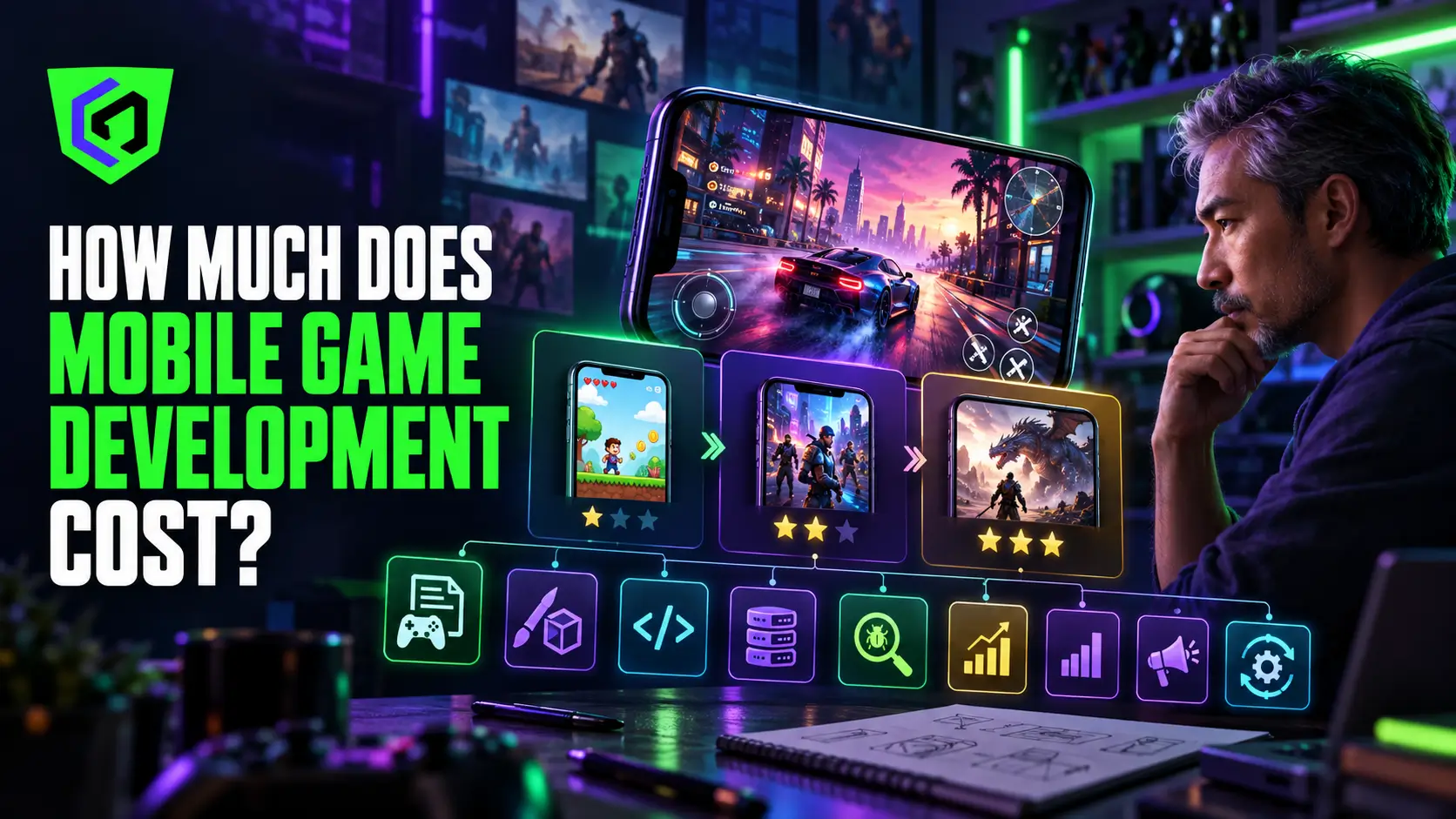
A weekend hackathon prototype and a live-service mobile title with a standing content calendar are both technically “a mobile game,” and quoting them with the same rule of thumb is how founders end up either wildly overpaying for a simple idea or wildly underestimating what a serious one actually requires.
Mobile game development cost genuinely spans from about four thousand dollars to well past a million, and the gap between those numbers is not marketing spin; it reflects real, measurable differences in scope, systems, and what happens after the app store listing goes live. Here is what actually moves that number, tier by tier, with current pricing rather than a vague range pulled from a five-year-old blog post.
The Real Range, Broken Down by Genre
Hypercasual titles, single-mechanic games built around one core loop and minimal art, sit at the floor of the market, typically running fifteen thousand to forty thousand dollars for a polished build ready for ad-based monetization. Casual and puzzle games, match-three titles, idle games, anything with a clean UI and modest meta-progression, generally land between thirty thousand and eighty thousand dollars, with the exact figure moving based on level count and art detail.
Midcore titles, RPGs, strategy games, anything introducing social features or real-time multiplayer, commonly run eighty thousand to three hundred thousand dollars, since backend infrastructure and balancing work add real cost on top of the base build. AAA-scale mobile titles chasing battle royale or open-world ambitions can run from three hundred thousand well past a million dollars, competing directly with console-quality production values on a phone screen.
What Actually Drives the Number Within Each Tier
Genre sets the floor, but several other factors decide where a specific project actually lands within that range. Art style is one of the biggest swing factors: flat, stylized 2D art costs meaningfully less than detailed hand-drawn sprite work, and both cost less than fully modeled, rigged, and animated 3D characters. A basic 2D character set might run a few thousand dollars, while a detailed animated 3D roster for the same game could run tens of thousands.
Platform target matters more than most first-time founders expect. Building natively for both iOS and Android roughly doubles certain categories of engineering and QA work compared to a single-platform build, while a well-executed cross-platform engine approach can capture most of that reach without duplicating the entire codebase. Team location adds another significant multiplier, since a fully staffed team in North America commands meaningfully higher rates than an equally capable team in South Asia or Eastern Europe, often by a factor of two to three times for comparable output.
Mobile Game Cost by Real, Documented Examples
Concrete examples make this far more useful than abstract ranges alone. A simple Flappy Bird-style hypercasual clone, built in Unity with basic ad mediation, has been documented running as low as five thousand to ten thousand dollars. Among Us, a casual multiplayer title, is reported to have cost roughly fifty thousand dollars for its initial version, built in Unity with networking handled through a lightweight third-party framework. Clash of Clans, by contrast, reportedly required over three hundred thousand dollars for its initial build, running on a custom engine with cloud infrastructure to match its systems complexity.
These examples matter because they show the range is not a marketing abstraction; it reflects wildly different underlying engineering and content scope hiding behind the deceptively simple phrase “make a mobile game.”
Where Game App Development Cost Actually Gets Spent
Core development, the client-side game logic and UI, typically represents the largest single line item, commonly ranging from fifteen thousand to well over one hundred thousand dollars depending on complexity. Backend and API work, required for anything with multiplayer sync, cloud saves, or live leaderboards, adds another five thousand to thirty thousand dollars on top, and this line item scales up sharply for any game with real-time competitive features.
Art and animation costs scale directly with visual ambition, as covered above, while QA and platform certification deserve their own honest budget line rather than getting folded into a general engineering estimate. A studio quoting a game app development cost estimate that never mentions QA separately is either bundling it invisibly into another category or planning to under-invest in it, and neither is a great sign. Any credible game app development cost breakdown should let you see QA as its own visible line, not a footnote buried inside engineering.
Regional Mobile Game Cost Differences Worth Understanding
Team location is worth its own dedicated look, since it is one of the largest single levers on final mobile game cost without necessarily changing the quality of what gets delivered. A team based in the United States or Canada commonly charges hourly rates in the range of one hundred fifty to two hundred eighty dollars, reflecting local salary and overhead norms rather than any inherent skill premium over teams elsewhere. Teams based in South Asia frequently operate in the twenty-five to sixty dollar hourly range while still delivering production-quality work, particularly strong for asset-heavy 2D and casual titles.
This gap does not mean cheaper is automatically comparable in every respect. Communication style, time zone overlap, and cultural alignment with your target market can matter as much as the hourly number itself, especially for titles with heavy narrative content or region-specific humor. The right regional choice balances raw mobile game cost against these softer factors rather than optimizing purely for the lowest rate on a spreadsheet.
The Hidden Costs That Blow Up a First-Time Founder’s Budget
Development cost is only the visible half of what it actually takes to run a mobile game. User acquisition and marketing spend in the first six months commonly runs one hundred to two hundred percent of the original development budget, meaning a fifty-thousand-dollar build might reasonably need another fifty to one hundred thousand dollars just to get in front of players. Average cost per install for casual games in 2026 sits around two dollars fifty to four dollars on iOS, somewhat lower on Android, and that spend adds up fast at any meaningful scale.
Post-launch maintenance adds a recurring cost most first-time budgets forget entirely, typically running fifteen to twenty percent of the original build cost annually to cover bug fixes, OS compatibility updates, and minor content additions. A worked example makes this concrete: a sixty-thousand-dollar build, two years of maintenance at roughly ten thousand five hundred dollars annually, fifteen thousand dollars in backend and hosting costs over that same period, and thirty thousand dollars in modest user acquisition spend adds up to a real two-year cash outlay well over one hundred twenty thousand dollars, more than double the original development number a founder might have budgeted around in isolation.
Reading a Mobile Game Pricing Quote Like Someone Who Has Seen a Few
Not all quotes claiming to represent the same scope actually do, and learning to read between the lines on a mobile game pricing document saves real money and frustration. A quote that lists a single lump sum with no breakdown by discipline, art, engineering, backend, QA, gives you almost nothing to compare against a competing bid, and should prompt a direct request for an itemized version before you take the number seriously.
Look specifically for how a quote handles ambiguity in your own brief. A studio that flags open questions and offers a range tied to specific unresolved decisions is being more honest than one that hands you a single confident number based on assumptions it never bothered to confirm with you first. That confidence can feel reassuring in the moment, right up until the actual build reveals which assumptions were wrong.
Financing and Payment Structures for a Mobile Game Development Budget
Most studios structure payment against milestones rather than requesting the full mobile game development budget upfront, and understanding common structures helps you negotiate from an informed position. A typical arrangement might split payment across pre-production sign-off, a mid-production milestone tied to a playable build, and final delivery, with each installment released only after the corresponding deliverable passes agreed acceptance criteria.
Founders working with limited runway should discuss phased development explicitly with potential partners, breaking a larger vision into a smaller, fully fundable first phase, a validated prototype or soft-launch build, before committing the full budget a complete vision would eventually require. This approach reduces risk on both sides and gives a founder real data to raise additional funding against, rather than betting an entire budget on an unproven concept in one uninterrupted push.
Monetization Model Changes the Cost Conversation Too
The revenue model a game is built around shapes engineering cost in ways founders sometimes overlook when budgeting purely around visible features. An ad-supported hypercasual title needs mediation integration across multiple ad networks and careful placement tuning, adding real engineering time even though the core game logic itself might be simple. A game built around in-app purchases needs a functioning virtual economy, storefront UI, and payment processing integration, each carrying its own testing burden beyond the core gameplay loop.
Hybrid monetization, blending ads and purchases, has become increasingly common and adds complexity on top of either model alone, since balancing two revenue streams without either cannibalizing the other requires careful design and ongoing tuning well past initial launch. Budgeting for monetization infrastructure as a distinct line item, rather than assuming it rides along for free inside the core build estimate, prevents an unpleasant surprise once real development begins.
Where a Mobile Game Development Budget Commonly Goes Wrong
Underestimating content volume is the most common planning mistake. A founder correctly estimates the cost of one level, one character, or one enemy type, then fails to multiply that unit cost accurately across the actual quantity the finished game needs, producing a budget that looks reasonable on a spreadsheet and falls apart once real production begins.
Skipping a prototype phase before committing to full production is a close second. Spending the majority of a budget building out full art and systems around an unvalidated core mechanic risks discovering, expensively, that the fundamental idea needed a different direction entirely, a lesson a five-thousand-dollar prototype phase would have delivered far more cheaply.
Ignoring post-launch costs entirely, as covered above, routinely blindsides founders who planned only as far as launch day. A mobile game development budget that stops at submission to the App Store is a budget planning to run out of money precisely when a successful game most needs continued investment to retain the players it worked so hard to acquire.
Frequently Asked Questions
What is the cheapest way to actually validate a mobile game idea?
A tightly scoped hypercasual prototype, one core mechanic, minimal art, basic ad integration, represents the lowest realistic entry point, typically landing between four thousand and fifteen thousand dollars depending on the studio and region. This approach prioritizes a fast, honest answer on whether the concept is worth further investment over producing anything polished.
Does building for both iOS and Android always double the cost?
Not necessarily, if the project uses a genuine cross-platform engine like Unity from the start, native, fully separate iOS and Android builds do add high cost, closer to double in many cases, but a well-architected cross-platform approach captures most of that reach from a largely shared codebase.
How accurate is a quote given before a full design document exists?
Treat early estimates without a complete design document as directional ranges rather than firm numbers, since real scope tends to firm up considerably during a proper discovery and pre-production phase. A studio offering a single precise figure this early is either working from an unusually detailed brief already or making assumptions that may not survive contact with real production.
