
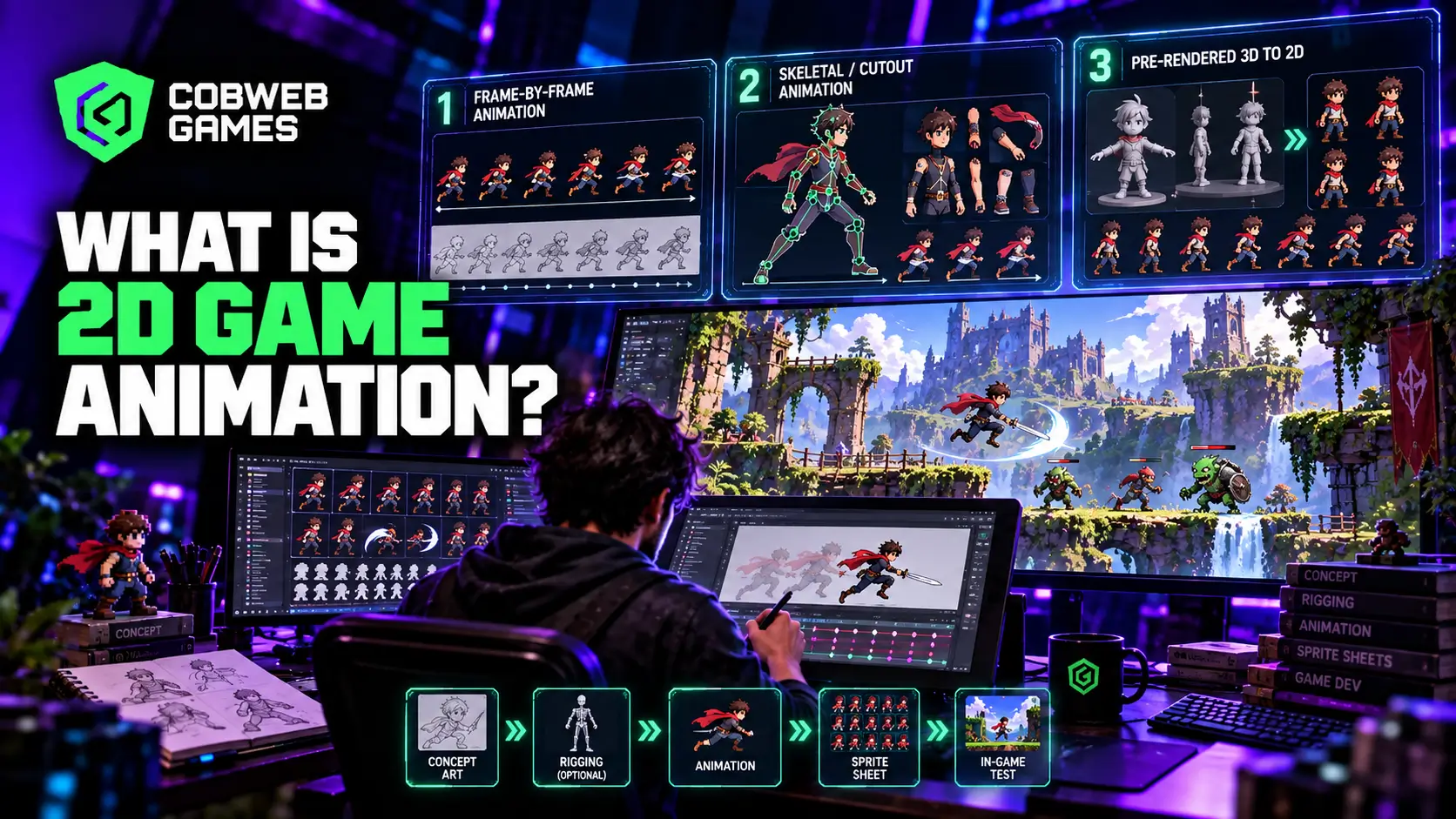
Before anyone argues about polygon counts or real-time ray tracing, games moved through sprites, and the genre never actually left. 2D game animation remains one of the most technically distinct and commercially thriving disciplines in the entire industry, powering everything from pixel-perfect platformers built by two-person teams to sprawling mobile titles with millions of daily players. It doesn’t get discussed with the same technical depth as its 3D counterpart, which is a mistake, because the technical decisions behind a convincing 2D animated character are genuinely as complex as anything in a modern 3D pipeline.
2D Game Animation, Defined
2D game animation is the process of creating movement for flat, two-dimensional characters, objects, and effects within a game, using techniques ranging from hand-drawn frame sequences to rigged digital puppets that never actually leave a flat plane. Unlike 3D animation, which manipulates a character in three-dimensional space before rendering a 2D image, 2D animation works directly with flat artwork throughout the process.
What distinguishes 2D game animation as its own discipline:
- Three genuinely distinct production techniques exist within the category, each with real, different tradeoffs a studio needs to choose between deliberately.
- Delivery almost universally happens through sprite sheets, packed collections of animation frames that enable efficient rendering.
- Style range runs from dense, hand-drawn pixel art to smooth, painterly cutout animation, and the right technique depends heavily on which visual direction a project actually commits to.
- Performance considerations differ meaningfully from 3D work, since 2D animation trades polygon and shader complexity for frame count and texture memory concerns instead.
The Three Core Techniques of Sprite Animation
Every 2D animated character in a shipping game is built using one of three fundamentally different techniques, and choosing the wrong one for a project’s actual visual style creates real production pain that is expensive to correct mid-development.
Frame-by-frame animation, sometimes called cel animation, draws a complete, distinct image for every single frame of movement. This technique is best suited to pixel art, hand-drawn character styles, and the kind of snappy, deliberately choppy combat feel certain genres depend on for their identity. It offers complete artistic control and reads cleanly even at low frame counts, but it demands high memory usage relative to its frame count and offers no runtime blending between frames, since each one is a fully separate, finished image. Games like *Celeste* and *Stardew Valley* rely on this approach specifically because their pixel art style depends on that crisp, frame-locked precision.
Skeletal, or cutout, animation treats a character as flat artwork pieces, individual limbs, a torso, a head, rigged to a digital bone structure and animated through keyframed bone movement rather than redrawn frame by frame. This technique stores bone positions and motion curves rather than hundreds of individual images, which keeps file size dramatically smaller, and it enables smooth cross-fading between different animation states in a way frame-by-frame simply cannot match. The tradeoff is real upfront rigging setup cost, and it works considerably better with painted, cutout-style art than with dense pixel art, since rotating and scaling pixel art parts breaks the pixel grid and produces visibly distorted results. *Return to Monkey Island* is a widely cited example of this technique done well.
Pre-rendered 3D-to-2D animation builds an actual 3D model, animates it using standard 3D techniques, then renders the output as flattened 2D sprite frames. This hybrid approach delivers remarkably smooth motion for a relatively modest number of stored frames, since the underlying 3D game animation data can be smoother than most artists could hand-draw frame by frame. The tradeoff is the heaviest production pipeline of the three techniques, since any character edit requires going back to the 3D model and re-rendering the entire animation sequence rather than adjusting a single frame or bone directly. *Dead Cells* is a well-known example of this approach in action.
| Technique | Storage Efficiency | Blending Capability | Best Fit |
| Frame-by-frame | Low, many full images stored | None, hard cuts between frames | Pixel art, hand-drawn styles, snappy combat |
| Skeletal (cutout) | High, stores bones and curves | Strong, smooth cross-fading | Painted or cutout art styles, live-service titles needing frequent variation |
| Pre-rendered 3D-to-2D | Moderate | Limited, baked at render time | Detailed characters needing smooth motion on a limited frame budget |
Sprite Sheet Delivery and Why It Actually Matters for Performance?
Regardless of which technique produces the actual animation, virtually every 2D animated asset in a shipping game gets delivered through a sprite sheet, a single packed image containing every frame of an animation sequence arranged in a grid or optimized layout. This is not simply a file organization convenience; it carries a real technical performance benefit.
Why sprite sheets matter beyond simple asset organization:
- Packing frames into a single sheet enables draw-call batching, letting the engine render many sprites using a single GPU call rather than one call per individual frame.
- Reduced draw call overhead translates directly into better performance, particularly meaningful on mobile hardware where GPU headroom is considerably more limited than on PC or console.
- Consistent sprite sheet layout and padding conventions prevent visual artifacts like bleeding between adjacent frames, a common and frustrating bug when sheets are packed carelessly.
- A well-organized sprite sheet pipeline scales more efficiently as a project’s animation library grows, compared to managing hundreds of loose individual image files.
Video Game Character Animation in 2D: Rigging Without a Skeleton in the 3D Sense
Video game character animation in 2D still requires a rigging discipline, even though the underlying structure looks nothing like a traditional 3D skeleton. For skeletal 2D animation specifically, a character gets broken into layered art pieces, then those pieces get connected to a bone hierarchy that drives their rotation, position, and layering order during animation.
What a strong 2D character rig needs to account for:
- Clean separation of art layers, since pieces that need to rotate or move independently, an upper arm versus a forearm, for instance, need to exist as genuinely separate art assets rather than one fused illustration.
- Pivot point placement that matches natural joint locations, since an incorrectly placed pivot produces visibly unnatural rotation during animation.
- Mesh deformation settings tuned carefully to avoid the visible stretching or pinching artifacts that occur when a joint rotates beyond what the underlying art can convincingly support.
- A layering and depth-sorting system that keeps overlapping body parts rendering in the correct order across every pose the rig needs to support.
This rigging discipline connects directly to the broader character design decisions made earlier in a project, since character artwork built without eventual rigging in mind, limbs drawn fused together, no consideration for how pieces will separate and move, routinely creates real friction once the animation team actually receives the finished art and discovers it needs meaningful rework before rigging can even begin.
2D Animation Services: What Actually Belongs in a Scope Document?
Studios seeking outside 2D animation services for a genuinely 2D video game animation project benefit from understanding these technical distinctions clearly before requesting a quote, since the three techniques carry meaningfully different costs, timelines, and revision workflows that a vague request cannot capture.
Questions worth clarifying before engaging any 2D animation partner:
- Which specific technique fits the project’s actual visual style, and does the partner have demonstrated, genre-appropriate experience in that specific technique rather than general 2D art experience alone?
- For skeletal work specifically, what rigging software and export pipeline do they use, and does it integrate cleanly with the target engine’s animation import system?
- How does their sprite sheet packing and delivery process work, and does it follow conventions the receiving engineering team can actually implement without additional cleanup?
- What does their revision process look like for animation specifically, since revising a rigged skeletal animation is typically far faster than revising frame-by-frame work, and pricing should reflect that real difference?
A 2d game animation partner who cannot speak to these distinctions specifically, or who quotes “2D animation” as a single undifferentiated line item without technique-specific detail, is signaling a level of generalism that frequently produces mismatched expectations once real production actually begins.
Sprite Animation Timing: The Detail That Separates Amateur Work From Professional Polish
Frame timing is where a lot of otherwise solid sprite animation quietly falls apart, and it deserves specific attention since the difference between competent and genuinely great 2D animation frequently comes down to timing choices rather than raw drawing or rigging skill.
What professional sprite animation timing actually accounts for:
- Uneven frame holds, holding a pose slightly longer at the peak of an action and moving faster through the middle, since real movement is rarely perfectly linear in speed.
- Anticipation frames before a major action, a slight crouch before a jump, a wind-up before a strike, that read almost subliminally but make an action feel intentional rather than abrupt.
- Follow-through and overlap on secondary elements, hair, clothing, accessories, that continue moving briefly after the main body stops, since everything stopping in perfect unison reads as stiff and mechanical.
- Consistent frame rate choices matched to the actual visual style, since a deliberately choppy, low-frame-rate pixel art style is an aesthetic decision, while inconsistent, uneven frame rates within skeletal or pre-rendered work usually just read as a technical mistake.
Studios producing this kind of work at real volume benefit from a documented timing standard the whole animation team works against, since inconsistent timing between different animators working on the same character or game creates a visible seam players notice even without being able to articulate exactly why one character’s movement feels different from another’s.
Choosing the Right Technique for a Project’s Actual Constraints
The decision between frame-by-frame, skeletal, and pre-rendered techniques should follow directly from a project’s art style, content volume, and update cadence, not from whichever technique a hired artist happens to already know best.
A practical framework for choosing:
- A project committed to dense, hand-drawn pixel art with a modest total animation count genuinely benefits from frame-by-frame’s complete creative control and crisp readability.
- A live-service or content-heavy project expecting frequent new character variations benefits enormously from skeletal animation’s reusability and smooth blending, since new poses and variations can be produced faster once the underlying rig exists.
- A project wanting smooth, detailed motion within a tight frame budget, and with the production resources to support a heavier pipeline, may find pre-rendered 3D-to-2D the right fit despite its higher upfront cost.
Committing to the wrong technique early, and discovering the mismatch only once a substantial content library already exists in that technique, is a genuinely expensive mistake to correct mid-project, which makes this decision worth real deliberation before any actual production animation work begins.
Common Mistakes in 2D Game Animation Production
Applying skeletal deformation to dense pixel art. Rotating and scaling pixel art parts breaks the underlying pixel grid and produces visibly distorted results, a mismatch between technique and art style that undermines the entire visual identity a pixel art project depends on.
Underestimating sprite sheet organization as a technical afterthought. Poorly packed sheets create bleeding artifacts and inefficient draw-call batching, both of which are considerably cheaper to prevent through good initial organization than to fix after the fact.
Building character art without rigging separation in mind. Fused, non-separated artwork forces a costly rework pass before skeletal rigging can even begin, undermining any time saved by skipping that consideration during the original art pass.
Choosing a technique based on artist familiarity rather than project fit. The technique that a given artist happens to know best is not automatically the right fit for a project’s actual visual style and content demands.
Where 2D Fits Alongside a Broader Production Pipeline?
A 2D video game art animation project rarely exists in complete isolation from the rest of a studio’s production pipeline, even on a title with an entirely 2D visual style. Character rigging decisions connect directly to earlier character design work, background and environment art needs to share a coherent visual language with animated characters moving through it, and UI elements frequently need their own lightweight animation treatment consistent with the rest of the game’s motion language.
Where 2D animation work typically intersects with other disciplines:
- Concept and character art established early needs to already account for eventual rigging separation if skeletal animation is the intended technique,
- Environment and background art benefits from matching the animated characters’ frame rate and motion style, since a smoothly animated character against a static, mismatched background can look visually disjointed.
- UI and menu animation, while a separate discipline from character animation proper, often shares tooling and visual sensibility with the broader 2D art direction.
- Sound design and animation timing need close coordination, since a footstep or impact sound landing even slightly off from its corresponding frame breaks the illusion considerably.
Treating 2D animation as one connected piece of a broader visual and technical pipeline, rather than an isolated task handed to a single animator working independently, consistently produces a more cohesive final product than treating each discipline as a separate silo.
How Cobweb Games Approaches 2D Game Animation?
Cobweb Games scopes 2D animation engagements around the specific technique a project’s visual style and content volume actually call for, rather than defaulting to a single generic 2D approach regardless of fit. That means evaluating frame-by-frame, skeletal, and pre-rendered techniques explicitly during discovery, alongside broader game art direction, so the chosen production method matches both the game’s visual ambitions and its realistic content pipeline needs.
Frequently Asked Questions
Is 2D game animation cheaper than 3D animation?
It depends heavily on technique and content volume rather than being universally cheaper or more expensive. Frame-by-frame work at high volume can rival or exceed 3D production costs, while skeletal 2D animation with a well-built rig can be considerably more efficient for ongoing content than either alternative.
Can frame-by-frame and skeletal animation be mixed within the same game?
Yes, and many titles do exactly this deliberately, using frame-by-frame for hero characters or signature moments needing maximum artistic control, and skeletal animation for background characters or content requiring frequent variation and faster iteration.
Why does pixel art specifically avoid skeletal animation?
Skeletal rigs rotate and scale flat art pieces to create movement, and this process breaks the crisp, aligned pixel grid that pixel art depends on for its visual identity, producing distorted, blurry-edged results. Pre-rendered 3D-to-2D or careful frame-by-frame work are the practical alternatives for this specific art style.
How much rework does switching 2D animation techniques mid-project actually require?
Considerably more than most teams expect. Switching from frame-by-frame to skeletal, for instance, typically means rebuilding character art with proper layer separation from scratch, not simply re-rigging existing assets, which is why choosing the right technique early matters so much.
