Players remember characters, not shader code. A studio can nail the lighting engine, the physics, the netcode, and still ship a forgettable game if nobody cared about the face on the box art. That emotional weight is exactly why game character design cost sits where it does in most production budgets, often the single largest per-asset line item in the entire art pipeline, and understanding what actually drives that number helps founders budget for characters that earn their place in a player’s memory rather than just filling a roster slot.
The Real Numbers: Character Design Cost by Style and Fidelity
Character production is only one part of the visual budget. Our guide to game art costs helps you place that investment within the broader scope of your game’s art production.
| Character Type | Style Tier | Typical Cost |
| 2D character (concept + final) | Minimal / flat-shaded | $100 – $400 |
| 2D character (concept + final) | Stylized / cartoon | $500 – $2,000 |
| 2D character (concept + final) | Detailed / semi-realistic | $1,000 – $3,000 |
| Full 2D character sheet (multiple poses/expressions) | Any style | $1,000 – $5,000 |
| 3D character, mobile-optimized (rigged) | Low-poly | $500 – $2,500 |
| 3D character, stylized (rigged) | Mid-poly | $2,500 – $6,000 |
| 3D character, realistic/AAA (rigged) | High-poly | $6,000 – $15,000+ |
| AAA hero character (full rig, textures, multiple outfit variants) | Highest fidelity | $15,000 – $30,000+ |
What Character Art Pricing Actually Buys: The Full Pipeline
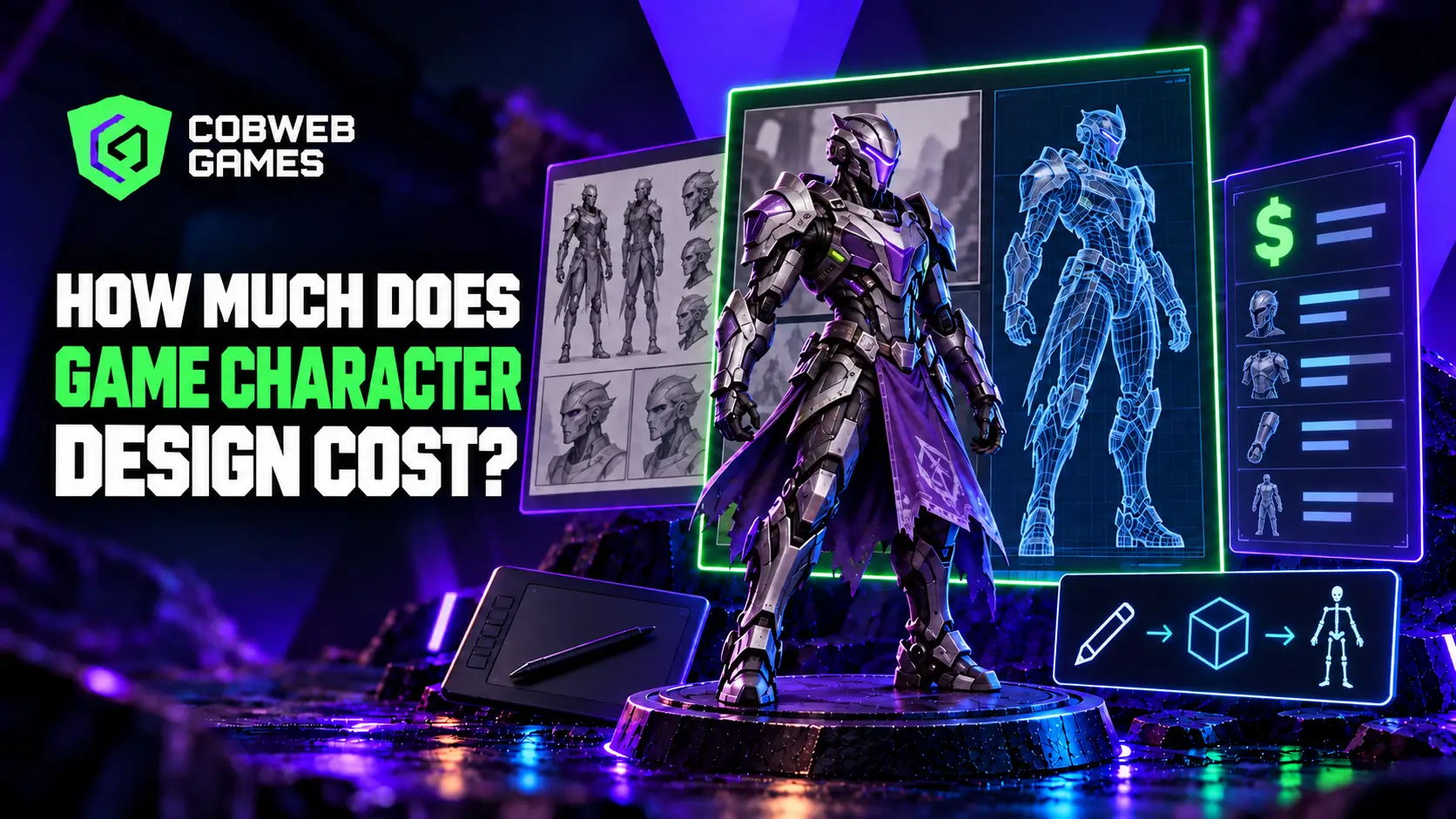
The standard character design pipeline:
- Concept and personality brief. A written brief covering role, personality, and world context gives the artist something specific to design toward.
- Silhouette and exploration sketches. Rough thumbnail exploration is far cheaper than building and rigging a character that turns out not to fit.
- Turnaround sheets. Front, side, and back views with proportion and material callouts give a modeler exactly what they need.
- Modeling or final illustration. Sculpting, hard-surface modeling, or final 2D production art.
- Texturing. Applying PBR material maps so the character responds correctly to in-game lighting.
- Rigging. A skeleton and control system, determining how much range an animator has later.
- QA and engine integration. Testing inside the actual build.
2D Versus 3D: Why the Pricing Gap Is So Wide?
Where the additional 3D cost actually goes:
- Topology quality: clean edge loops at joints and faces, saving considerable rework before rigging
- UV efficiency: poor layouts waste resolution and create visible seams
- Rig complexity: a full combat kit needs a considerably more sophisticated rig than idle-only animation
When comparing quotes for 3D character modeling services, confirm whether retopology, UV mapping, texturing, and preparation for rigging are included in the deliverable.
Concept Art Cost: The Cheapest, Highest-Leverage Stage
Why spending properly on concept art actually saves money overall:
- Iterating on a rough sketch costs a fraction of iterating on a finished, rigged 3D model
- A locked concept phase means modeling and rigging proceed with clear direction
- Multiple silhouette and color explorations catch design problems while they are still cheap to fix
Our 2D game art services cover concept exploration and character reference sheets that help establish a clear direction before production begins.
What Drives Character Art Pricing Within Each Tier?
- Number of variants and outfit states. Each variant needs its own texturing pass even when sharing a base model.
- Facial rigging and expression range. Characters carrying dialogue need facial rigs capable of a wide expression range.
- Reference complexity. A vague verbal description produces revision rounds a clear brief would have avoided.
- Licensing and exclusivity terms. Full, exclusive IP transfer typically costs more than a deal where the artist retains residual rights.
A Worked Example: Budgeting a Playable Character Roster
| Character Role | Style | Cost |
| Hero character (full rig, 2 outfit variants) | Stylized 3D | $6,000 |
| 3 companion characters (full rig, 1 outfit each) | Stylized 3D | $4,000 × 3 = $12,000 |
| 8 enemy variants (shared base rig) | Stylized 3D, lower detail | $2,000 × 8 = $16,000 |
| Concept art pass (all characters) | N/A | $2,500 |
| Total character design cost for this roster | $36,500 |
Regional Game Character Cost Differences
| Region | 2D Character Hourly Rate | 3D Character Hourly Rate |
| South and Southeast Asia | $15 – $40 | $30 – $50 |
| Eastern Europe | $25 – $50 | $30 – $60 |
| Western Europe | $40 – $75 | $50 – $100 |
| North America | $40 – $80 | $60 – $150 |
Why Character Art Pricing Rarely Matches a Simple Hourly Estimate?
Most professional studios quote character art pricing as a flat project fee bundling a defined number of revision rounds, rather than an open hourly clock. A flat quote protects both sides: the client gets budget certainty, and the studio is not penalized for the genuinely iterative nature of good character work.
How Game Character Cost Scales With a Growing Content Roadmap?
A framework for planning recurring character content spend:
- Estimate the character or variant volume for a typical content season
- Multiply against the relevant per-character rate from the pricing tiers above
- Check if new characters can share a base rig with existing ones
- Add a buffer for concept exploration and revision rounds, typically fifteen to twenty percent
For a roadmap that includes characters, environments, and props, scoping these assets together through game art outsourcing services can help clarify shared production requirements and delivery milestones.
Character Design Services: In-House Versus Outsourced
Cobweb Games’ game character design services support single-character projects for indie titles and ongoing character production for studios with expanding content roadmaps.
Why Player Perception Justifies the Investment
Before choosing a production partner, review our guide on how to choose a game art studio. Use it to assess pipeline compatibility, delivery standards, and review processes alongside the quoted price.
Players form emotional attachment to characters far more readily than to systems, mechanics, or technical achievements. Silhouette readability directly affects how easily players parse a scene, which means character quality measurably affects how the game plays, not just how it looks.
Frequently Asked Questions
Q: Why does a 3D hero character cost so much more than a supporting character in the same game?
Ans: Hero characters typically need more outfit variants, facial rigging for cinematic close-ups, and higher texture resolution, since players spend far more time looking closely at them.
Q: Is concept art cost included in a final character price, or billed separately?
Ans: This varies by studio, so confirm it explicitly before starting.
Q: Can I reuse a character rig to reduce cost for similar characters?
Ans: Yes, when characters share compatible proportions and movement requirements. Coordinate rig reuse with your game animation services provider early, since substantial changes to anatomy or the move set may require additional rigging work.
Q: How long does professional character design typically take?
Ans: A single stylized 3D character with a full rig typically takes two to four weeks. A realistic AAA hero character with multiple outfit variants can take six to ten weeks. Studios planning a launch roster should work backward from this timeline, since a dozen hero-tier characters cannot realistically be compressed into a final month without either cutting quality or blowing the budget on parallel overtime work.
