
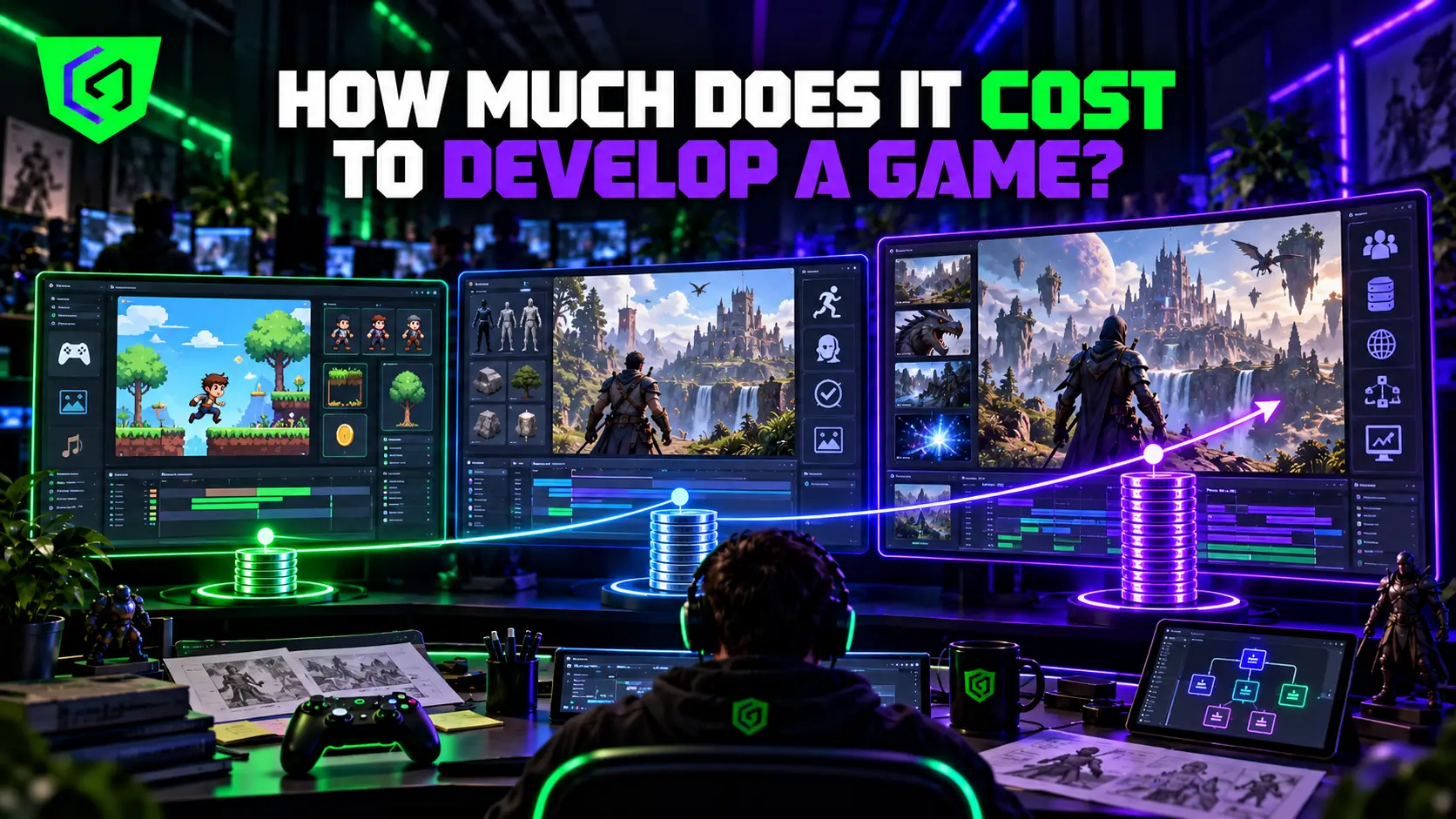
Two founders can pitch what sounds like the same game and walk away with quotes forty times apart, and neither of them is being scammed.
Game development cost spans an almost absurd range, from a five-thousand-dollar hypercasual prototype validated in a few weeks to AAA productions that court filings have placed north of four hundred million dollars. That spread exists because the phrase “make a game” hides an enormous amount of variation in scope, platform, and ambition. This guide breaks down what actually drives video game development cost at every tier, with real numbers from documented projects and current industry pricing, so the next conversation about budget starts from an informed baseline instead of a guess.
What Determines Game Development Cost More Than Anything Else?
Scope is the single biggest lever, and it dwarfs every other factor combined. A two-week hypercasual prototype with one core mechanic and placeholder art costs a fraction of a mid-core mobile title with custom characters design, an in-app purchase economy, and live-service content planned for years after launch, even though both technically fall under the same broad category of mobile game. Genre compounds this effect further: a simple match-three puzzle game and a systems-heavy simulation game both count as “a game” in casual conversation, yet a polished match-three title commonly runs between five hundred thousand and three million dollars while a deep simulation game in the vein of a major farming or life-sim franchise can run into the tens of millions once full AI systems, environments, and content depth are accounted for.
Platform target adds another significant multiplier on top of genre and scope. A mobile-only release generally costs less than the same concept built for console, since console certification requirements, additional QA passes, and platform-specific optimization work all add cost that a mobile-only build simply does not carry. Team location factors in heavily too, since a fully in-house team in a major North American or Western European market carries meaningfully higher salary costs than an equivalent outsourced team in Eastern Europe, Latin America, or parts of Asia, often by a factor of two to three times for comparable skill and experience levels.
Game Development Cost by Tier: Indie, AA, and AAA
The cost to make a game at the indie tier typically spans from around fifty thousand dollars for a small, focused solo or two-person project up to roughly seven hundred fifty thousand dollars for a larger indie team working over one to two years, according to recent documented industry ranges. A hypercasual prototype built purely to validate a core mechanic can come in as low as five thousand to twenty-five thousand dollars, since the entire point of that phase is minimal art and a fast answer on whether the concept is worth pursuing further, not a polished product. A simple 2D mobile or casual game generally lands between ten thousand and fifty thousand dollars, while a more ambitious 2D platformer or RPG with original art and audio commonly runs fifty thousand to one hundred fifty thousand dollars depending on content volume and polish level.
AA production budgets occupy a much larger tier, typically ranging from roughly one million to fifty million dollars depending on team size and production scope. A small AA project with around twenty people over three years might land in the six to twelve million dollar range, comparable to publicly disclosed budgets for titles like Hellblade: Senua’s Sacrifice, which reportedly came in under ten million dollars. A mid-sized AA production with forty to sixty people over a similar timeline typically runs eighteen to thirty-five million dollars, while larger AA teams pushing eighty to one hundred people can reach thirty-five to fifty million dollars or more before marketing spend is even added to the total.
AAA production costs start at roughly one hundred million dollars and climb well beyond that floor for the industry’s biggest releases. Sworn court declarations from a major publisher placed lifecycle budgets for recent Call of Duty titles between four hundred fifty million and seven hundred million dollars, and other documented or leaked figures put titles like Grand Theft Auto V’s total spend, development plus marketing, around two hundred sixty-five million dollars. Bloomberg’s industry reporting has described current AAA development budgets in the US and Canada as commonly floating around three hundred million dollars or more, driven primarily by salary and overhead costs across teams that can exceed a thousand people on the largest productions.
What Actually Makes Up a Game’s Development Budget?
Programming and engineering typically represent one of the largest single line items in any video game development cost structure, covering core gameplay systems, networking infrastructure for multiplayer titles, backend services, and the ongoing technical work required to keep a build stable through the entire production. Art and animation usually rank as the second major cost center, and this category scales dramatically with visual ambition: 2D sprite work costs meaningfully less than fully rigged, textured, and animated 3D characters design, and the gap widens further once environmental art, VFX, and cinematic content enter the picture.
Sound design, music, and voice acting round out the core production costs, and their weight in the total budget varies enormously by genre, with narrative-heavy titles investing far more here than a mechanics-focused puzzle game would need to. Quality assurance and testing deserve their own line item rather than getting absorbed into a general engineering estimate, since thorough QA across device matrices, platform certification, and regression testing represents real, dedicated cost that scales with how many platforms and configurations a game needs to support at launch. Marketing frequently gets underestimated or left out of an initial budget entirely, despite the fact that industry reporting consistently shows marketing spend can match or even exceed the development budget itself on commercially ambitious titles, particularly at the AAA tier where a single global launch campaign can run into tens of millions of dollars on its own.
How Game Development Pricing Models Actually Work?
Studios typically quote projects under one of three pricing models, and understanding the tradeoffs between them matters as much as the raw dollar figure attached to any single quote. Fixed-price arrangements lock in a total cost against a detailed, locked scope document, giving a client budget certainty but requiring genuine upfront clarity about exactly what the finished game needs to include before work begins. Time-and-materials pricing bills for actual hours worked, offering more flexibility to adjust scope as a project evolves but carrying more open-ended cost exposure if a production runs longer than initially estimated.
Dedicated team pricing, common for longer engagements, functions more like an extended staffing arrangement, with a client paying a recurring rate for an embedded team over a set period regardless of exactly how many features ship in any given sprint. Each game development pricing model suits different project types: a well-defined mobile game with a clear scope benefits from fixed-price certainty, while an evolving live-service title with an uncertain long-term roadmap often fits a dedicated team or time-and-materials structure better, since the actual work will keep shifting well past any initial estimate.
Real Cost Examples by Game Type
A simple 2D mobile puzzle or casual game with basic mechanics and minimal art commonly costs between ten thousand and fifty thousand dollars, with a team of one to three people delivering it over four to eight months. A mid-core mobile game development with custom character designs, an in-app purchase economy, and more involved systems typically runs eighty thousand to three hundred thousand dollars or more, reflecting the additional art, backend infrastructure, and balancing work that a monetized live title demands compared to a simple premium download.
A polished indie 3D title for PC or console generally falls between one hundred fifty thousand and one million dollars depending on scope, team size, and how many platforms it targets at launch. A match-three style game with the polish and content depth of a major mobile hit commonly costs five hundred thousand to three million dollars once hundreds of hand-tuned levels, backend infrastructure, and live operations support are factored into the total. A deep simulation title in the style of a major life-sim or farming franchise sits at the far end of the spectrum among non-AAA titles, with 3D environment designs, detailed character systems, and AI behavior alone commonly consuming ten to fifty million dollars of a total budget that can run considerably higher once every system is accounted for.
Post-Launch Costs Most Founders Forget to Budget For
Development cost does not end at launch, and treating it as though it does is one of the more common budgeting mistakes first-time founders make. Live operations and ongoing content typically consume twenty to thirty percent of the original development budget annually for a title with any kind of live-service ambition, covering new content, seasonal events, and the balance tuning that keeps an audience engaged well past launch week. Server and infrastructure costs add a separate ongoing line item for any game with online features, multiplayer functionality, or cloud save support, and this cost scales directly with player count rather than staying fixed regardless of how successful a title becomes.
Platform recertification, required whenever a significant content update or engine version change necessitates resubmission to console or major storefront review processes, adds periodic cost throughout a game’s live lifespan rather than being a one-time expense paid only at initial launch. Founders planning a budget that stops at launch day are effectively planning to run out of money exactly when a successful game most needs continued investment to retain the audience it worked so hard to acquire in the first place.
How to Get an Accurate Cost to Make a Game Estimate?
Start with a genuinely complete brief rather than a vague concept pitch, since the quality of a cost estimate depends entirely on how much real detail a studio has to scope against. A complete brief covers target platform, core gameplay loop, reference titles that capture the intended scope and visual quality, estimated content volume, and any specific technical requirements like multiplayer, live operations, or platform certification needs. Vague briefs produce vague estimates, and a studio quoting a project without this information is essentially guessing at scope on your behalf, which tends to produce numbers that shift significantly once real production begins.
Get multiple quotes from studios with genuinely comparable portfolio work rather than comparing a AAA studio’s estimate against an indie shop’s rate card, since neither number reflects an apples-to-apples comparison of what your specific project would actually cost. Ask every studio how they handle scope changes during production, since a suspiciously low initial quote sometimes reflects an assumption that any additional requirement discovered mid-production will simply become a costly change order later, effectively deferring the real price of the project rather than avoiding it. Cobweb Games’ game development discovery process builds a detailed scope document before quoting a number specifically to avoid this kind of budget surprise, treating an accurate estimate as the product of a real discovery conversation rather than a number pulled from a generic rate card.
Common Mistakes That Blow Up a Game Budget
Underestimating content volume is one of the most frequent and costly mistakes in early production planning. A founder might accurately estimate the cost of a single enemy type, a single level, or a single character, then simply fail to multiply that unit cost correctly across the actual quantity the finished game needs, producing a budget that looks reasonable on paper but falls apart once real production scope becomes clear. Choosing platform and scope before validating the core concept is a similarly expensive error, since committing to full 3D console production before confirming a mechanic is actually fun risks spending the majority of a budget on a game that a cheap prototype phase would have revealed needed a fundamentally different direction.
Ignoring post-launch costs entirely, as covered above, routinely catches founders off guard specifically because initial planning conversations tend to focus exclusively on reaching launch day rather than sustaining a title afterward. Choosing a development partner purely on the lowest quoted number, without examining what that number actually includes or excludes, frequently produces a final total considerably higher than the original estimate once every necessary piece of scope gets added back in through change orders during active production.
Frequently Asked Questions
What is the cheapest way to actually make a game?
A hypercasual prototype built to test a single core mechanic, using placeholder art and minimal systems, represents the lowest realistic cost to make a game, typically landing between five thousand and twenty-five thousand dollars. This approach prioritizes answering whether a concept is worth pursuing further over producing anything resembling a finished, polished product.
Does hiring an outsourcing partner actually reduce video game development cost compared to an in-house team?
Generally yes, often by thirty to sixty percent depending on region and team structure, since outsourcing eliminates the fixed overhead of full-time salaries, benefits, and equipment that an in-house team carries regardless of actual workload in a given month. The savings are most significant for project-based work rather than for studios with a long-term, continuous production pipeline that might eventually justify permanent in-house hires instead.
How accurate are early game development pricing estimates before a full design document exists?
Early estimates without a complete design document should be treated as rough ranges rather than firm numbers, since scope tends to firm up considerably during pre-production. A studio providing a single precise figure before design work is complete is either working from a very detailed brief already or making assumptions that may not hold once real production scope becomes clear.
What percentage of a total game budget typically goes to marketing?
This varies enormously by tier and ambition, but marketing spend for commercially ambitious titles frequently matches or exceeds the development budget itself, particularly at the AAA level where global launch campaigns can run into tens of millions of dollars. Smaller indie and mobile titles often budget a smaller marketing percentage but still need to account for user acquisition costs, especially for free-to-play titles relying on paid installs to build an initial audience.
Is it possible to get a fixed-price quote for game development, or does cost always fluctuate during production?
Fixed-price quotes are possible and common for well-scoped projects with a detailed, locked design document, but any significant scope change during production, adding a feature, extending content volume, changing platform targets, typically triggers a change order that adjusts the original price. Studios should expect some degree of cost flexibility built into contracts specifically to handle the reality that game design often evolves during active development.
How much of a total game budget should go toward QA and testing specifically?
This varies by project complexity and platform count, but thorough QA typically represents a meaningful percentage of total development cost rather than a minor afterthought, particularly for titles targeting multiple platforms with different certification requirements. Underinvesting in this category is one of the more common ways a launched game accumulates the kind of negative reviews that are far more expensive to recover from than the QA budget would have cost to spend properly upfront.
