
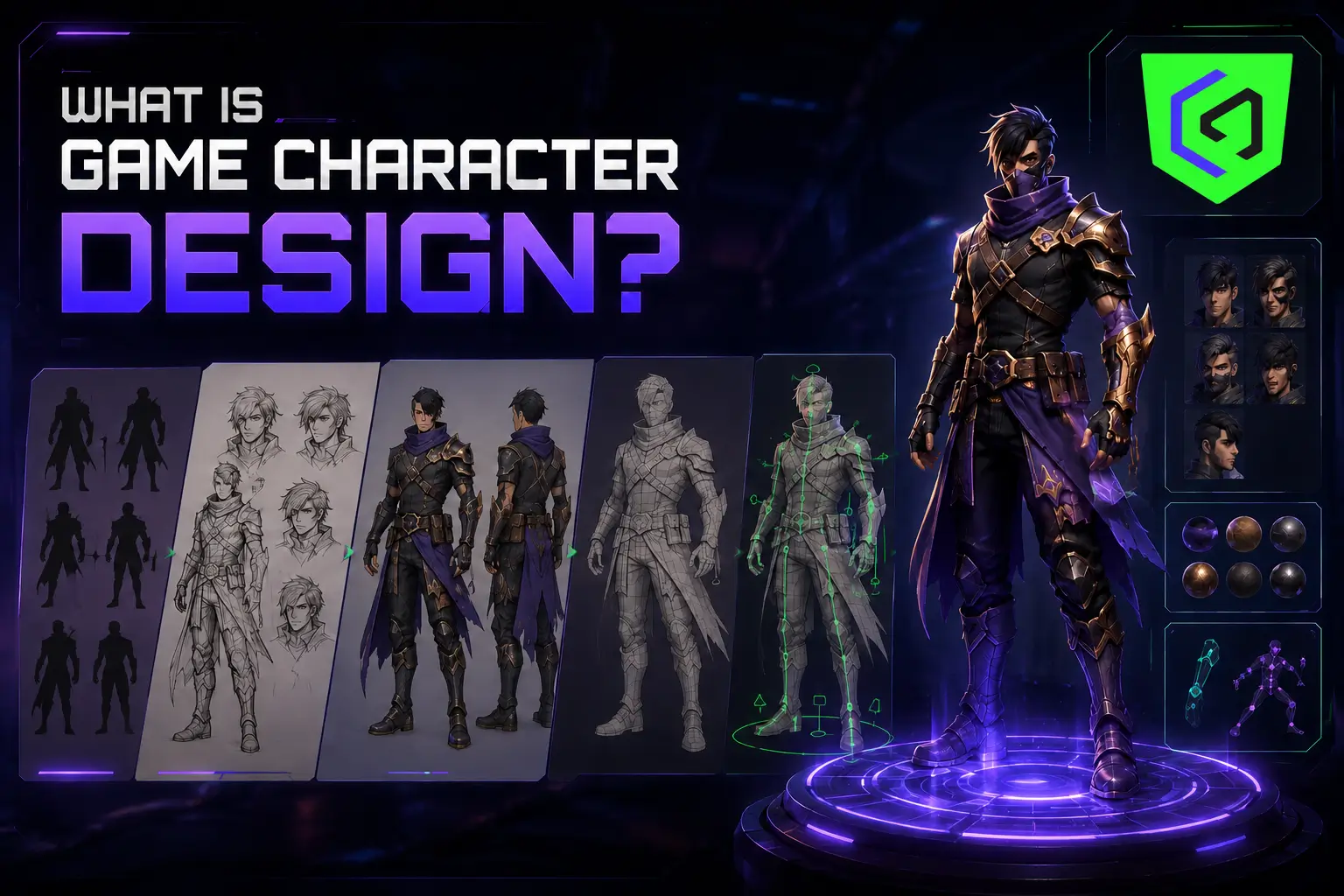
Players remember characters, not code. Nobody replays a game because the collision detection was elegant. They come back because a character felt real enough to root for, hate, or grieve. Game character design is the discipline responsible for that, and it is a lot more technical than the phrase “draw a cool character” makes it sound. A silhouette that reads at a glance, a rig that survives combat animation without breaking, a personality that comes through before a single line of dialogue plays. All of that lives inside character design, and getting it wrong is one of the fastest ways to make an otherwise good game forgettable.
What Is Game Character Design, Exactly?
Game character design is the process of creating a character’s visual identity, personality, and technical structure for use inside a playable game, covering everything from early concept sketches through final rigged, animation-ready models. It sits at the intersection of art and engineering: a character has to look right, communicate personality instantly, and also survive the technical demands of rigging, animation, and real-time rendering without falling apart.
Video game character design differs from character design for film or illustration in one critical way: the character has to work from every camera angle, at every distance, under real-time lighting, and while being deformed by an animation rig hundreds of times over the course of a playthrough. A character that looks perfect in a single concept art piece can fail once it needs to run, jump, and emote convincingly inside an actual game engine.
Why Does Character Design Matter So Much?
A character is often the single biggest driver of a game’s marketing, merchandise potential, and long-term brand recognition. Players form emotional attachment to characters far more readily than to systems or mechanics, and a strong character concept art piece can carry a marketing campaign on its own long before the game itself is playable.
Good character development also directly affects gameplay clarity. Silhouette readability tells a player at a glance whether a character is a threat, an ally, or interactive scenery, often before any UI element confirms it. A game character artist who understands this is not just making something look appealing; they are making the game easier to actually play.
How Does the Game Character Design Process Work?
Concept and Personality Development
Character development starts before any visual work happens. A written brief covering the character’s role, personality, backstory, and relationship to the game’s world gives the artist something to design toward rather than guessing at what might look interesting. A character with no defined personality tends to produce generic-looking concept art, because there is nothing specific for the design to communicate.
Concept Art and Iteration
Character concept art typically goes through several rounds of exploration, silhouette studies, color and material exploration, and expression sheets, before a final direction gets locked. This stage is intentionally rough and iterative, since it is far cheaper to explore ten silhouette variations on paper than to model and rig a character that turns out not to fit the game’s tone once built.
Turnarounds and Model Sheets
Once a direction is approved, the character artist produces detailed turnaround sheets showing the character from multiple angles, along with callouts on proportions, materials, and key design details. This documentation is what a 3D modeler actually builds from, so gaps or inconsistencies here become expensive problems once modeling starts.
3D Modeling and Texturing
The approved concept gets translated into a 3D model with topology built specifically for deformation, meaning the mesh needs clean edge loops in the areas that will bend during animation, like elbows, knees, and facial expressions. Texturing then applies materials and surface detail, usually through a physically-based rendering workflow that responds correctly to in-game lighting.
Rigging for Animation
A finished model still needs a skeleton and control system before it can move. Rigging decisions made here directly determine how much range an animator has later, and problems discovered at this stage, like a shoulder that cannot rotate far enough for a specific combat animation, are far easier to fix now than after animation work has already started.
What Makes Great Game Character Design?
- Silhouette clarity comes first. A character should be identifiable purely from its outline, at a distance, without color or detail to lean on. This is one of the oldest rules in character design, and it holds up because it directly maps to how quickly a player can read a scene during actual gameplay.
- Personality expressed through design, not just dialogue. Posture, proportions, color choices, and material selection should all reinforce who a character is before they say a single word. A hunched, muted-color character reads differently than an upright, saturated one, and players pick up on that instantly, even subconsciously.
- Technical feasibility baked in from the first sketch. The best video game character design accounts for rigging and animation constraints during the concept phase, not as a problem to solve later. A character artist who understands how a rig actually works designs proportions and silhouettes that will not fight the animator once production starts.
2D vs 3D Character Design: Different Constraints, Same Goals
2D character design works within sprite sheets, expression sheets, and frame-by-frame or rigged 2D animation, with constraints around resolution and animation frame count. 3D character design has to account for topology, rigging, and how the character reads under dynamic lighting from every camera angle. Both disciplines share the same core goal: a character that communicates clearly and supports the game’s tone, but the technical path to get there is different enough that strong 2D character artists and strong 3D character artists are not automatically interchangeable.
Common Mistakes in Game Character Design
- Designing without a rig in mind. A visually striking character concept that ignores how joints and proportions will actually deform in animation often needs a costly redesign once modeling begins.
- Weak silhouette readability. A character that looks great in a detailed illustration but reads as a blob at gameplay distance and lighting fails at its most basic job.
- Skipping personality development. Characters designed purely on visual appeal without a defined personality tend to feel generic, even when the individual art is technically strong.
- Locking a design too early. Committing to a final character before enough silhouette and concept exploration happens often means discovering a better direction after it is too expensive to pivot.
- Designing in isolation from the art bible. A game character artist working without a clear style guide for the rest of the game risks producing a character that looks great alone but clashes badly once placed next to the environments and UI it actually has to share a screen with.
Character Design for Player-Created and Customizable Characters
Not every character in a game gets a single fixed design. Games built around customization, player avatars, gear-based visual progression, and cosmetic systems need video game character design that works as a modular system rather than a single locked model. This means designing a base body and rig that can support dozens or hundreds of interchangeable pieces without clipping, texture seams, or proportion issues, which is a meaningfully different technical challenge from designing one hero character with a fixed silhouette.
A modular character pipeline also needs a consistent visual language across every piece a player might combine, since an armor set designed months after the base character needs to still look like it belongs to the same world. Studios that get this wrong end up with customization systems where certain combinations look obviously mismatched, which undercuts the entire appeal of letting players build their own look in the first place.
How to Brief a Character Design Project?
The single biggest predictor of a smooth character design engagement is the quality of the initial brief. A strong brief includes the character’s role in the story or gameplay, their personality in a few concrete words rather than vague adjectives, visual references for tone and style, technical constraints like polygon budget and target platform, and any existing art bible the character needs to fit within. Vague direction like “make them look cool and heroic” produces vague results, while specific direction, a weary mercenary who has stopped believing the cause is worth it, still shows up in every fight, produces character concept art that actually has something to say.
It also helps to flag early whether the character needs to survive a modular customization system, appear in cinematic close-ups, or work primarily as a small on-screen silhouette in fast-paced gameplay. Each of those contexts changes what level of detail actually matters, and catching that mismatch before modeling starts saves real production time later.
Frequently Asked Questions
What software is used for game character design?
Concept art typically starts in Photoshop or Procreate, while 3D character modeling commonly uses ZBrush for sculpting, Maya or Blender for final topology, and Substance Painter for texturing. The specific toolchain varies by studio, but this combination covers the majority of professional game character design pipelines, and a skilled game character artist usually moves fluidly between two or three of these tools within a single production.
How long does it take to design a game character?
A single character typically takes two to six weeks from initial concept through a rigged, animation-ready model, depending on complexity and how many concept iterations the design goes through before approval. A simple stylized mobile character can move faster, while a detailed AAA hero character with multiple outfit variations takes considerably longer.
What is the difference between a character artist and a character designer?
The terms overlap significantly and are often used interchangeably, but some studios distinguish them: a character designer focuses on the conceptual and personality work, while a character artist executes the final 2D or 3D production art. Smaller studios frequently combine both responsibilities into a single role.
Do game characters need to be designed differently for mobile vs console?
Yes, to some degree. Mobile character design often needs to read clearly at a much smaller screen size and lower polygon budget, which pushes toward bolder silhouettes and simpler detail. Console and PC characters can support finer detail and more complex rigs, since screen size and hardware budgets allow for it.
Can character design be outsourced?
Yes, and it is one of the most commonly outsourced disciplines in game production. Studios frequently bring in specialized character design services for a specific character roster or art style, particularly when the internal team’s strengths lie elsewhere, in systems design or environment art, for example, rather than character work specifically.
Characters Are the Game People Remember
Game character design succeeds when a player can recognize a character’s silhouette from across the map and understand something about who that character is before any dialogue plays. That takes real collaboration between concept art, technical modeling, and rigging, not just a talented illustrator working in isolation. Cobweb Games builds characters through that full pipeline, from early concept art and character development through rigged, production-ready models built for the animation systems they will actually live in.
