
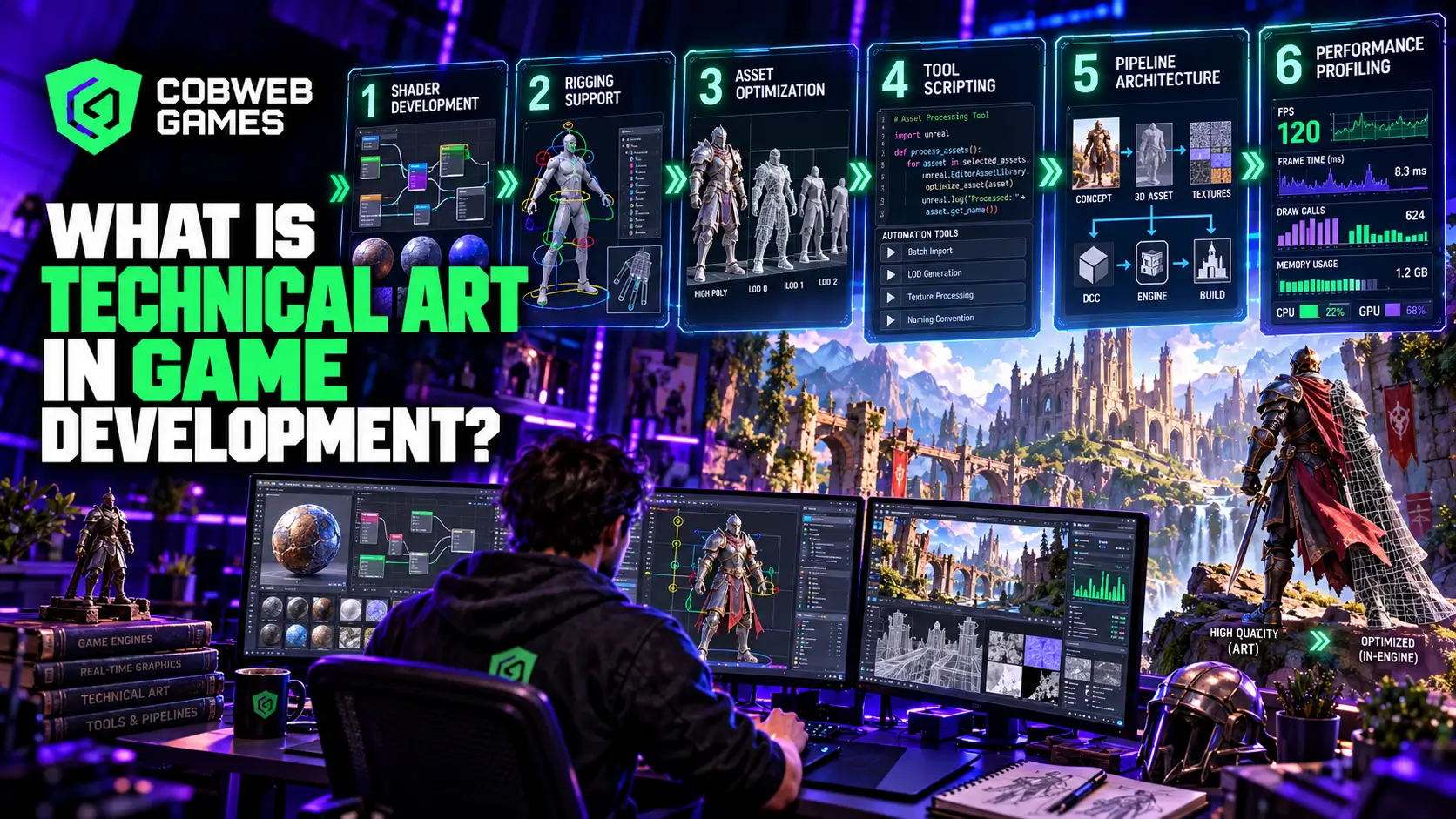
Every game studio eventually hits the same wall: the art team designs something beautiful, the engine can’t run it at target frame rate, and nobody on either side quite knows how to close the gap. Technical art game development work exists specifically to close that gap, sitting between artists who think in silhouettes and lighting and engineers who think in draw calls and memory budgets.
It’s one of the least understood roles in production, partly because it doesn’t map cleanly to either “artist” or “programmer” on an org chart, and partly because the actual day-to-day work varies enormously between studios. Some technical artists spend most of their time writing shaders. Others spend it building rigging tools or optimizing texture pipelines. What they share is a specific kind of fluency: enough art sensibility to know what a director actually wants, and enough engineering knowledge to know what the engine can realistically deliver.
The Core Function: Translator Between Two Disciplines
A technical artist is often described as the translator of a studio, someone who knows enough art and enough programming to keep production moving without either side waiting on the other. That description undersells how much load-bearing work sits in that translation.
When a lighting artist wants a specific mood but the current shader can’t produce it without tanking frame rate on target hardware, someone has to solve that problem without simply telling the artist no. When an animator’s rig behaves correctly in isolation but breaks under the game’s actual physics system, someone has to diagnose why. Technical artists sit at exactly these intersections, all day, across every discipline in the studio.
This isn’t a junior role that graduates into “real” art or “real” engineering. It’s a specialization in its own right, and studios that treat it as a stepping-stone position tend to lose their most capable technical artists to studios that value the role properly.
What Technical Artists Actually Build?
The job breaks down into a handful of recurring responsibility areas, though the exact mix shifts depending on studio size and project phase.
Shader development and optimization. Writing and tuning shaders that balance visual style against performance cost is a huge part of the role. A shader that looks perfect in an isolated test scene can still be the single biggest frame-time cost once it’s running across hundreds of on-screen characters simultaneously. Technical artists profile this constantly, not just once at the end of production.
Rigging and animation pipeline support. Rigs need to survive contact with the actual game engine, not just look correct in the modeling software. Technical artists build the tooling that lets riggers and animators iterate quickly while keeping the underlying skeleton and deformation systems clean enough for the engine to run efficiently at scale.
Asset optimization. Reducing polygon counts, resizing textures appropriately, and eliminating unnecessary draw calls sound like small tasks individually, but across a full game they’re often the difference between hitting a target frame rate and missing it entirely. This work happens throughout production, not as a single late-stage cleanup pass.
Tool scripting. Most technical artists write custom tools in Python or C# to automate repetitive tasks: batch-processing textures, validating asset naming conventions, or building custom exporters between art software and the game engine. A well-built internal tool can save an entire team hundreds of hours across a production cycle.
Pipeline architecture. As projects scale, someone needs to design how assets actually flow from concept through modeling, texturing, rigging, and into the engine without bottlenecking at any single stage. That’s technical art pipeline work, and it’s often invisible until it’s missing, at which point every other discipline feels the slowdown.
The Toolset
Technical artists tend to work across a wider software range than almost any other role in production.
| Category | Common Tools |
| Game engines | Unity, Unreal Engine |
| 3D modeling | Blender, Maya, 3ds Max |
| Texturing | Substance Painter |
| Procedural VFX | Houdini |
| Scripting languages | Python, C# |
| Version control | Git |
The scripting layer is what separates technical artists from most other art roles. Fluency in Python or C# lets a technical artist build the exact tool a pipeline needs rather than working around a gap with manual labor. This is also the skill set that tends to age best across engine and tool changes, since the underlying scripting logic transfers even when the specific software doesn’t.
Where Technical Art Sits in the Production Pipeline?
Technical artists participate from pre-production through post-production, which is broader involvement than most other specialized roles get. Early in a project, they’re often prototyping shader approaches or building the first version of an asset pipeline before there’s much content to run through it. Mid-production, they’re the ones optimizing as content volume scales up and performance problems that didn’t exist with ten assets suddenly appear with a thousand.
Late in production, technical artists are frequently the last line of defense against performance regressions introduced by last-minute content changes. A new particle effect added two weeks before ship can tank frame rate on lower-end hardware in ways nobody notices until a technical artist profiles the build and traces it back.
This continuous involvement is part of why the role connects so directly to other specialized services. Studios building out 3D environment design or character design work closely with technical art to confirm assets will actually perform once they’re inside the engine, not just look correct in a modeling viewport.
Technical Art and Game Art Pipeline Design
A game art pipeline that ignores technical constraints from the start almost always needs expensive rework later. Technical artists are usually the ones who define the actual production standards: polygon budgets per asset type, texture resolution tiers, naming conventions, and file organization structures that keep a growing team from stepping on each other’s work.
Getting this pipeline right early is far cheaper than fixing it mid-production. A studio that waits until performance problems appear before defining these standards typically ends up re-touching hundreds of already-completed assets, which is a far more expensive fix than setting the standard before the first asset is built.
- Polygon and texture budgets set per platform and per asset category, agreed on before production ramps up.
- Shader complexity tiers matched to hardware targets, so a mobile build and a PC build aren’t running the same shader cost structure.
- Automated validation tools that flag assets exceeding budget before they’re merged into the main production branch, rather than catching the problem during a late optimization pass.
- Clear escalation paths for when an artist needs an exception to a budget for a specific hero asset that genuinely needs the extra detail.
Art Optimization: Where the Real Time Savings Live
Art optimization isn’t a single task. It’s a continuous discipline that touches nearly every asset that ships in a game.
Draw call reduction is one of the highest-leverage areas, since every additional draw call adds CPU overhead regardless of how simple the underlying geometry is. Technical artists frequently batch materials, combine meshes, or restructure how assets are organized specifically to reduce this overhead without visibly changing what players see on screen.
Texture memory is the other perennial pressure point, particularly on mobile and lower-end hardware where memory budgets are tight. Technical artists build texture atlasing systems, enforce compression standards, and profile memory usage across representative gameplay scenarios rather than just checking a single test scene.
Level-of-detail systems, where an asset’s complexity scales down at distance, require technical art involvement to build correctly. A poorly tuned LOD transition is immediately noticeable to players as visual popping, while an overly conservative one wastes performance budget that could go toward something players would actually notice.
Technical Artist as Career Path
For someone considering this specialization, the path usually starts from one of two directions: an artist who picked up scripting to solve their own production frustrations, or an engineer with strong enough art sensibility to work comfortably alongside artists and directors. Both paths are common, and studios generally don’t have a strong preference for which background a technical artist came from as long as the fluency in both domains is real.
Portfolio expectations differ from a standard art or engineering portfolio. Hiring managers typically want to see specific problems solved: a shader that achieved a particular visual effect within a defined performance budget, a tool that measurably sped up a production task, or a pipeline improvement with before-and-after metrics attached. Pure aesthetic portfolios or pure code samples without production context tend to undersell a technical art candidate’s actual value.
Shaders: The Skill Most Associated With the Role
If there’s one skill people picture when they hear “technical artist,” it’s shader work. Shaders games rely on for everything from basic surface lighting to complex stylized rendering effects sit right at the intersection of art direction and engine performance, which makes them the clearest example of what technical art actually does day to day.
A shader isn’t just a visual effect. It’s a small program running on the GPU for every pixel or vertex it touches, which means a shader that looks stunning in a single test scene can become the single biggest performance cost once it’s multiplied across a full battlefield of characters or a dense open-world environment. Technical artists write these shaders with both outcomes in mind from the start: does it achieve the visual target the art director wants, and does it survive contact with the actual performance budget the project has committed to.
Stylized rendering pipelines lean on this especially hard. A cel-shaded or painterly look often requires custom shader work that a default engine material pipeline simply doesn’t provide out of the box. Building and tuning that custom shader library, then keeping it consistent across hundreds of assets built by different artists, is core technical art territory. Realistic rendering pipelines have their own version of this challenge, usually centered on balancing physically based rendering accuracy against the performance cost of the additional texture lookups and lighting calculations that realism demands.
Debugging shader performance issues is its own specialized skill. A technical artist profiling a frame-rate drop needs to pinpoint the actual cost source, shader complexity, texture bandwidth, draw call overhead, or something else entirely, often using GPU profiling tools that visualize exactly where each millisecond of frame time is going. This diagnostic work is frequently the difference between a game that hits its target frame rate on release hardware and one that ships with a patch already planned to fix performance complaints.
How Technical Art Differs Across Genres and Platforms?
The specific technical art challenges a studio faces shift significantly depending on genre and target platform, which is part of why the role resists a single fixed job description.
Mobile titles push technical artists toward aggressive optimization work almost constantly, since target hardware varies enormously across the install base and memory budgets are tight even on flagship devices. A technical artist on a mobile project often spends more time reducing asset footprint than adding visual polish, simply because the performance ceiling is so much lower than console or PC.
Open-world titles create a different pressure: level-of-detail systems, streaming asset pipelines, and draw call management become critical at a scale that smaller, more contained levels never really test. A technical artist working on an open-world project needs pipeline tooling that can handle thousands of unique assets without every optimization decision becoming a manual, one-off task.
Stylized multiplayer titles, particularly ones with large concurrent player counts on screen, push hard on shader efficiency and character silhouette clarity at a distance, since readability at scale matters as much as individual character detail. Technical artists on these projects often spend significant time on LOD tuning specifically to keep large crowds of characters rendering cleanly without overwhelming the frame budget.
Building or Outsourcing Technical Art Capacity
Smaller studios often can’t justify a full-time technical artist early in development, but the pipeline decisions that role would normally own still need to get made correctly from the start. This creates a real tension: wait too long to establish technical art standards, and a studio accumulates rework debt across every asset produced before someone finally addresses it.
Studios in this position often bring in technical art expertise on a project basis, specifically to establish pipeline standards, build initial tooling, and set shader and optimization guidelines before scaling up content production. This pairs naturally with outside game art production, where an established technical pipeline keeps every new asset arriving in a format the engine can actually run well, rather than discovering performance problems only after a large batch of content is already built.
Measuring Technical Art’s Impact on Production
Because technical art work is often preventive rather than visible, it can be hard for studios to quantify its value until it’s missing. A few concrete metrics help make the impact tangible.
Build size and load times. A studio with strong texture and asset optimization practices ships smaller builds that load faster, directly affecting player retention on first launch, particularly on mobile where install size influences download conversion rates.
Frame rate stability across representative hardware. Rather than testing only on a development workstation, mature technical art practices profile against a spread of target devices, catching performance regressions before they reach players rather than after launch reviews start mentioning stutter.
Time saved per asset produced. A well-built pipeline tool that automates a repetitive export or validation step saves a small amount of time per asset, but multiplied across hundreds or thousands of assets across a production cycle, that saved time becomes a meaningful percentage of total art production capacity.
Rework rate. Studios tracking how often an asset needs to be revisited after initial completion, because it exceeded a budget, broke in-engine, or needed re-rigging, get a direct signal on if pipeline standards are actually working as intended. A dropping rework rate over a production cycle is one of the clearest signs that technical art investment is paying off.
Studios that track these numbers consistently tend to make a stronger internal case for continued technical art investment, since the value becomes visible in production velocity rather than staying an abstract quality argument.
Frequently Asked Questions
Is technical art the same as a technical director role?
No. A technical director typically oversees broader production and engineering strategy across a project. A technical artist works hands-on with specific art and pipeline problems, though a technical artist can grow into a technical director role over time.
Does every game project need a dedicated technical artist?
A full-time hire isn’t necessary for every project, though every project benefits from someone establishing technical art standards early, either through a dedicated role, a senior artist with the right skills, or outside support brought in for a defined pipeline-setup phase.
What programming languages should someone learn to become a technical artist?
Python and C# cover the large majority of technical art tooling work across most studios. Shader-focused technical artists also need HLSL or GLSL depending on their target engine and rendering pipeline.
How is technical art different from general 3D art?
General 3D art focuses on producing the final visual asset. Technical art focuses on how that asset performs, how it moves through the production pipeline, and how the tools around it can be improved to make the whole team faster.
Can technical art problems be fixed after a game has already shipped?
Some can, through post-launch optimization patches, but many pipeline-level issues are far cheaper to solve before a large content library is built on top of a flawed foundation. Establishing standards early is consistently less expensive than retrofitting them later.
