
Every engine comparison article eventually arrives at the same tired conclusion: it depends on your project. That answer is technically true and practically useless. Unreal Engine game development earns its reputation in specific, identifiable situations, and understanding exactly which situations those are is worth more than another paragraph restating that engine choice is complicated.
What Nanite and Lumen Actually Change About Production?
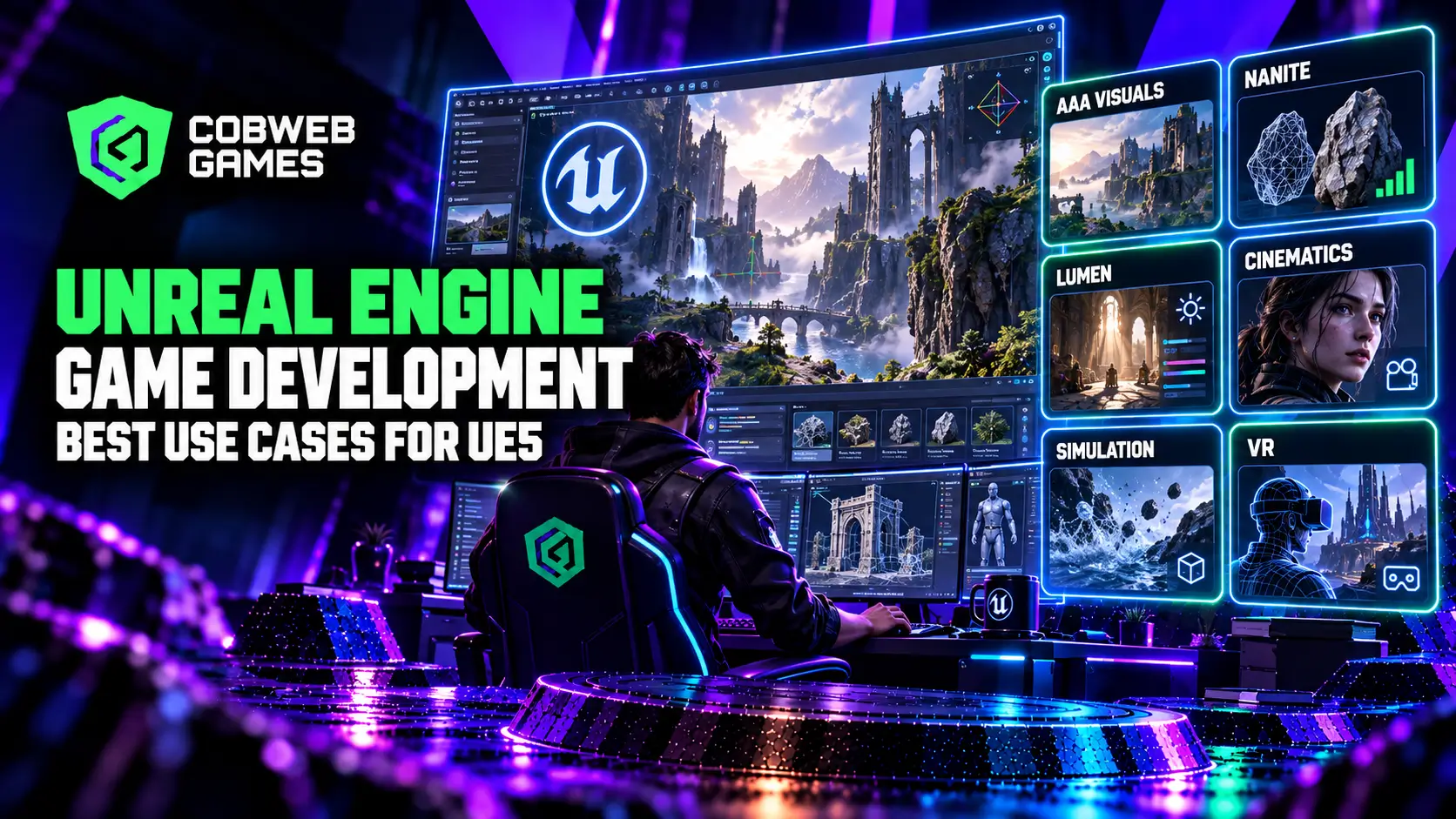
Nanite is virtualized geometry that eliminates traditional polygon budgets, letting artists import film-quality assets without grueling manual optimization. Lumen provides fully dynamic global illumination that responds in real time, eliminating the baked lighting workflow.
- Artists work with source-quality assets without a dedicated optimization pass
- Lighting iteration happens instantly rather than waiting on a bake
- The gap between concept art and in-engine visuals narrows considerably
This is a specific trade-off of hardware requirements and complexity for a fidelity ceiling nothing else currently matches. If that trade is worth making depends entirely on the project.
The Clearest Use Case: Cinematic, Visually Ambitious AAA Titles
If photorealism is the primary goal, Unreal is the least contested recommendation in this guide.
- Nanite removes the traditional detail ceiling
- Lumen supports moody, cinematic scene composition cheaply to iterate on
- Built-in cinematic tooling (Sequencer, MetaHuman) is purpose-built for this
- Hardware requirements (16GB RAM, RTX 3060+) are usually already a given at this tier
Simulation, Architectural Visualization, and Virtual Production
- Automotive and architectural visualization, where the real-time render becomes part of the sales process
- Film/broadcast virtual production, rendering live background plates on an LED volume
- Training simulations and high-end VR, where believable detail improves effectiveness
Epic’s dedicated Unreal Enterprise program supports these non-game interactive categories adjacent to traditional game development.
When UE5 Game Developers Should Recommend Something Else?
- Mobile-first projects with modest ambition: Unity game development delivers comparable results with less overhead
- 2D and stylized projects: Unity’s more mature 2D tooling
- Rapid prototyping: a lighter engine iterates faster during high-uncertainty phases
- Teams without C++/Blueprint experience on a tight timeline
Licensing Economics Genuinely Change the Calculus
| Factor | Unreal Engine 5 | Unity |
|---|---|---|
| Base cost | Free | Free under a revenue threshold |
| Ongoing fee | 5% royalty above a lifetime threshold | Per-seat licensing above a threshold |
| Best fit | Projects confident in eventual scale | Projects wanting predictable, revenue-independent cost |
AAA Game Engine Decisions: Genre-by-Genre
| Genre | Direction | Why |
| Open-world AAA action/RPG | Unreal | Nanite/Lumen support large detailed environments |
| Mobile hypercasual/casual | Unity | Lighter footprint, faster builds |
| Competitive multiplayer shooter | Either | Comes down to team expertise |
| Stylized 2D indie | Unity | Mature 2D pipeline |
| VR and high-end simulation | Unreal | Photorealism improves immersion |
| Architectural/automotive visualization | Unreal | Real-time photorealism is the deliverable |
What a Genuine UE5 Production Pipeline Looks Like?
Asset ingestion and Nanite configuration, lighting setup with Lumen, Blueprint/C++ architecture planning, and platform-specific optimization. Environment art and character design should be built with Nanite’s constraints in mind from the first asset. A 3D character modeling pipeline should account for Unreal’s skeletal mesh and animation blueprint systems
What UE5 Game Development Actually Costs to Staff?
Senior Unreal game developers are a narrower talent pool than the broader Unity market. Onboarding a Unity-native team takes real ramp-up time. Technical art roles carry outsized importance in a Nanite/Lumen pipeline. Outsourcing to a studio with established Unreal Engine services and an existing bench often proves more cost-effective than building an internal team from scratch.
AAA Game Engine Reputation Versus Practical Fit
Chasing the prestige of an AAA game engine without the budget, timeline, or hardware target it demands means fighting the engine rather than benefiting from it. A mobile puzzle game doesn’t get more successful by sharing an engine with a big-budget console shooter.
Testing and QA Considerations Specific to Unreal Productions
Frame rate profiling across target hardware, Nanite/Lumen-specific visual regression checks, build size and load time validation, and platform certification tuned to the actual hardware ceiling. Thorough game testing matters more, not less, on a UE5 production, since the engine’s ceiling makes it easy to build something stunning in a demo that performs inconsistently without real optimization discipline.
Migrating an Existing Project Into Unreal Engine
Worth the disruption: the fidelity gap is fundamental, real runway remains, systems can port with manageable rework, the team has or can acquire the expertise.
Not worth it: deep into content production already, the visual gap is marginal, no realistic timeline to build Unreal expertise before launch.
How Cobweb Games Approaches Unreal Engine Game Development?
Cobweb Games scopes engine choice during discovery, comparing genuine Unreal Engine game development fit against Unity based on genre, platform, and team composition rather than defaulting to one stack.
Frequently Asked Questions
Is Unreal always better for visually ambitious games?
Not automatically; platform and team expertise matter too.
Do UE5 developers need extensive C++ experience?
Not for every role; Blueprint covers substantial gameplay logic without deep C++.
How much does the royalty model actually cost?
5% above a defined lifetime revenue threshold, so it only bites after genuine commercial success.
Can a studio use both engines across projects?
Yes, increasingly common, choosing per-project by genre and platform fit.
