
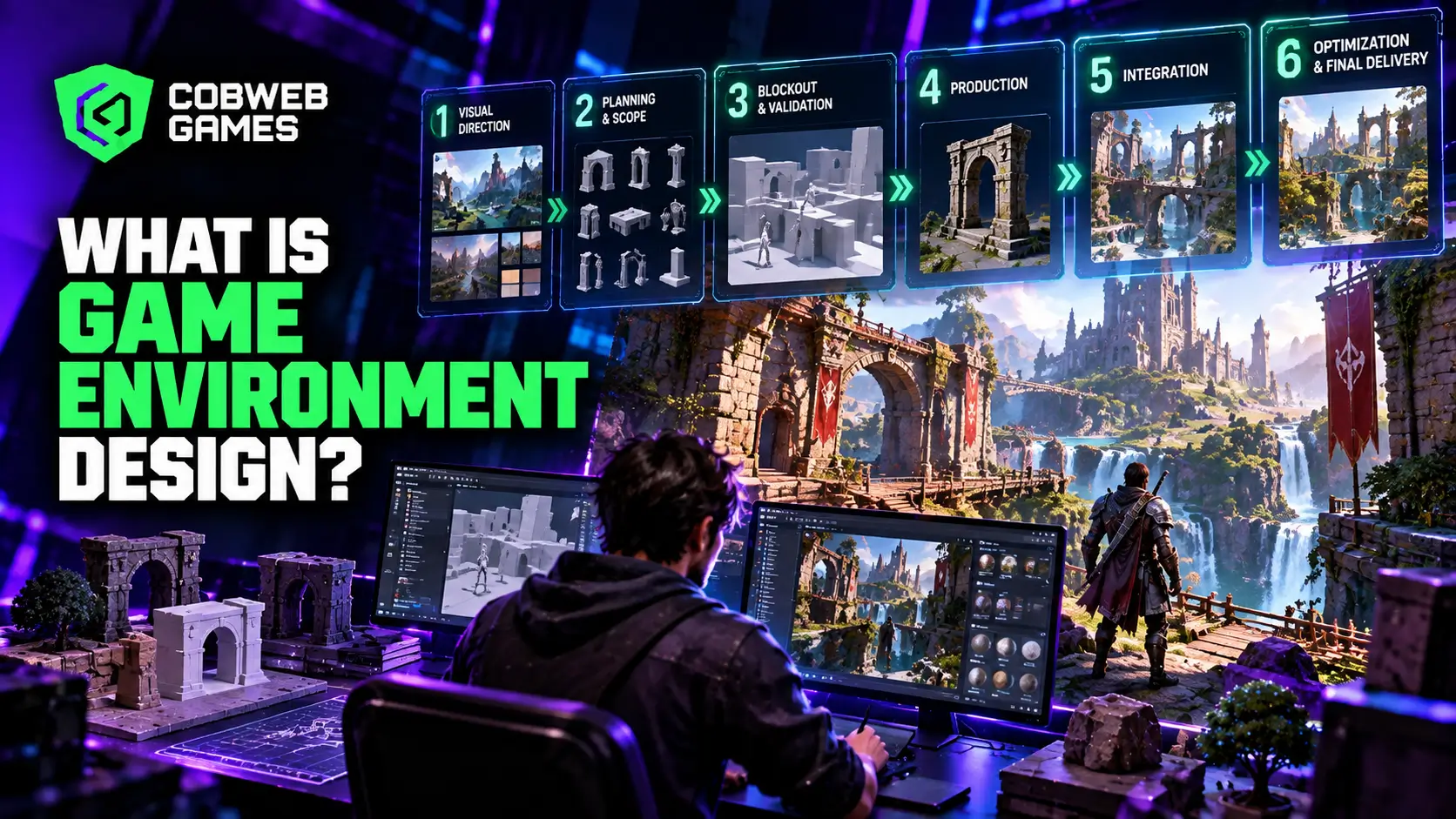
Every memorable game world, the flooded ruins of a collapsed city, the neon-slick streets of a cyberpunk hub, the quiet forest clearing right before a boss fight, exists because someone made hundreds of deliberate decisions about space, lighting, and scale before a single player ever walked through it. Game environment design is the discipline behind that work: building the physical spaces a game takes place in as an active system that guides player behavior, sets emotional tone, and supports the mechanics the gameplay actually depends on, well beyond simple scenery.
Game Environment Design, Defined
Game environment design is the process of creating the physical spaces, structures, and settings a player navigates within a game, combining visual art, spatial planning, and gameplay logic into environments that look convincing and actually function correctly for how players move through and interact with them. It sits at the intersection of art and design in a way few other game disciplines do, since an environment artist has to think simultaneously about how a space looks and how it plays.
What distinguishes environment design from general game art:
- Spatial reasoning about scale, sightlines, and navigation, not just surface-level visual polish
- Direct responsibility for supporting gameplay mechanics, cover systems, verticality, pacing, rather than existing purely as a visual backdrop
- Close coordination with game level design, since an environment often needs to communicate gameplay information, where to go, what is dangerous, what is interactive, through visual language alone
- A production pipeline that moves from rough spatial blockouts through iterative refinement, rather than a single concept-to-final workflow more typical of standalone character or prop art
The Six-Stage Environment Production Pipeline
A well-run environment design process follows a defined sequence of stages, each building on decisions locked in during the one before it, rather than jumping straight to detailed final assets before the underlying space is actually validated.
Stage 1: Visual Direction. Establishing the art style, gathering references, and aligning the environment’s visual language with the game’s overall creative vision. This stage sets constraints every later decision has to respect, color palette, level of stylization, real-world versus fantastical influence.
Stage 2: Planning and Scope. Building an asset list, deciding which pieces will be modular and reusable versus unique one-off builds, and estimating the realistic workload the scope actually represents. Underestimating this stage is one of the most common sources of schedule overruns in environment art specifically.
Stage 3: Blockout, Scale, and Gameplay Validation. Building rough placeholder geometry, simple cubes and primitives, to define space and structure before any final art gets touched. This stage exists specifically to confirm scale matches actual player needs and to catch gameplay problems early, since a beautifully detailed environment built on a flawed layout means redoing finished work rather than adjusting a rough blockout.
Stage 4: Production. Creating final assets, set dressing the space with props and detail, and iterating based on how the environment actually reads once real art replaces the blockout geometry.
Stage 5: Integration. Implementing assets directly in-engine and assembling the complete environment from its component pieces, confirming everything fits together the way it was planned during the blockout stage.
Stage 6: Optimization and Final Delivery. Performance tuning, final lighting and shader passes, and the last polish sweep before the environment is considered genuinely finished, not just visually complete.
Why the Blockout Stage Is Non-Negotiable?
Skipping or rushing the blockout stage is one of the most expensive mistakes a studio can make in environment production, and it deserves specific attention because so many teams under deadline pressure are tempted to shortcut it. Blockout uses deliberately crude, unfinished geometry precisely because the goal is testing space and structure, not evaluating visual quality, and locking in scale, sightlines, and navigation before investing real art hours is what prevents a costly rebuild later.
What a proper blockout pass actually validates:
- Player movement speed and space scale feeling correct together, since an environment that reads fine in a top-down layout can feel cramped or oversized once a player actually walks through it at gameplay speed
- Sightlines supporting the intended gameplay, combat encounters need clear lines of sight and meaningful cover, exploration spaces need landmarks visible from a distance to support navigation
- Critical gameplay paths reading clearly, since a player needs to intuitively understand where they can and cannot go without constant explicit signposting
- Early performance implications of the space’s scale and complexity, caught before detailed assets make later adjustments considerably more expensive
Teams that validate all of this against actual gameplay with game testing services, not just a visual walkthrough, catch problems here that would otherwise surface far later and cost considerably more to fix once detailed art is already built around a flawed foundation.
Modular Design: The Backbone of Efficient Environment Work
Modular design, building reusable component kits, wall sections, ground pieces, structural elements, that combine flexibly into varied spaces, is one of the most important efficiency decisions an environment team makes, and getting it wrong early creates ripple effects through the entire remaining production schedule.
Why modular kits matter so much to environment design specifically:
- A well-designed modular kit lets a relatively small set of base pieces generate an enormous variety of unique-feeling spaces through different combinations and arrangements
- Reusable components like 3d environment design dramatically reduce total asset count compared to building every environment piece as a unique, one-off asset
- Modular pieces are easier to optimize consistently, since performance work applied to a base wall module automatically benefits every instance of that module across the entire game
- A studio has to decide deliberately what genuinely benefits from modularity versus what needs unique, hand-built treatment, since forcing genuinely unique hero locations into a rigid modular system tends to produce environments that feel repetitive and generic
The planning stage is where this decision gets made, and teams that skip deliberate modular planning in favor of building assets ad hoc as needs arise typically end up with an inconsistent mix that is harder to optimize and visually less cohesive than a kit planned deliberately from the start.
Video Game Environments as Systems, Not Just Scenery
Strong video game environments do considerably more work than looking visually impressive, they actively support and reinforce the game’s core mechanics and pacing. An environment built purely for visual spectacle, without genuine consideration for how gameplay actually happens within it, tends to feel hollow even when individual assets are technically excellent.
How environment design actively supports gameplay:
- Verticality and cover placement directly shape how combat encounters play out, turning a space into a meaningful tactical decision rather than a flat backdrop
- Visual landmarks and distinct area identities support player navigation and spatial memory without requiring constant UI intervention like minimaps or waypoint markers
- Pacing through environmental design, tight corridors before an open reveal, a quiet area before a boss encounter, shapes emotional rhythm as deliberately as any scripted story beat
- Environmental storytelling, scattered debris, signs of past events, implied history in a space’s condition, communicates narrative context without a single line of dialogue
This is exactly where environment design as a discipline earns its place as genuinely collaborative work between art and design teams, rather than art simply executing a layout handed down from a level designer with no input into how the space actually reads.
The Game Environment Artist Role in a Modern Production Pipeline
A game environment artist today typically works across a broader skill range than the role demanded a decade ago, spanning modeling, texturing, lighting, and often direct familiarity with the target engine’s specific rendering pipeline. This breadth exists because modern environment work increasingly happens directly inside the engine rather than purely in external modeling software, which means an environment artist genuinely benefits from understanding how their work performs once integrated, not just how it looks in isolation.
Core competencies a strong environment artist brings to a production:
- Modeling and texturing skill applied specifically to architectural and natural spaces, a genuinely different discipline from character or prop modeling in game art services
- Lighting and shader setup, since lighting choices shape mood and readability as much as the geometry itself
- An understanding of engine-specific optimization requirements, since a beautifully modeled space that tanks frame rate is not actually production-ready
- Collaborative fluency with level design and gameplay teams, translating functional requirements into environments that satisfy them without sacrificing visual quality
This range of responsibility is exactly why 3D game development studios increasingly treat this work as a specialized discipline within their broader visual pipeline, distinct from character design work even though both fall under the general umbrella of game art production.
Environment Art and Character Design: Related but Distinct Disciplines
The two disciplines share underlying technical skills, modeling, texturing, engine integration, but the actual work demands genuinely different thinking, and character design illustrates the contrast clearly. Character work centers on a single, focused subject viewed from many angles at close range. Environment work centers on composing entire spaces that a player moves through continuously, where individual pieces matter less in isolation than how the whole assembly reads together.
A 3D character modeling pipeline optimizes heavily around a single hero asset getting maximum polish and detail. Environment production optimizes around efficient reuse across dozens or hundreds of individual placements, which is exactly why the modular thinking discussed earlier matters so much more in environment work than it typically does for character production.
Lighting and Atmosphere as Core Design Tools
Lighting decisions in environment work function as genuine design tools, not just a final polish pass applied after everything else is finished. A space lit purely for visibility, evenly bright everywhere, tells the player almost nothing emotionally or spatially. A space lit deliberately, warm light pooling around a safe checkpoint, cold shadow stretching down a threatening corridor, communicates meaning before a player reads a single line of text or UI prompt.
How lighting shapes an environment beyond simple visibility:
- Contrast and color temperature guide a player’s eye toward important objects or paths without needing explicit visual markers
- Shadow density and placement can signal danger or safety instinctively, drawing on player intuition built up across years of playing other games
- Dynamic lighting that shifts with time of day or story progression reinforces narrative pacing and gives a static space a sense of ongoing life
- Lighting consistency across a modular kit’s individual pieces is what actually sells the illusion of a cohesive, handcrafted space built from repeated components
Teams that treat lighting as a late-stage technical task rather than a core design decision made early tend to end up with environments that look technically correct but emotionally flat, missing the atmospheric weight that makes a space actually memorable to the player moving through it.
How Environment Scope Gets Estimated Realistically?
Underestimating environment scope during planning is one of the most persistent sources of schedule pressure across game productions, and it deserves direct attention since the consequences ripple through every later production stage. A realistic scope estimate accounts for more than just the raw count of unique assets needed.
For pricing context alongside the schedule estimate, see our breakdown of game art costs, including environment sets and individual props.
What a realistic environment scope estimate actually factors in:
- The true ratio of modular to unique assets, since unique hero pieces take considerably longer per asset than modular kit components that get reused dozens of times
- Iteration time built explicitly into the schedule, since blockout validation frequently surfaces changes that ripple back through already-completed planning decisions
- Integration and optimization time treated as its own dedicated phase, not an afterthought squeezed into whatever time happens to remain before a milestone deadline
- Buffer time for the inevitable gap between how a space reads in isolated review and how it actually feels once assembled into the full level alongside gameplay systems
A studio that builds this realism into its planning stage from the start avoids the far more painful alternative: discovering the true scope only once production is already underway and the schedule has no remaining slack to absorb the correction. Treating the planning stage as a genuine estimation exercise, backed by past project data rather than optimistic guesswork, consistently produces schedules that survive contact with actual production far better than ones built on hope alone.
Environment production also needs to fit within the overall game development budget, alongside engineering, animation, and testing.
Common Mistakes in Game World Design
Skipping or rushing the blockout stage under schedule pressure. This is consistently the most expensive shortcut a team can take, since problems caught here cost a layout adjustment, while the same problems caught during final production cost a rebuild.
Treating environments as pure decoration disconnected from gameplay. A visually stunning space that does not actually support how players move, fight, or explore within it undermines the game’s core experience regardless of art quality.
Underplanning modular kit scope during the planning stage. A kit designed too narrowly forces repetitive-feeling spaces, while one planned without enough discipline produces an inconsistent, harder-to-optimize asset library.
Deferring optimization until the very end of production. Performance problems discovered only during final delivery are considerably more expensive to fix than issues caught and addressed incrementally throughout production.
How Cobweb Games Approaches Game Environment Design?
Cobweb Games treats environment design as a genuinely collaborative discipline between art and gameplay teams from the earliest blockout stage, not a visual pass applied after level design decisions are already locked. That approach, grounded in real production pipeline discipline across modular planning, gameplay validation, and engine-specific optimization, is what separates environments that merely look good from environments that actually work as functioning game spaces.
Frequently Asked Questions
What is the difference between environment design and level design?
Level design focuses primarily on gameplay layout, encounter placement, pacing, and player progression through a space. Environment design focuses on building the actual visual and spatial content of that space. The two disciplines overlap heavily and work best in close collaboration, since a level’s gameplay intent shapes what the environment needs to communicate visually.
Why does the blockout stage use such crude, unfinished geometry?
Crude geometry keeps the stage focused specifically on testing scale, sightlines, and navigation without the distraction or sunk cost of detailed visual work. Using simple primitives makes changes fast and cheap at exactly the stage where changes are most likely to be needed.
Is modular environment design always the right approach?
Not for every space. Hero locations and key narrative moments often benefit from unique, hand-built treatment that a modular kit cannot replicate convincingly. The skill lies in deciding deliberately which spaces need that unique investment and which genuinely benefit from modular efficiency.
What skills does someone need to become a game environment artist?
A strong foundation in 3D modeling and texturing specifically applied to architectural and natural forms, an understanding of lighting and shader work, and increasingly, direct familiarity with a target game engine’s rendering pipeline and optimization requirements. Spatial reasoning and an understanding of how environments support gameplay matter as much as raw art skill.
